At the height of their power, authoritarian regimes project an aura of invincibility. When they suddenly fall, their very existence seems improbably absurd. We stare at the rubble and ask in disbelief, how did something so clumsy last so long?
But what looks like a headlong collapse is invariably the result of structural erosion — and most importantly the erosion of fear.
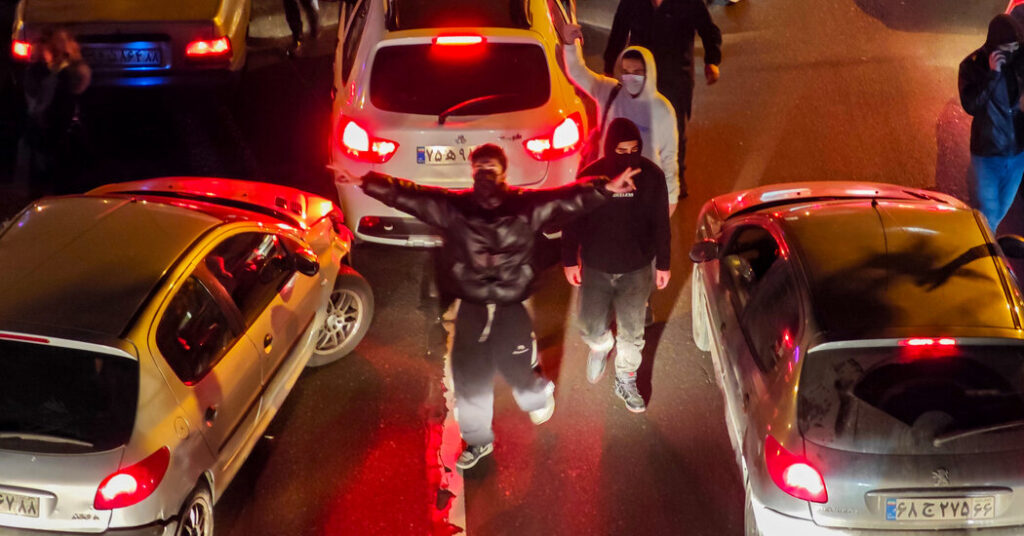
We are seeing this happening now in Iran. Since late December, people have taken to the streets to protest inflation, a collapsing economy and the continued intransigence of the government. The breadth of the demonstrations is unprecedented. They extend from small towns, hitherto the bastion of government support, to bazaars, historically the critical source of financial and political support for the clergy. If in 2009 protesters demanded that their votes be counted, now some were shouting death to Ayatollah Ali Khamenei, Iran’s supreme leader, and demanding regime change.
The fearlessness shown by the demonstrators is why this uprising may prove enduring. Western powers should take this into account in supporting them; ignoring these increasingly powerful movements means forfeiting the chance to help the people of Iran rid themselves of this nightmare and to bring about a more peaceful and democratic Middle East.
Fear is the cement of every authoritarian structure. Not ideology, not theology, not even brute force on its own can keep the towering edifice in place. Fear does. When it dissipates, the usual tools of oppression, from prisons and thugs, to murder and official media, lose their power to dissuade a disgruntled population from rising up. Bereft of fear, the question is no longer whether authoritarian rule will collapse, but when.
Iran’s Islamic Republic understood this truth from the beginning. As soon as it seized power, it aimed to intimidate. Violence was not incidental but pedagogical. Public executions were carried out with ritual precision. Images of hanging corpses or bullet-pierced bodies were splashed across newspapers and broadcast on state television. The message was unmistakable: The revolution was victorious and merciless.
At first, this violence was directed against many officials from the overthrown government of Shah Mohammed Reza Pahlavi. But it soon expanded to leftists, liberals, dissident ethnic groups and women fighting for their rights. Dissent was redefined as sin, even heresy, and punishment was public and gruesome. The clerical regime fused a modern security apparatus with a methodic, medieval choreography of terror. Fear became a civic lesson.
Once terror is internalized, as it invariably is in authoritarian societies, the need for public displays of brutality can diminish. By the late 1980s in Iran, when fear became ensconced in the peoples’ hearts and minds and the world began scrutinizing the government’s egregious human rights record, the severest acts of violence were conducted behind closed doors. The executions of thousands of prisoners in 1988, at the time the largest mass killing of Iranians by the Islamic Republic’s leadership, were carried out in secrecy. Bodies were hidden, graves unmarked, families silenced. Terror was still deployed, but no longer displayed.
Then came a gradual erosion of the regime’s legitimacy. Elections became rituals without choice; official slogans lost their resonance; inherited bureaucracies thinned into corrupt, inept networks that often simply distributed their spoils to different constituencies of new rulers. The only remaining source of true power was the fear the government continued to cultivate — the sense that resistance was futile because the regime was too entrenched, too ruthless, too omnipresent to be challenged.
That aura of invincibility — that despair of a battered citizenry — was shattered by Iranian women and their sustained, prudent civil disobedience movement that began in 2022, called Woman, Life, Freedom.
The movement marked a decisive rupture in the clerical rulers’ emotional hold. When women defiantly removed their hijabs in public, when they walked with their hair uncovered past armed agents of the state, something irreversible happened. Fear changed sides. The regime could still arrest, beat, blind, and kill — but it could no longer intimidate women into docile acceptance of a misogynist order. More than 19,000 people were arrested and some 500 were killed in the first few months of the protests as government forces tried to reinstall fear in women — and by extension society. The effort failed, and women continued their defiance.
Regionally, too, the leadership’s cultivated image of omnipotence began to fray. The first Trump administration’s assassination of Qassim Suleimani, the commander of the Quds Force of the Islamic Revolutionary Guards Corps, in 2020 helped erode the myth of strategic omniscience. The weakening by Israel of the Iranian proxy forces Hezbollah in Lebanon and Hamas in Gaza punctured the narrative of inevitable regional dominance. More recently, Iran’s brief but consequential 12-day war with Israel and the United States delivered another blow — not simply militarily, but psychologically. What authoritarian systems fear most is not defeat but exposure of weakness.
The regime’s response to the latest cycle of demonstrations has been predictably vicious, and protests have waned in recent days. Human rights organizations have put the death toll at 2,500 to 3,400 people, many of them demonstrators shot in the streets. The regime has threatened executions and displayed forced confessions. This is not strength; it is panic. As fear dissipates, the regime must escalate violence to compensate. The fact that past cycles of resistance and repression have only begot yet another, larger, movement has not dissuaded the government from its violence. It is the only language they know.
Now Tehran confronts a paradox. The same social media platforms it uses to intimidate, by circulating images of punishment and amplifying threats, are being used by citizens — or were, before this week’s government-imposed blackout. Videos of defiance travel faster than government-created clips of warnings. Mockery and satire spreads more quickly than terror and threats. Courage, once grown contagious, is difficult to quarantine.
Jorge Luis Borges observed that “censorship is the mother of metaphor.” When speech is constrained, people find new ways to speak. In Iran today, repression is the mother of finding ever new forms of dissent — the antidote to fear. Every attempt to silence generates new forms of expression; every effort to terrify produces new grammars of defiance. The state still controls the instruments of violence, but it has lost control of the imagination.
Authoritarian regimes do not fall when they are exposed as cruel. Cruelty is their currency. They fall when they are exposed as fragile. The Islamic Republic may still rule by force and it may succeed in crushing this round of dissent, but it is losing its weapon of fear, the very heart of its power. It will not go on forever.
Abbas Milani is the Hamid and Christina Moghadam director of Iranian studies at Stanford University and a fellow at the Hoover Institution.
The Times is committed to publishing a diversity of letters to the editor. We’d like to hear what you think about this or any of our articles. Here are some tips. And here’s our email: [email protected].
Follow the New York Times Opinion section on Facebook, Instagram, TikTok, Bluesky, WhatsApp and Threads.
The post Iran’s Regime Is Losing Its Greatest Weapon: Fear appeared first on New York Times.