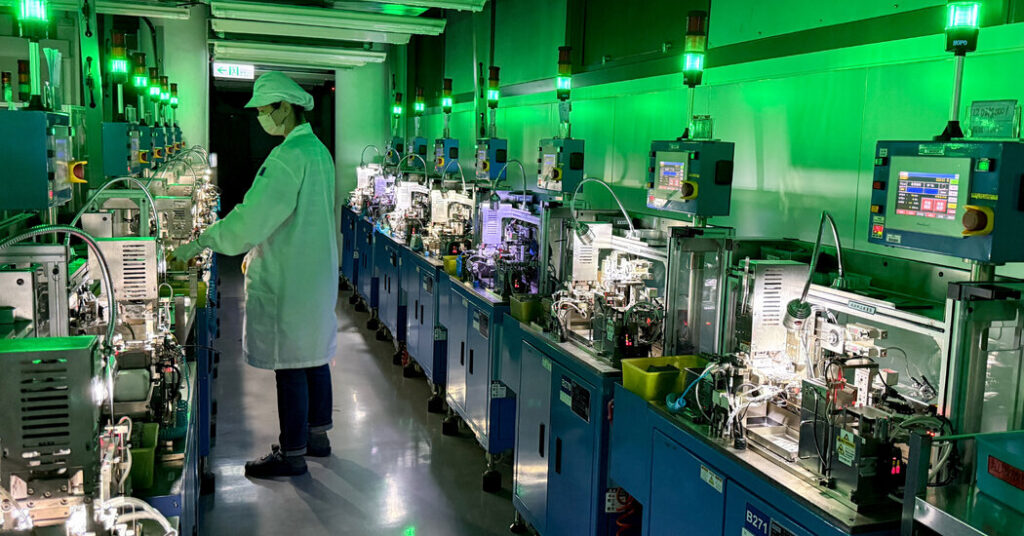
The United States announced a trade agreement with Taiwan on Thursday, securing commitments to invest $250 billion in semiconductor and technology manufacturing in America in exchange for lowering tariffs on imports from the island.
Taiwan’s government would provide an additional $250 billion in credit guarantees to support smaller companies in the industry’s complex chip supply chain to expand in the United States, the Commerce Department said in a statement.
After months of negotiations, the Trump administration said it would lower the U.S. tariff rate on goods from Taiwan to 15 percent from the current 20 percent.
Taiwan’s negotiating team met with its American counterparts more than a dozen times since President Trump announced his first round of tariffs across most of the world in April. The negotiators, led by Vice Premier Cheng Li-chiun and the chief trade representative Yang Jen-ni, made six trips to Washington and held more sessions online.
Taiwan’s economy depends on exports, and the United States surpassed China last year to become its biggest buyer. Computer chips and electronics that contain them have long been the island’s main export. Taiwan is also a major source of steel products, especially metal fasteners such as screws and bolts, most of which go to the United States.
President Trump has repeatedly pressed Taiwan to loosen its dominance in advanced semiconductors and to move production to the United States.
“We are going to bring it all over so that we become self-sufficient in the capacity of building semiconductors,” said Howard Lutnick, the commerce secretary, in a television interview on Thursday.
The United States has agreed to assist Taiwanese companies in acquiring resources such as land, water, electricity, infrastructure, tax incentives and visa programs, Taiwan’s cabinet, the Executive Yuan, said in a statement on Friday.
By value, only a small portion of Taiwan’s exports have been subject to the tariffs. These include plastic, textile and agricultural products. Washington would waive tariffs on generic pharmaceuticals and their ingredients, as well as aircraft components and some natural resources.
The administration had already exempted semiconductors and many electronics from those tariffs, saying those sectors would be subject to separate national security tariffs issued under a legal provision known as Section 232.
However, under the new agreement, the United States said it would allow Taiwanese companies that have built or are building semiconductor facilities to import a certain amount of chips, proportional to their U.S. production capacity, without paying the duty.
Taiwan has said that, as the source of most of the world’s advanced chips, it has requested preferential treatment regardless of any tariffs the Trump administration imposes under Section 232.
Last March, Taiwan’s biggest chip maker, Taiwan Semiconductor Manufacturing Company, committed to investing $100 billion to expand its operations in Arizona. That amount will count toward the $250 billion, Mr. Lutnick said.
TSMC said it plans to continue building more factories, which are known as fabs, in the United States.
The company recently bought a second piece of land in Arizona, C.C. Wei, the chief executive of TSMC, said during the company’s earnings call on Thursday. “That gives you a hint of what we plan to do, because we need it. We are going to expand many fabs out there.”
TSMC’s commitment to spend $100 billion has stirred debate and misgivings in Taiwan, a democratically governed island where many people see the chip sector as a vital economic pillar and a shield against possible aggression by China, which claims it is part of its territory.
Meaghan Tobin covers business and tech stories in Asia with a focus on China and is based in Taipei.
The post Taiwan Reaches Trade Deal with Trump, Pledges More U.S. Chip Factories appeared first on New York Times.