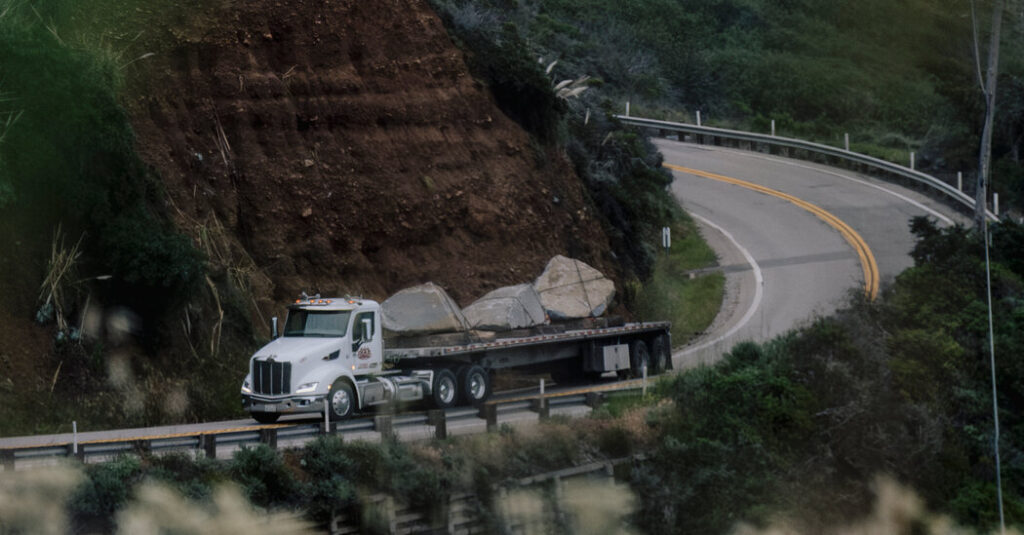
A stretch of California’s Pacific Coast Highway, the world-famous route that winds through steep, rugged and breathtaking terrain along the ocean, has reopened after a yearslong closure that hampered tourism and cast doubt on its future.
The nearly seven-mile stretch in Big Sur reopened Wednesday. It was the first time in three years that the entirety of the highway has been open after consecutive landslides and the Palisades fire had closed separate sections of the road.
In a statement, Gov. Gavin Newsom of California said the reopening would “bring much-needed relief to small businesses and families in Big Sur and the surrounding communities who have shown remarkable resilience and strength.”
“This vital corridor is the gateway to California’s coast and the lifeblood of the Big Sur economy,” he added, “and today it’s restored.”
The newly reopened section had closed after the landslide known as Regent’s Slide on Feb. 9, 2024. Paul’s Slide had closed another stretch of road six miles south from Jan. 14, 2023, to June 23, 2024. Both are in Big Sur, a remote coastal region that has long lured writers, monks and others seeking transcendence — as well as millions of tourists a year.
The region, which is caught between major fault lines, also has more than 1,500 active slide areas, making it among the most landslide-prone areas in the Western United States, according to the U.S. Geological Survey. In some places, chunks of the road have slipped into the ocean. In others, more than a million tons of earth have barreled onto the highway, slicing it to pieces. Bridges have failed. Rainstorms have flooded the road with mud. Residents have been left marooned. Tourists have been shut out.
In May, the slide on the shuttered stretch of road was moving more than a foot a day, making the site so treacherous that the California Department of Transportation, known as Caltrans, used remote-controlled bulldozers to keep workers safe. Mr. Newsom said that Caltrans had managed to stabilize the slopes with thousands of steel reinforcements drilled up to 60 feet deep, and in the days leading up to the reopening, the agency had removed about 240 dump trucks’ worth of mud and debris from the site.
John Laird, a state senator from Santa Cruz, on California’s Central Coast, said in a statement that the closure had threatened the region’s economic stability. Mr. Laird, a Democrat, like Mr. Newsom, added that “reopening this vital corridor restores jobs, revives local businesses, and reconnects people to their homes and livelihoods.”
Mary Vargas, who owns the Gorda by the Sea Mini Mart, said the road had been closed so many times, and for such extended periods, that it was initially hard to believe that it would reopen.
“They say it’s going to be open in a couple of days, or a couple of months, and then it doesn’t, so you stop getting your hopes up,” she said. When it finally did at noon on Wednesday, Ms. Vargas was thrilled, she said, adding that she was most looking forward to “having everything turned back to normal.”
Kirk Gafill, who is the president of the Big Sur Chamber of Commerce and the owner of Nepenthe, a cliff-top restaurant that has been in his family for generations, said that the reopening had provided a morale boost for his staff, and that his business had already received guests from south of the closure. “We’re feeling great,” he said.
At the same time, he acknowledged the reality of living in a slide-, storm- and wildfire-prone region. “Inevitably there’s going to be a few events,” Mr. Gafill added. “We just hope we get a few-year breather.”
Livia Albeck-Ripka is a Times reporter based in Los Angeles, covering breaking news, California and other subjects.
The post California’s Pacific Coast Highway Fully Reopens After Three Years appeared first on New York Times.