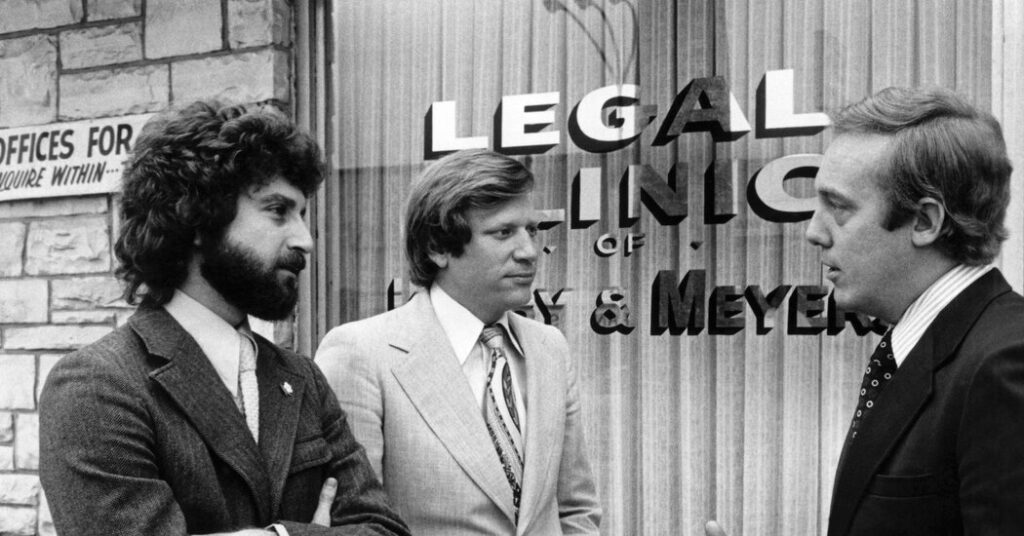
Leonard D. Jacoby, who as one-half of the law firm Jacoby & Meyers revolutionized the legal world in the 1970s by bringing low-cost services to everyday Americans — and by winning the right to advertise those services on billboards and television — died on Monday in Manhattan. He was 83.
His stepdaughter Lindsey Schank said the death, at a hospital, was from complications of cardiac arrest.
Mr. Jacoby and Stephen Z. Meyers, a friend from law school, started their firm in 1972 out of a single storefront in California’s San Fernando Valley. They wanted to fill a hole in the legal services industry: As they saw it, only the wealthy could afford the fees that most lawyers charged, while the very poor had access to legal aid. Those in the middle were left out.
They called their new firm a “legal clinic” to differentiate it from a traditional practice. It offered flat fees instead of charging by the hour. Potential clients met first with a paralegal who, if needed, could refer them to a lawyer — a process that kept costs down.
Jacoby & Meyers opened clinics in suburbs and strip malls, close to its client bases, and stayed open late and on the weekends. People came for all sorts of services, including no-fault divorces, wills and personal bankruptcies.
“We set out to be the Sears of the legal profession, good value for a reasonable price,” Mr. Jacoby told Los Angeles Business Journal in 1999 — and, in fact, as the firm grew, it put some of its offices in department stores.
The partners innovated in other ways, as well. They allowed clients to pay with credit cards. They created standardized intake forms and managed the information using a centralized database.
They were also unabashedly populist. In terms that are ubiquitous now, but were remarkable at the time, they promised to represent their clients in the fight against corporate greed and a broken system, a message that resonated during the anti-establishment 1970s.
The State Bar of California banned most forms of advertising, including speaking to the press. Nevertheless, the partners invited reporters to the opening of their first location. After giving a short speech, Mr. Jacoby asked, “Who needs a lawyer?”
One man shouted that he did — his car had been repossessed. After a quick consultation and a phone call, they got it back for him, charging all of $15. The story made the evening news.
Clients came flooding in, but the State Bar was not pleased. It moved to censure the partners, who fought back. In 1977, the California Supreme Court — and, in a separate case, the U.S. Supreme Court — ruled that banning legal advertising was unconstitutional.
The next day, Jacoby & Meyers ran its first print ad, in The Los Angeles Times. Within a few weeks, the firm was running ads on television. In Southern California in the late 1970s, the ads were inescapable — the firm was running up to 100 a week, each ending with the slogan “Jacoby & Meyers: It’s about time.”
By 1982, Jacoby & Meyers had 43 offices in California and another 18 in New York, and was seeing around 9,000 new clients a month. It was also spending about $1.9 million a year on advertising (about $7 million today).
Mr. Jacoby found that even more than the law itself, he loved promoting it. He wrote the scripts for the TV ads and helped direct them, standing alongside voice actors in the studio to make sure they nailed the delivery.
As the pioneering firm in a trend that brought legal services to the masses, Jacoby & Meyers was omnipresent. It was even name-checked in a rap song: “Got more suits than Jacoby & Meyers,” the Beastie Boys sang in “Shadrach” in 1989.
Such services are taxing, low-margin work, profitable only at a high volume. Yet by the end of the 1980s, thousands of lawyers had flooded into the space that Jacoby & Meyers had carved out, plastering ads for low-cost legal representation on highway billboards and in subway cars.
In the early 1990s, the firm pivoted toward more lucrative areas of consumer law, including personal injury, sexual harassment and class-action suits.
It also reduced the number of its offices and lawyers, and in the process Mr. Jacoby came to believe that Mr. Meyers and another partner, Gail Koff, were trying to push him out. He sued, and the partners settled by effectively splitting the firm in half: Mr. Jacoby took the West Coast, while Mr. Meyers and Ms. Koff took the East.
Mr. Meyers died in an automobile accident in 1996.
Leonard David Jacoby was born on March 27, 1942, in Lorain, Ohio, west of Cleveland. When he was 4, his parents, Nathan and Florence (Glasser) Jacoby, moved the family to the San Fernando Valley because Mr. Jacoby, who worked in real estate and giftware sales, had persistent health issues and thought the Southern California climate would do him good.
Leonard spent two years at the University of California, Berkeley before transferring to the University of California, Los Angeles, from which he graduated with a degree in history in 1964. He received his law degree from U.C.L.A. in 1967.
During law school, he grew close to Mr. Meyers, although they lost touch after graduation. Mr. Jacoby was working in private practice when he ran into Mr. Meyers, who was working in legal aid, at a conference in 1972. They founded their firm later that year.
Mr. Jacoby’s first marriage, to Barbara Rood, ended in divorce. He married Nancy Platt in 1979.
In addition to his stepdaughter, she survives him, along with a daughter from his first marriage, Sharre Jacoby; another stepdaughter, Laurie Arent; a son from an earlier relationship, Tom Nelson; five grandchildren; and a sister, Sandra Klein. Another sister, Daryl Saunders, died in 2014.
After splitting with Mr. Meyers, Mr. Jacoby remained involved with the West Coast iteration of the firm, though he eventually sold most of his shares.
“Len was a visionary leader who fundamentally transformed the legal industry for both the profession and the public,” Michael Akiva, a managing partner at the firm, said in a statement. “His commitment to the middle class challenged longstanding barriers and brought quality legal representation to those who previously had nowhere to turn.”
Clay Risen is a Times reporter on the Obituaries desk.
The post Leonard D. Jacoby, 83, Dies; Brought Legal Services to the Masses appeared first on New York Times.