MINNEAPOLIS — President Donald Trump threatened to invoke the Insurrection Act in Minnesota on Thursday, raising the prospect of sending U.S. troops into Minneapolis, despite opposition from state and local leaders, to quell protests over a recent federal immigration enforcement surge.
Trump, in a Truth Social post, put the onus on Minnesota politicians to stop protesters from “attacking” Immigration and Customs Enforcement agents. Trump wrote that if the state couldn’t calm the protesters, whom he referred to as “insurrectionists,” he would “institute the INSURRECTION ACT … and quickly put an end to the travesty that is taking place in that once great State.”
Federal agents have flooded the streets of Minneapolis in recent days, detaining people, pulling them from their vehicles, stopping U.S. citizens and — as of Wednesday evening — shooting two people, one of whom was killed. Residents have responded by protesting the agents’ use of force and the Trump administration’s campaign to round up people who are not in the country legally.
The Insurrection Act enables a president to deploy the military on U.S. soil in extraordinary circumstances: to quell an insurrection, civil disorder or armed rebellion. By invoking the Insurrection Act, a president empowers the military to make arrests and perform searches domestically, functions that the military is generally otherwise prohibited from performing in the United States.
Trump’s threat to invoke the law came after an immigration enforcement officer shot a man in the leg during a struggle outside a residence Wednesday evening, leading residents to flood the streets in protest and, in some cases, clash with federal authorities.
Federal officials on Thursday identified the man who was shot by law enforcement as Julio Cesar Sosa-Celis, a Venezuelan man who the Department of Homeland Security said was in the U.S. illegally after arriving in 2022. DHS has not identified the officer who shot Sosa-Celis.
Trump raised the prospect of deploying the Insurrection Act previously, as well, but didn’t formally invoke it. He threatened to do so in 2020, during his first term, saying he would deploy troops if governors did not calm civil unrest after the death of George Floyd, a Black man whose killing by Minneapolis police ignited national protests. And in June, after protests in Los Angeles over immigration raids, he said he would “certainly” invoke the act “if there’s an insurrection.”
Homeland Security Secretary Kristi L. Noem told reporters at the White House that she spoke with Trump on Thursday morning about invoking the Insurrection Act, calling the option his “constitutional right” but adding that she did not know whether he was likely to follow through on the threat. White House press secretary Karoline Leavitt would not say what it would take for Trump to invoke the act but claimed during Thursday’s press briefing that Democratic politicians “are holding their state and local law enforcement hostage” by declining to comply with federal immigration authorities sent to their cities and states by the Trump administration.
It is not clear how or whether the federal government would deploy U.S. troops in Minneapolis, which is part of a broader metro area with nearly 3.8 million residents. According to a Pew Research estimate of U.S. Census Bureau data, there were about 90,000 undocumented immigrants in Minnesota in 2023, and a majority are presumed to reside in the seven counties that make up the Twin Cities metro area.
The Insurrection Act has been invoked about 30 times in its more-than-200-year history. It was last invoked in 1992 during the Rodney King riots in Los Angeles and has not been used without the consent of a state’s governor for 60 years.
Minnesota Gov. Tim Walz (D), who has urged protesters to remain peaceful, has attempted to contact Trump following the threat to invoke the Insurrection Act, according to the governor’s office. He is also convening business leaders, other governors and lawmakers, his office said, to appeal to the administration to reverse course.
On social media, Walz made a direct appeal to Trump, writing: “Let’s turn the temperature down. Stop this campaign of retribution. This is not who we are.”
Leavitt told reporters Thursday that she was not sure whether Walz’s appeal was a genuine request to speak with the president, saying Trump had not spoken to the governor as of early Thursday afternoon.
Minneapolis Mayor Jacob Frey (D) wrote on X that “Minnesota needs ICE to leave, not an escalation that brings additional federal troops beyond the 3,000 already here. My priority is keeping local law enforcement focused on public safety, not diverted by federal overreach.”
Minnesota’s congressional Democrats condemned Trump’s threat to invoke the Insurrection Act. Sen. Tina Smith told reporters that Trump’s statements “essentially amount to threats of declaring war on Minnesota.” Rep. Ilhan Omar, on X, called Trump’s threat “a blatant act of authoritarianism.”
Hina Shamsi, director of the American Civil Liberties Union’s National Security Project, in a statement called Trump’s threat to invoke the Insurrection Act “unnecessary, irresponsible, and dangerous,” adding that “what’s needed now is not federal escalation, but de-escalation.”
Responding to Trump’s threat to use the Insurrection Act, Senate Majority Leader John Thune (R-South Dakota) said, “Hopefully the local officials, working with not only the federal law enforcement, ICE and other agencies, but also the local law enforcement officials, will be able to settle things down.”
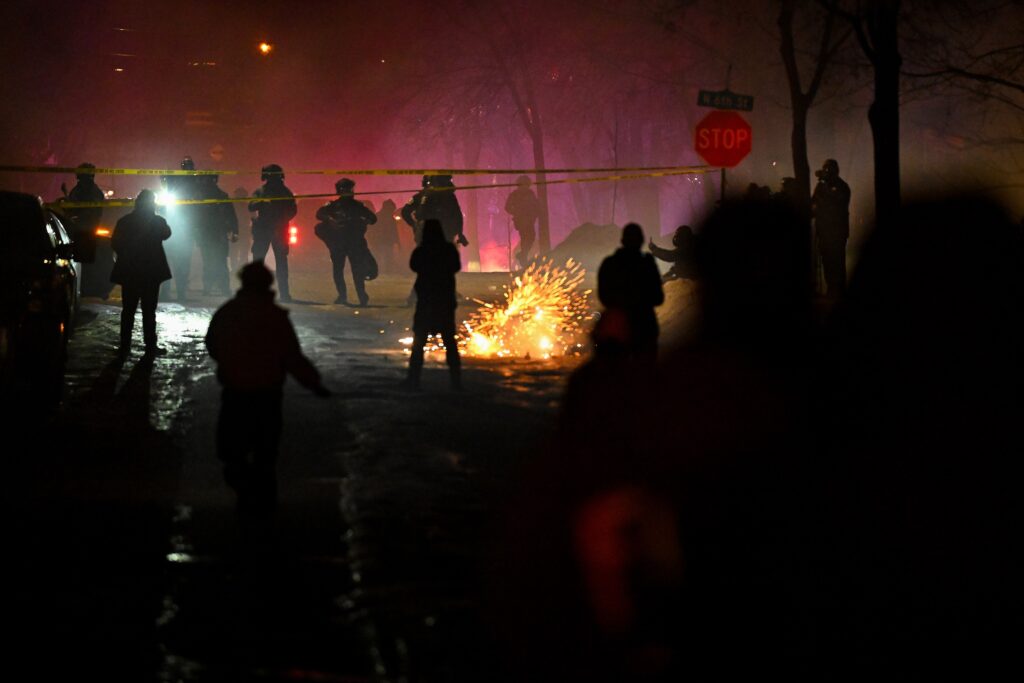
Federal and local leaders traded blame late Wednesday as protesters clashed with authorities in Minneapolis following the shooting of Sosa-Celis. On Wednesday night, protesters gathered in the city to denounce immigration agents’ actions. Footage from the streets showed protesters shouting, blowing whistles, filming ICE officers with their cellphones and calling for them to leave the city amid bursts of tear gas and stun grenades.
Minneapolis Police Chief Brian O’Hara said a crowd near the scene of Wednesday’s shooting was “engaging in unlawful acts,” including throwing fireworks at officers, as he urged them to disperse. Minneapolis police did not make any arrests Wednesday night, according to a city spokesperson.
At a news conference, Frey described an “impossible situation” in which Minneapolis’s 600 police officers are at times finding themselves at odds with some of the approximately 3,000 ICE agents who have been deployed to the city.
“We cannot be at a place right now in America where we have two governmental entities that are literally fighting one another,” Frey added. He said that he hoped to force ICE out of the state through a lawsuit he and other Minnesota officials filed Monday.
U.S. Deputy Attorney General Todd Blanche referred to the protests in Minneapolis on Wednesday as an “insurrection” and blamed the unrest on Walz and Frey, who he said were “encouraging violence against law enforcement” in a situation that has escalated since the fatal shooting of Renée Good last week by an ICE officer.
DHS alleged that Sosa-Celis attempted to evade arrest by driving a vehicle away from federal law enforcement officers, crashing it into a parked car and running away.
As an officer caught up with Sosa-Celis, two other men came out of a nearby property and began attacking the officer with a snow shovel and a broom handle, according to DHS. Sosa-Celis then “began striking the officer with a shovel or a broom stick,” the agency said.
The three men fled into the nearby apartment before ICE “successfully arrested” them, according to DHS. Sosa-Celis and the officer who fired the shot were hospitalized, according to DHS.
The Post was not able to confirm the government’s account of the events. DHS said officers arrested the other two people, whom they identified as Alfredo Alejandro Ajorna and Gabriel Alejandro Hernandez-Ledezma. The agency said both were undocumented immigrants from Venezuela. Noem claimed in a statement that the actions of the men amounted to “attempted murder of federal law enforcement.”
The federal government has sent thousands of additional officers to the city in the days since Good was shot in her car, leading to complaints from residents that the effort to detain undocumented immigrants instead resembles an armed occupation. Good’s family has hired lawyers to investigate her killing, including one of the lawyers who represented Floyd’s family.
Since returning to the White House for a second term, Trump has deployed or tried to deploy the National Guard in Los Angeles; Portland, Oregon; and Chicago to combat what he has cast as rampant crime often tied to illegal migration.
Local and state officials sued to challenge these deployments, calling them unlawful actions that infringed upon their sovereignty. They also said law enforcement officials could manage protests without the National Guard and added that these deployments would only fuel larger protests. The Trump administration has said immigration officers and facilities have faced violence and threats and wrote in court papers that troops were needed to protect them from “cruel activists” and “violent mobs.”
Judges have handed the Trump administration a string of defeats in some of these cases, culminating in the Supreme Court saying last month that it would not allow Trump to deploy troops in the Chicago area for now. Before that, lower courts had blocked deployments in Chicago as well as Portland, and judges have rebuked the administration’s arguments that protests in these places amounted to a “rebellion.”
Days after the Supreme Court’s order, Trump announced on social media that he was effectively throwing in the towel and “removing the National Guard from Chicago, Los Angeles, and Portland.” But troops remain on the ground in New Orleans and Memphis, where state officials supported deployments, as well as in D.C., where the mayor lacks control over the D.C. National Guard.
Trump’s surge of federal immigration enforcement in Minnesota is being challenged in court.
On Wednesday, a federal district court judge in Minneapolis declined to issue a temporary restraining order against federal immigration operations in Minnesota, in a case filed this week by the state of Minnesota and the cities of Minneapolis and St. Paul. The same judge, Katherine Menendez, is expected to decide this week on whether to issue a preliminary injunction against ICE activity in the Twin Cities in a case brought by six Minneapolis-area residents represented by the ACLU of Minnesota.
Federal agents’ activity has disrupted life across the Twin Cities and their suburbs, from retail parking lots where agents have stopped workers to residential neighborhoods where officers have knocked on doors looking for undocumented immigrants. Federal officers have deployed pepper spray and irritants against protesters, including outside a church whose pastors said they were among those “pepper-bombed” Tuesday and at a high school last week.
School officials in St. Paul said they are opening registration for temporary virtual learning and have canceled school until next Thursday so teachers can prepare. Schools Superintendent Stacie Stanley said in a video message to families that she had received hundreds of messages asking about virtual learning in recent days and acknowledged that some students “do not feel comfortable coming to school right now.”
Tension and fear were palpable on Thursday in the city. Jamey Erickson, a 44-year-old longtime resident of Minneapolis, said residents have become wary of leaving their homes because federal immigration agents have been confronting people “indiscriminately.”
“It doesn’t matter if they’re a citizen or not,” he said.
Mark Berman, Marianne LeVine, Praveena Somasundaram, Kelly Kasulis Cho, Arelis R. Hernández, Theodoric Meyer, Anna Liss-Roy and Natalie Allison contributed to this report.
The post Trump threatens Insurrection Act deployment to quell Minnesota ICE protests appeared first on Washington Post.