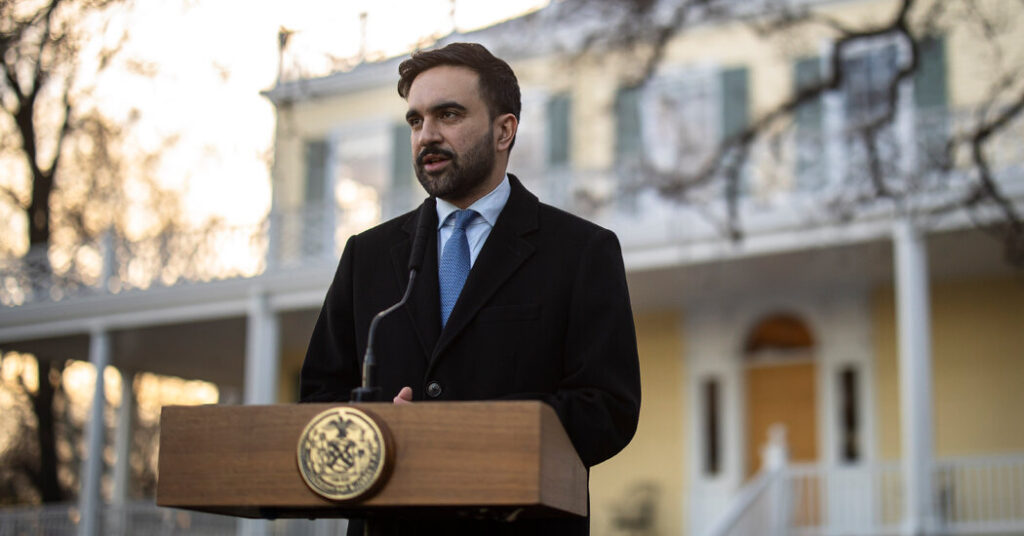
After winning the Democratic mayoral primary last year, Zohran Mamdani acknowledged that his victory came without much support from Black voters, and he pledged to do better.
Mr. Mamdani spent the next few months working to improve his relationship with Black leaders in New York City and vowed, from Black church pulpits around the city, that he would have a diverse administration representative of the city.
But in his rollout as mayor, Mr. Mamdani has appointed five deputy mayors, none of them Black; one was Latino.
On Thursday, Mr. Mamdani announced Afua Atta-Mensah, who led his campaign outreach to Black voters, as the new chief equity officer and commissioner of the Mayor’s Office of Equity and Racial Justice. The mayor also reaffirmed his commitment to releasing a long overdue and mandated plan to address racial disparities in New York City, vowing to do so in his first 100 days in office.
The moves were welcomed by Black and Latino leaders, but they still questioned Mr. Mamdani’s commitment to racial equity.
Tyquana Henderson-Rivers, a well-known Black political consultant, said in an interview that she believed it was “damaging that there’s no Black deputy mayor.”
“He already doesn’t have the best relationship with the Black community,” she said. “And it seems like he’s not interested in us because there’s no representation in his kitchen cabinet.”
Former Mayor Eric Adams had perhaps the most diverse administration in city history, tapping Black and Latino officials for top positions that included first deputy mayor, chief of staff, police commissioner and corporation counsel. Former Mayor Bill de Blasio also had Black and Latino leaders serving as deputy mayor, chief counsel and the city’s top lawyer.
“For someone who prides himself on being directly engaged with everyday New Yorkers, to be so tone deaf to the cries of Black and Latinos in the city for access to power is shocking,” said Kirsten John Foy, the president of the civil rights group Arc of Justice. “There are some very good people of color that have been appointed to some high-level positions, but those people are not at the center of the decision-making apparatus in this city.”
In addition to Ms. Atta-Mensah, Mr. Mamdani has hired two other Black people for top jobs including schools chancellor (Kamar Samuels) and the director of intergovernmental affairs (Jahmila Edwards), and his aides typically cite those hires as examples of his belief in diversity, according to several people who have been in contact with the administration over the issue.
Black and Latino leaders say those appointments do not constitute the level of diversity they had expected from Mr. Mamdani, and they have begun to go public with their concerns.
Ms. Henderson-Rivers wrote on Facebook that in this “new era” of city politics, a term Mr. Mamdani uses to describe his administration, Black women “no longer have a seat at the big table” where decisions are made.
“It is acting out what Black people don’t like about the D.S.A.,” Ms. Henderson-Rivers said of the Democratic Socialists of America, of which Mr. Mamdani is a member. “And that’s acting as if race doesn’t matter.”
Kyle Bragg, the former head of the powerful union Local 32BJ, wrote on Facebook that the Mamdani administration was the first in decades to not appoint a Black deputy mayor. He also attributed the lack of diversity to the “D.S.A.-aligned politics” of the left, where issues of class are given more weight than race.
Marc H. Morial, the president of the National Urban League who became mayor of New Orleans when he was just two years older than Mr. Mamdani, who is 34, said in an interview that choosing a diverse administration was considered a “basic rule of being a mayor.”
“I don’t care whether the mayor’s Black, white, Asian or Latino,” he said, “you need a leadership team that mirrors the city.” (Black and Latino people make up more than half of the city’s residents.)
Dora Pekec, a spokeswoman for Mr. Mamdani, disputed the notion that the administration was somehow not committed to diversity. Out of 32 appointees so far, 18 have been Asian American, Latino, Middle Eastern or Black, she said. In the next week, the administration expects to make six high-level commissioner or director appointments, five of whom are expected to be Black or Latino.
Mr. Mamdani also intends to reach out more to the general public and has created an Office of Mass Engagement to help New Yorkers drive the administration’s agenda and to reach those who are often excluded from the process.
Ms. Pekec said the mayor had an expansive view of what constitutes a City Hall leadership team.
“It’s not him and five deputy mayors” in senior meetings, Ms. Pekec said. “It’s a much wider group.”
In the mayoral primary, Mr. Mamdani did win strong support from younger Black voters, but not older Black New Yorkers. In precincts where at least 70 percent of residents are Black, Mr. Mamdani lost to his closest competitor, former Gov. Andrew M. Cuomo, by a margin of 59 percent to 26 percent, according to a New York Times analysis.
After the primary, Mr. Mamdani hired Ms. Atta-Mensah, a respected organizer, to help bridge the gap. The efforts seemingly worked. Mr. Mamdani won 61 percent of the vote in the 479 precincts with large numbers of Black voters, according to an analysis of the November election.
Many Black leaders thought that the support Mr. Mamdani received would translate into appointments to high-ranking positions, especially as he made very visible efforts to assure the Black community that it would be a vital part of his administration.
“It is clear from the lack of conversation and engagement that there doesn’t seem to be a lot of focus and attention on the needs of Black New Yorkers in the city,” said L. Joy Williams, the head of the New York State NAACP.
Other nonpersonnel issues have arisen. Many thought that he did not do enough to help Crystal Hudson, a Black councilwoman from Brooklyn, in her bid to become City Council speaker. (Julie Menin, who is white, has taken over the position.)
Some found fault with Mr. Mamdani’s decision to back Brad Lander, the former New York City comptroller, in his challenge to unseat Representative Daniel Goldman, noting that another democratic socialist, Councilwoman Alexa Avilés, had already secured the D.S.A.’s endorsement in the race. Ms. Avilés soon dropped out.
Mr. Mamdani also spoke forcefully against the D.S.A. endorsing Chi Ossé, an ally and Black councilman from Brooklyn, who was hoping to challenge Representative Hakeem Jeffries, the leader of House Democrats. Mr. Ossé also dropped his challenge.
Black leaders aren’t the only ones expressing concern. Many Latino leaders were upset by Mr. Mamdani’s decision to not keep Melissa Aviles-Ramos as schools chancellor.
Frankie Miranda, the president and chief executive of the Hispanic Federation, one of the most prominent Latino organizations in the country, said Mr. Mamdani called two days before his inauguration to inform him that Ms. Aviles-Ramos would not be retained, calling it a “very difficult decision.”
Mr. Miranda said his organization had been in touch with both the transition team and administration to provide Latino candidates for consideration. He said he was happy to see the appointment of Helen Arteaga as a deputy mayor, Rafael Espinal as director of the Mayor’s Office of Media and Entertainment and Midori Valdivia as head of the New York City Taxi and Limousine Commission.
“We were very much interested in getting more deputy mayors, but as of right now we know that process is closed and that there may be other positions that they may create,” Mr. Miranda said in an interview. “Right now, the focus is commissioners and we continue to provide names.”
Other Black leaders are also taking a wait-and-see approach. Jennifer Jones Austin, the chief executive of the Federation of Protestant Welfare Agencies, has served as an informal adviser to the mayor and his team.
“I’m not defending this administration for not having a Black deputy mayor,” Ms. Jones Austin said in an interview. “What I am saying is that is not the sole criterion on which I’m going to make a judgment as to whether this mayor will keep close the concerns and the particular challenges facing the Black community in New York.”
Jeffery C. Mays is a Times reporter covering politics with a focus on New York City Hall.
The post None of Mamdani’s Deputy Mayors Are Black. It Has Become a Problem. appeared first on New York Times.