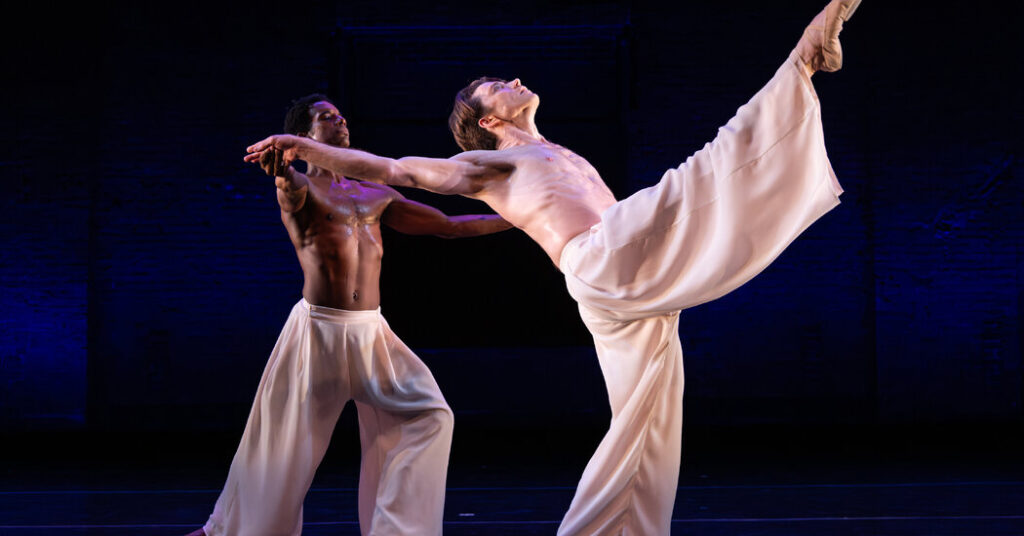
Once upon a time, kings of dance would gather to flaunt their power, their masculine prowess and their prerogative to behave as they wished.
I speak of “Kings of the Dance,” touring programs in the 2000s and 2010s that packaged some of the world’s greatest male ballet dancers, usually in choreography beneath their gifts.
Now we have “Sons of Echo,” a program that debuted at the Joyce Theater on Wednesday. Once again, men of great skill perform together, only now they show their sensitivity by dancing works exclusively by female choreographers.
Men seen through the female gaze — that’s an idea with revelatory potential. Presumably, the sons of Echo, like Echo in Greek myth, repeat and reflect rather than assert or originate. Unfortunately, the point the program ends up making is that male choreographers have no monopoly on bad taste.
This is particularly disappointing because of the five-man cast. Led by Daniil Simkin, who also serves as creative director, it features dancers seldom if ever seen in New York, like Osiel Gouneo of the Bayerisches Staatsballett and Siphesihle November of the National Ballet of Canada. Others are much missed, like Jeffrey Cirio who was a principal dancer with American Ballet Theater before returning to Boston Ballet a few years ago; and especially Alban Lendorf, a Danish paragon who was a frequent guest artist with Ballet Theater before he announced that he was retiring from performing after a knee injury in 2019. His return to dancing is wonderful news.
The show starts with a tease, an abbreviated ballet class led by the Swedish ballet master Tomas Karlborg. Shaggy haired and low-key goofy, he sings his step combinations to the tunes of “Love and Marriage” and “Hava Nagila” and makes tired jokes about being old and tired. But amid the silliness are flashes of Lendorf’s buoyancy and clarity, Cirio’s explosiveness and Gouneo’s finessed control, changing speed and position in a string of pirouettes. (On Wednesday, the Russian ballerina Maria Kochetkova joined the class, providing some gendered compare-contrast.)
The opener is a tease because the works that follow make little use of these gifts. First up is “Notes,” by Lucinda Childs, the most distinguished of the choreographers here by far. Her dance is the least bad. In its first moments, as Lendorf advances on a diagonal while Cirio and November counter, the sense of lateral force and form is firm and exciting. There’s an intriguing overlap between Lendorf’s Danish modesty and Childs’s minimalism. But the music — from Matteo Myderwyk’s “Notes of Longing,” played live by Vladimir Rumyantsev — is Relaxing Classical Muzak that dampens Childs’s careful patterns into dullness.
I don’t know why Tiler Peck chose “Real Truth,” a recording in which the talented jazz vocalist Gregory Porter recites inane lyrics about “the real” before and after singing them. The track gives her little opportunity to engage her trademark musicality. Tasked with finding a tossed-off cool, Lendorf and Gouneo look out of place and Simkin is just embarrassing.
In “Will You Catch My Fall,” Anne Plamondon buries Cirio and November in the stark yet maudlin clichés made popular by her fellow Canadian choreographer Crystal Pite. As a female voice, in a score by the electronic musician Ouri, recites phrases (with an irritating echo effect) about carrying and catching, the dancers put their hands to their mouths or their own pulsing chests and find ways to support one another.
Drew Jacoby’s “Jack” (2019) at least has some courage, selecting Dadaist gibberish and Futurist noise for part of its score. But the choreography, perhaps attempting to objectify men, is no more than pseudo vogue. In a solo to gratuitously chopped-up Gershwin, Gouneo has the slinkiness of Gene Kelly impersonating Chocolat in “An American in Paris.” Yet the rest of this tiresomely self-serious work has nothing to say about men or anything else.
The program as a whole — interspersed with echo-enhanced poems by Monty Richthofen that sound like Deep Thoughts by Jack Handey — has hardly anything to reveal about new aspects of masculinity in dance, apart from an avoidance of aggression. Competition leaks into the ballet class, when Simkin takes too many turns, but there’s no gender angle to Karlborg’s jokes about giving dancers “artistic freedom.” Under Simkin’s direction, it translates as a fatal abundance of rope. Echoes are what one hears in empty spaces.
Sons of Echo
Through Jan. 25 at the Joyce Theater; joyce.org.
The post Review: These Kings of Dance Get Their Marching Orders From Women appeared first on New York Times.