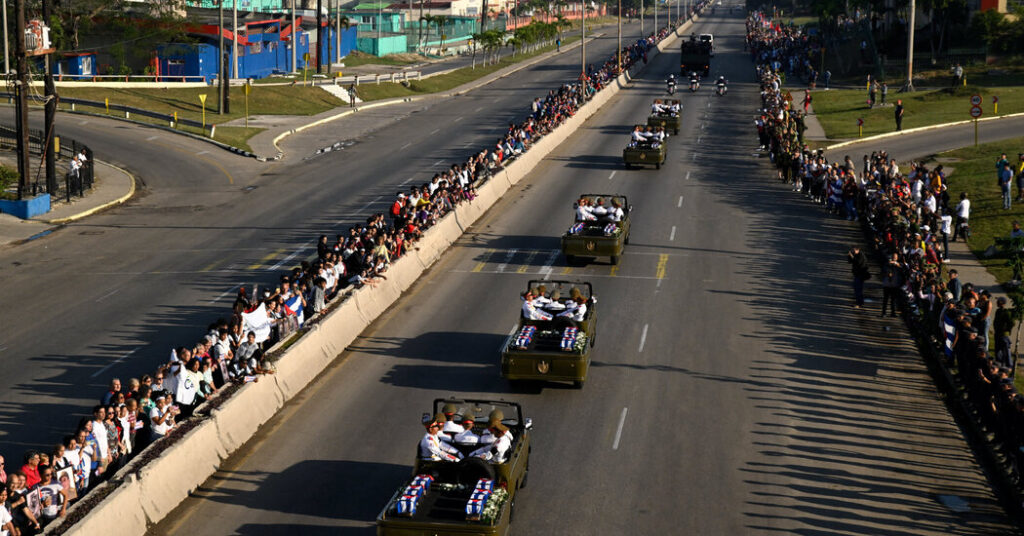
Cuban national television broadcast live on Thursday morning the return of the remains of 32 of its citizens, who were killed in the U.S. strikes on Venezuela during the operation in the early morning of Jan. 3 to capture the ousted Venezuelan president, Nicolás Maduro.
The remains arrived in boxes, smaller than caskets, draped in the Cuban flag.
For years, Cuba has sent thousands of its citizens to Venezuela, which, in turn, provided Cuba with oil. Many of the Cubans sent to Venezuela are teachers and doctors, but they also include intelligence agents and security guards.
The New York Times reported in December that, in the face of increasing U.S. military pressure, Mr. Maduro had expanded the role of Cuban bodyguards in his personal security detail and placed more Cuban counterintelligence agents in Venezuela’s military.
The remains were received at Havana’s international airport by Cuban President Miguel Díaz-Canel and the country’s Minister of the Interior, Maj. Gen. Lázaro Alberto Álvarez Casas, among other high-ranking officials in the Cuban Communist Party.
“The enemy speaks euphorically of high-precision operations, of elite troops, of supremacy. We, on the other hand, speak of faces, of families who lost their father, their son, their husband, their brother,” said Mr. Álvarez, speaking at the airport. “People do not become great because of their material wealth, but because of their ability to keep the memory of their heroes alive.”
The ousting of Mr. Maduro was a significant blow to Cuba, which relied heavily on Venezuelan oil to keep its economy afloat. Venezuelan oil shipments to Cuba have essentially ceased. Experts have described Cuba’s economy as being in “free fall” since the U.S. government cut off the supply of Venezuelan oil.
On Sunday, President Trump said in a social media post that “no more oil or money” would be going to Cuba from Venezuela, and that the United States military would be involved in enforcing a separation between the two countries.
“Venezuela doesn’t need protection anymore from the thugs and extortionists who held them hostage for so many years,” Mr. Trump wrote. “Venezuela now has the United States of America, the most powerful military in the World (by far!), to protect them, and protect them we will.”
The loss of Venezuelan oil would be “catastrophic” for Cuba, according to Jorge Piñon, a former oil executive in Mexico and an expert on the energy industry at the University of Texas at Austin, who said that Venezuela had been supplying roughly a third of Cuba’s daily fuel needs.
Max Bearak is a reporter for The Times based in Bogotá, Colombia.
The post Cuba Receives Remains of 32 Citizens Killed in U.S. Strikes in Venezuela appeared first on New York Times.