Ugandans headed to the polls on Thursday for an election in which President Yoweri Museveni, 81, is expected to extend his rule of nearly four decades in the east African nation.
The vote is taking place against the backdrop of an internet blackout imposed by the authorities. Technical problems with the biometric voting machines introduced in recent weeks in a bid to prevent voting fraud have caused widespread disruptions at polling places.
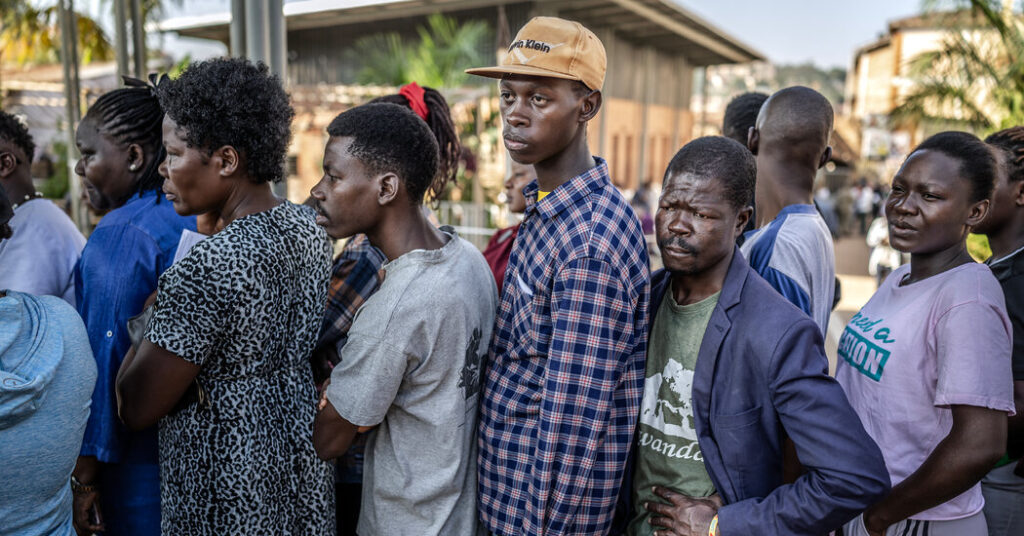
By midmorning, few people had cast their ballots, with lines forming at polling stations in the capital, Kampala, and elsewhere. “I am ready to wait,” said Ssenyondwa Martha, who said she had arrived at her polling station in Kampala around sunrise. “We came here to vote.”
The electoral commission announced on Thursday that the country’s more than 50,000 polling stations would revert to paper verification for voter identities for the rest of the day, according to the spokesman, Julius Mucunguzi.
Seven candidates are contesting the election, but Mr. Museveni’s main challenger is Bobi Wine, the former pop star whose real name is Robert Kyagulanyi.
Drawing on the support of Uganda’s young voters, Mr. Wine’s campaign rattled the ruling National Resistance Movement during the last election in 2021. In an interview on Monday, Mr. Wine acknowledged that recent defections had weakened his campaign.
“We code-named this a ‘protest vote,’” he said. “If the vote is rigged, we shall call for protests.”
Speaking to journalists after voting near his home in rural western Uganda on Thursday, Mr. Museveni accused the opposition of fraudulently obtaining millions of extra votes during the previous election.
Any opposition candidate in Uganda must contend with the overwhelming financial and political advantages of a ruling party that is deeply embedded in the state machinery. The entire electoral commission is selected by the president, who has been in power for decades.
In one example of the ruling party’s dominance, Kampala has for weeks been plastered with posters promoting Mr. Museveni and his party’s candidates for Parliament. The posters, in the party’s color yellow, dwarf the number of posters from Mr. Wine’s National Unity Platform.
In an apparent bid to forestall any opposition demonstrations, the authorities cut the internet nationwide on Tuesday, justifying the decision on the grounds that it would stop the weaponization of misinformation.
The Ugandan government has been accused of weakening civil society groups in recent years, and on Tuesday the country’s bureau for nongovernmental organizations said it was temporarily closing several such groups.
The Center for Constitutional Governance said on Tuesday that it had received a letter from the government accusing it of engaging “in activities which are prejudicial to the security and laws of Uganda,” and that it was being forced to close.
The Uganda Law Society condemned the decision. “This action, taken just days before the general election, is not coincidental,” the society said, calling it an effort to silence civil society and an “attack the public’s right to accountability.” The Center for Constitutional Governance monitors the health of the country’s democracy.
The United Nations human rights agency said Wednesday that the internet blackout and suspension of civil society groups were “deeply worrying,” with Amnesty International calling for the immediate lifting of the internet restrictions.
Mr. Museveni has campaigned on the slogan “Protecting the Gains” made since he fought his way to power as the head of a rebellion in 1986. He said at his final campaign on Tuesday that the economy had grown 17-fold during his tenure and now exports products such as milk.
Making sure that all Ugandans benefit from the country’s economic gains was a priority for his next term, he said. “Love Uganda. Why? Because you need it for your own good,” Mr. Museveni told journalists.
While Uganda’s economy lags behind its eastern neighbor Kenya, the country is a diplomatic powerhouse in the region and the largest contributor to a peacekeeping force in Somalia. Ugandan troops are also stationed in the Democratic Republic of Congo and in South Sudan, where they support the president.
The Ugandan government, like many others in Africa, has been at pains to manage its relationship with the Trump administration. The State Department said on Wednesday that it would suspend the processing of immigrant visas for people from 75 countries, including Uganda.
Election results are expected to be announced over the weekend.
Matthew Mpoke Bigg is a London-based reporter on the Live team at The Times, which covers breaking and developing news.
The post ‘We Came Here to Vote’: Ugandans Go to Polls Despite Major Delays appeared first on New York Times.