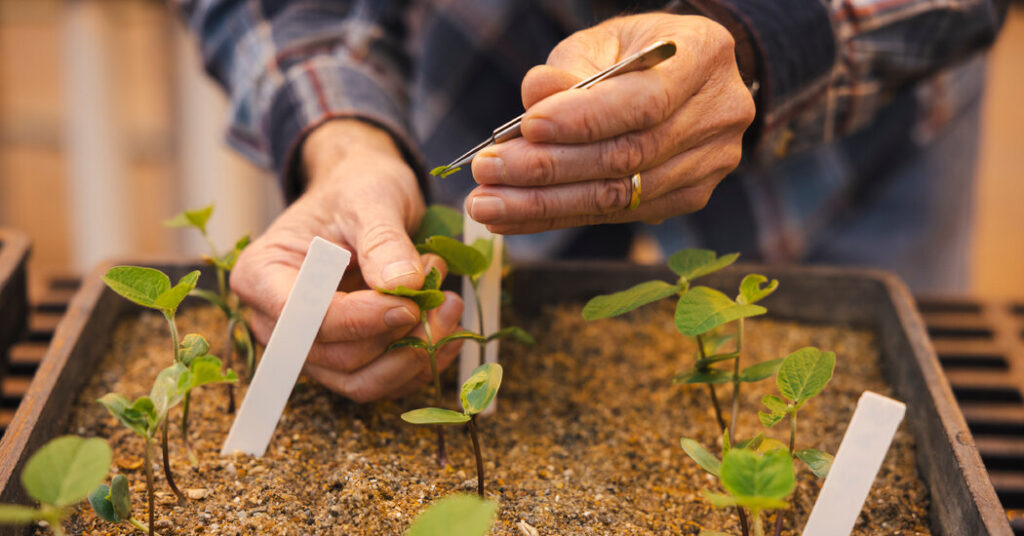
Crops and livestock that are essential for feeding the world’s population are constantly threatened by depleted soil, evolving pathogens and erratic weather spurred by a changing climate.
So in laboratories and farms around the world, scientists labor to protect them, breeding more resilient varieties and developing farming practices to stabilize harvests against the swings and shocks of the environment.
But lately, the United States, not nature, has created the biggest uncertainty for global agriculture.
Until last year, when the Trump administration dismantled it, the U.S. Agency for International Development had been a major supporter of global agricultural science, disbursing about $150 million a year to universities, companies and international research centers. That funding was part of the Feed the Future initiative, which was most recently reauthorized in 2023, with broad bipartisan support. Now, around the world, scientists are scuttling or scaling back studies meant to defend the world’s food supply against plant disease outbreaks, and to develop crops and farming practices that will help ensure adequate food in the decades to come.
About a third of Feed the Future’s agricultural science budget went to 17 labs at U.S. universities that study everything from aquaculture and cereals to fruits and tubers. All but one of the labs received stop-work orders early last year when the Trump administration froze development spending and later eliminated it. The soybean “innovation lab” at the University of Illinois Urbana-Champaign, for example, had been developing dozens of higher-yielding varieties of soybeans for West African farmers, which Peter Goldsmith, the lab’s director, said would have accelerated local economic growth and created new export markets for U.S. soy farmers. Instead, he had to shutter the lab and lay off 30 staff members. “It was lights-off in an instant,” he said.
Another lab that lost funding, at the University of Florida, was running dozens of studies on how to raise livestock more efficiently and expand access to protein-rich foods sourced from animals, including for children and pregnant women.
J. Scott Angle, a senior vice president of the university who served in the first Trump administration, said U.S.A.I.D. had made some mistakes but Americans had benefited from many of the projects it funded. “They were just as important for the U.S. economy, U.S. farmers, U.S. consumers as it was for overseas,” Dr. Angle said.
Only Kansas State University’s lab for climate-resilient cereals retained its federal funding, albeit on a year-to-year basis, making it difficult to pursue agricultural projects that, by necessity, unfold over multiple growing seasons.
Tim Dalton, an agricultural economist who served as interim director of the Kansas State lab until August, credited Kansas’ Republican senior senator, Jerry Moran, with protecting its budget, but he expressed frustration that such intervention was necessary. “What’s maddening to me as a scientist,” he said, “is that national policy of this importance is now devolved to political favorites, as opposed to a strategic investment for the benefit of the nation.”
The funding cuts landed at a time when global public support for agricultural science was already slackening, as high-income countries grew complacent about their food supply and ceded research to private industry. The falloff has raised concerns among food-industry executives and national security experts, who see the food system as a pillar of global stability.
Vern Long, who directed U.S.A.I.D.’s agricultural research team from 2017 to 2019, said the need to address threats to the global breadbasket was bigger than partisan politics. “These issues transcend national identity,” she said. “These issues are about humanity.”
A pillar of development
Science that improves the resilience and productivity of agriculture is an undervalued driver of development, with outsized implications for health and economic well-being.
Around the world, crops and livestock are routinely felled by new diseases, their yields depressed by changing conditions. Shocks to the food supply can precipitate humanitarian disasters and political crises, since hunger can motivate citizens to topple their governments.
To respond to such emergencies, the United States often sends other countries food aid — American-grown commodities or, more commonly, food vouchers — to stave off famine. But agricultural science offers a more durable solution by seeking to unlock permanent improvements in how local farmers produce food. Among other practices, agronomists and biologists breed crops that are more resistant to disease, select varieties that increase yields and develop farming techniques that improve harvests.
As farmers become more efficient and food grows more abundant, people eat better and incomes rise, particularly in rural areas and among small-scale farmers who account for many of the world’s poorest people. Advances in agricultural productivity reduce poverty more than improvements in any other sector do, according to the World Bank.
Historically, there have been huge gains to make. A review of five decades’ worth of agricultural science found that each dollar of research yielded more than 10 dollars in economic benefits.
According to Keith Fuglie, chief economist of the nonprofit Food Security Leadership Council, “some of the most effective investments that U.S.A.I.D. made over its entire history were in agricultural research and development.”
Unexpected consequences
The federal government, via the aid agency, was also a leading funder of C.G.I.A.R., a network of institutions around the world that draws funding from a variety of public and private philanthropic sources.
Trump Administration: Live Updates
Updated
- Under Trump, a shift toward ‘absolute immunity’ for ICE.
- Trump cheers ‘good news’ after Iran says a prominent protester isn’t set to be executed.
- Machado will meet Trump, after offering to share her Nobel.
Among the most renowned of those institutions is the International Maize and Wheat Improvement Center, which is based outside Mexico City and known by its Spanish acronym, CIMMYT. The center has 1300 affiliated employees and manages a seed bank of more than 150,000 genetically unique types of wheat and corn, including nearly every known variety and some decades-old samples that no longer exist beyond its walls.
The withdrawal of U.S. funding opened up a $60 million gap in the center’s budget, according to the executive director, Bram Govaerts.
That has unsettled leaders in the food industry like Matthias Berninger, an executive vice president at Bayer, the world’s largest supplier of seeds and agricultural chemicals since it acquired Monsanto in 2018. Bayer spends nearly $2.5 billion annually on agricultural research, Mr. Berninger said, predominantly on projects it can commercialize. The company depends on organizations like CIMMYT to bring those innovations to small-scale farmers and to conduct open-source research about shared threats.
“If you have a crop disease suddenly appearing in one part of the world, everybody, including us, relies on CIMMYT to catch that early and to help working on remedies,” Mr. Berninger said.
CIMMYT’s budget troubles also appear to have drawn the interest of Chinese officials. China is the world’s largest wheat producer and second-largest corn producer, and the country recently became the leading funder of agricultural research, spending double what the United States does.
Mr. Govaerts, the director, said that throughout last year, the center saw an uptick in visits by Chinese scientists, businesses and government officials. Mexican officials publicly fretted that China might seek to “relocate” CIMMYT closer to China as a condition for its financial support.
Citing these claims, the State Department sent Congress a letter in November warning that this would give China “unprecedented access to a wealth of valuable data and create vulnerabilities for the global food supply.” The agency promised CIMMYT $32 million.
But the money, drawn from a special fund for countering Chinese influence, was a one-time infusion and not a stable source of support, said Francisco Bencosme, who led China policy for U.S.A.I.D. until last year. “Just because they doled out this money doesn’t mean they will again next year,” he said. “This is not a food security funding stream.”
An uncertain future
Whether the United States will revive its funding for international agricultural research remains unclear.
Supporters’ hopes hinge on comments that the White House budget director, Russell T. Vought, made during a hearing last June, asserting that science like that taking place in U.S. labs “will be protected.” But the administration did not unfreeze previously appropriated funds for the labs, and in August it zeroed them out as part of a pocket rescission of billions of dollars of foreign aid.
There were further signs of momentum last weekend, when House and Senate negotiators cemented an agreement on a spending bill for this year that would devote $175 million to agricultural research funding. The House passed the measure on Wednesday.
With U.S.A.I.D. effectively dissolved, the State Department’s office of global food security now has primary oversight. The office’s head, Meghan Hanson, declined to comment on the administration’s plans.
The U.S. cuts are part of a broader slowdown in research on agriculture and food. From 2015 to 2021, the growth rate of global spending on agricultural science fell by a third, according to a recent paper published in the journal Nature.
Governments of high-income countries, in particular, have slowed their investment, whereas China, India and Brazil have risen to be among the world’s largest funders. And as the public sector has wavered, private industry has taken a bigger role, now accounting for more than half of funding.
Philip Pardey, an economics professor at the University of Minnesota and one of the Nature paper’s authors, said the global deceleration was likely to drive up food prices and hamper efforts to reduce malnutrition. It may also increase habitat loss, as farmers enlarge their holdings rather than intensify their use of fields already under cultivation.
Reaping the benefits of agricultural research takes patience, as anyone with a garden can attest. “There are really long lags from when you spend those R&D dollars to when they have their productivity impacts,” Dr. Pardey said. “Cutting back now is casting the die for the productivity performance in the 2030s and 2040s.”
This article was written with the support of the Pulitzer Center.
The post For the World’s Food Supply, Federal Funding Cuts Have Long-Term Impacts appeared first on New York Times.