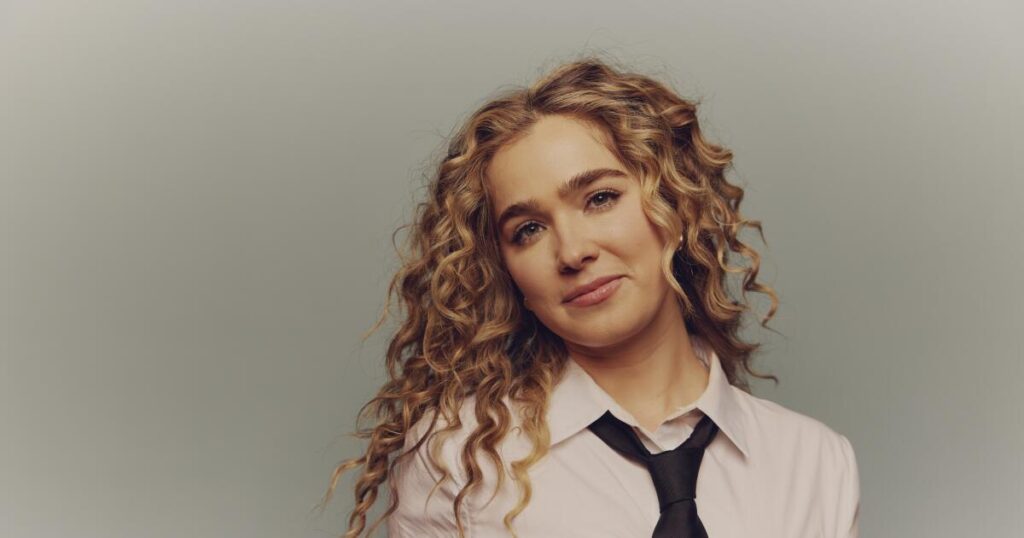
Twice in her career Haley Lu Richardson has read a script and immediately known, “I have to do this.” The first time was Kogonada’s 2017 indie “Columbus,” a poignant film that put Richardson on the map as an actor. The second was “Ponies,” Richardson’s new Peacock series, now streaming, in which she plays Twila, a CIA spy in Cold War Russia, alongside Emilia Clarke.
“I often read scripts and there’s this soul-crushing thing that happens where you get 10 pages in and it doesn’t spark anything in you, no connection or inspiration,” says Richardson, 30, speaking over Zoom from her home in Phoenix in December. Last year was particularly busy for her, shooting “Ponies” and two films, and she’s still learning how to be back in her everyday life without the constant stimulation of a set.
She adds, “When you read something and there is that spark — it’s so rare. But it happened to me when I read the character of Twila.”
“Ponies,” created by Susanna Fogel and David Iserson, centers on two secretaries working at the U.S. Embassy in Moscow in 1977. When their husbands, both CIA operatives, mysteriously die in action, Bea (Clarke) and Twila (Richardson) are enlisted to take their places. Although they begin as novice agents, both gamely step up and build an unlikely friendship in the process. It’s action-packed, thrilling TV, but also deeply grounded in humanity and emotion. Twila and Bea are complexly wrought, which is largely what attracted Richardson.
“I feel lucky that I’ve gotten to play characters who aren’t all the same person, but I often play the straight one in the duo,” she says. “As a person in real life, I am very big and loud and inappropriate at times and expressive and sensitive and all of these things. So I’ve always had to find a way to tone myself down.”
With Twila, however, that wasn’t the case. The character, who is escaping a bleak past in the U.S., is loud and sometimes chaotic, but in a completely charismatic way. Unlike Bea, Twila isn’t college-educated and she’s far less poised, which sometimes works to her advantage. Richardson collaborated with the costume and hair and makeup teams to create a vibrant look for Twila, who favors fur and brights, complete with wildly messy hair (it’s not a wig).
“Sometimes I have to try really hard to find at least one thing that tethers a character to me,” Richardson says. “But when I first read Twila, I was like, ‘Oh, my God, this is me.’ I was trying to think, ‘But how can I make her different than me?’ It was the opposite experience I normally have.”
Clarke, speaking separately over Zoom from London, adds, “The skeleton of the character on the page was Haley. So her filling in the gaps was inevitable. And it was beautiful to work with someone who so thoroughly went to bat for her character.”
Fogel met with Richardson several years ago when she was casting her 2024 film “Winner.” Although Richardson didn’t end up in the movie, Fogel kept her in the back of her mind. “She’s such a deep, emotional, intuitive actress who was in these teen movies where the depth and gravitas of her soul weren’t able to fully express themselves,” Fogel says. “I had an inkling that she was ready to play an adult role.”
Clarke joined the series early on as a producer and was part of the casting process. She remembers Richardson’s name being brought up and feeling like it was a “divine moment.” “As soon as her name was there, we got rid of every other name on the list,” Clarke says. “The first time I talked to her I was like, ‘I just met my baby sister.’ I’ve never met anyone like Haley and I don’t think I ever will.”
The tangible connection was apparent to Richardson too. “It was the most joyful Zoom,” she says. “I hope this show goes for 50 seasons so I can just keep spending days after days with Emilia.”
Richardson moved to Budapest, which stands in for Moscow, where the show is largely set, in January 2024 and spent six months in the city to film “Ponies.” Being away for so long was a new experience for the actor, although she did live in Sicily while making the second season of “The White Lotus.” It meant completely uprooting her life and also focusing on a singular character for an extended period of time. The intensity of the work was sometimes a challenge.
“We went back and forth between day and night shoots, which f— Emilia and my immune systems,” Richardson remembers. “We got sick like three times — I’d be sick, and then she’d be sick and then they would do all my scenes while she was sick, and then sometimes we’d both be sick. We had 18-hour days. It was constant.”
Despite the hurdles, Richardson reveled in playing Twila. She felt completely locked in to the character, a woman with a big personality, and a fearless, sometimes chaotic approach to situations. Twila charges in headfirst without concern for the consequences, whether it’s setting a bar on fire to escape the notice of KGB or brazenly approaching Russian sources. She’s a stark juxtaposition to the more calculated Bea. But under Twila’s confidence is a vulnerability that Richardson aptly tapped into, perhaps because it felt so much like her own experience in the world. Twila is unabashedly herself, something Richardson channeled in her recent poetry book, “I’m Sad and Horny,” even if it means alienating some people.
“She learns about herself, admits things and grows throughout the show,” Richardson says of Twila. “There’s a lot of parallels for me. This has been a big theme of my year, like with my poetry book — when you are a lot or too much or bold and loud there can be people who don’t get it or don’t like it and shame you. There’s a lot I learned from Twila, but the main thing is feeling free and safe to be all of yourself and know that someone is going to see you and still love you.”
Iserson says Richardson found a complex balance in Twila’s psyche that ended up being perfect for the show. “There were versions of this character where we could have cast more of a straight comedian, who just played into the comedy, or we could have cast someone who played more into the toughness and the trauma,” he says. “Haley is somebody who holds both sides of this character in a way that is so real. She thought of Twila as this fully formed person who she was embodying but who also existed and who she loved.”
Foley describes Richardson as having “an obsessive commitment to a moment feeling true.” “She would litigate those moments until they felt true to her, and then they were so transcendent when she did them,” Foley says. “There’s a perfectionism to her that you don’t see because it’s so invisible and seamless by the time she’s performing. You can feel the precision and it’s impressive because it doesn’t ever seem hard.”
Although Twila and Bea discover new romantic relationships after the deaths of their husbands — Twila’s is particularly unexpected — “Ponies” is rooted in female friendship. Fogel says the characters were written as foils for each other. Each has something the other needs, which pulls them together despite occasionally butting heads.
“The combined total of the two of them would make this complete, well-rounded and totally functional woman in the world,” Fogel says. “But they’re each two halves of the whole. Bea leads with her brain and Twila is all id. She’s like a bull in a china shop because she has no filter and has a lot of defense mechanisms. Bea has to learn to be braver and bolder. For Twila, bravery isn’t the problem. For her, it’s about learning to trust that other people will love and accept her.”
Clarke notes that Hollywood likes to isolate women, often only spotting one actress in a particular film or TV show. But “Ponies” gives Bea and Twila equal space in the spotlight and ultimately concurs that they’re stronger because of their friendship.
“The thing that makes the show so unique is that so much stuff happens and you want to watch every episode, but it is about character,” Clarke says. “Things happen to the characters, as opposed to stuff happening and then we meet the characters. The show lives and dies on this relationship.”
Richardson and Clarke developed a similar friendship offscreen. There wasn’t a lot of time on set in Budapest for leisure, but the pair would often discuss their work or interrogate upcoming scenes while in their side-by-side makeup chairs. One holiday weekend, Richardson booked an Airbnb for the cast at a nearby lake and everyone took shrooms together.
“I don’t know how they got them into Budapest, but we had a pretty great night,” Richardson recalls. “I swear I was not the drug dealer, but I was the drug taker.”
Clarke denies being responsible too. “I can’t remember who brought the mushrooms,” she says. “Someone did, and then game over. It was so wonderful.”
After wrapping “Ponies” last summer, Richardson flew to South Africa to shoot Gore Verbinski’s upcoming sci-fi thriller “Good Luck, Have Fun, Don’t Die,” which she describes as “psychotic but amazing.” She then headed to Hong Kong to make a “collaborative experimental thing” with Kogonada, which the filmmaker has since edited into a movie called “zi” that is set to premiere at Sundance. In the midst of it, she wrote and released her book of poetry.
“I never thought I would write a poetry book, but in doing that, I feel like I found real empathy for myself,” she says. “I realized I can put myself out there and some people will relate and laugh and love it, and some people won’t and I am still OK. It was a really cool, freeing experience.”
Richardson says she’s always been open but discerning when it comes to her career. She’s not interested in manifesting the perfect role because she’s not sure what that will look like in advance. She simply knows it when she reads it. She has nothing upcoming on her slate, although there’s a hope that “Ponies” will live on beyond the first season. It ends on a gripping cliffhanger (and, it’s not a spoiler to say, with Bea and Twila holding hands in solidarity).
“I’ve been having a good time lately,” Richardson says. “Acting and with the creative stuff, I’ve been having fun. I don’t know what my next thing will be, but it will be fun.”
Excavating Twila has fundamentally changed Richardson, calling the experience profound, creatively and personally, unlocking a new layer of acting for her.
“I know that acting is fake, and we are playing make-believe and saying lines written for us and playing a character who writers create and then actors bring to life and who really only lives on a screen,” she says. “But playing Twila made me realize how real acting can be too.”
There’s a feeling of “extreme accomplishment” that has lingered since “Ponies” wrapped last summer. She knows she gave herself to the work fully.
“I felt exhausted, but I also didn’t feel depleted,” Richardson says. “It was a reciprocal experience, like where Twila and the experience of the show gave back to me. I’m challenged every time I work on a project. My confidence builds.”
She pauses, then adds, “I’m trying to do this and express myself in this way and explore in this way creatively for maybe the rest of my life. What I do is so personal. It’s make believe, but it’s also real. You have to take your real heart and feelings and body and voice and give it to something that is being created. That’s what I did with Twila.”
The post Haley Lu Richardson felt a spark with ‘Ponies’: ‘Oh, my God, this is me’ appeared first on Los Angeles Times.