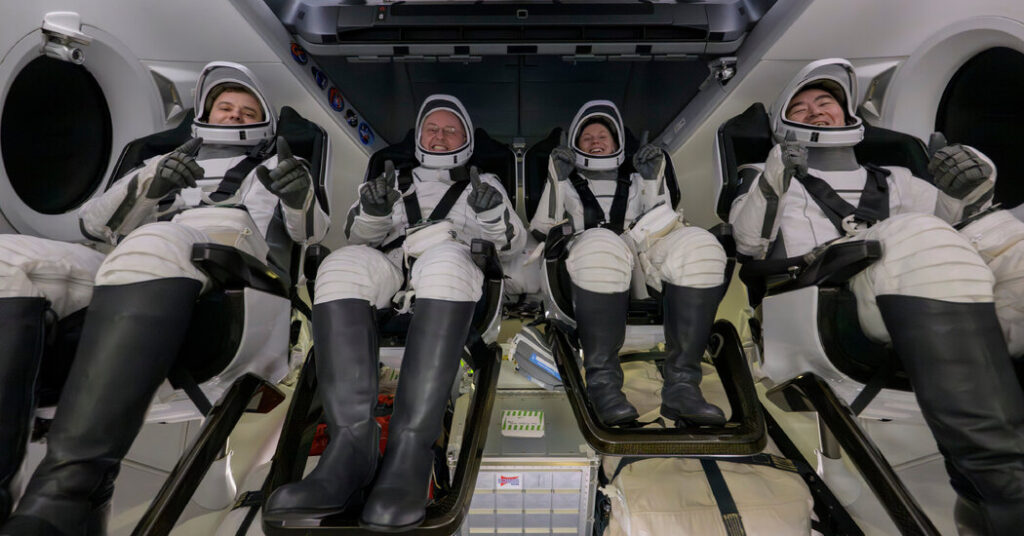
An astronaut who experienced a medical issue aboard the International Space Station is back on Earth and in good condition, NASA officials said early Thursday morning.
“The crew member of concern is doing fine,” Jared Isaacman, the NASA administrator, said during a news conference after the landing.
The four astronauts who splashed down in the Pacific Ocean on Thursday were Zena Cardman and Michael Fincke of NASA; Kimiya Yui of JAXA, the Japanese space agency; and Oleg Platonov of Roscosmos, the Russian space agency. NASA did not identify which astronaut was ill or the nature of the medical issue.
Their spacecraft, a SpaceX Crew Dragon, splashed down in the calm waters of the Pacific Ocean off San Diego at 3:41 a.m. Eastern time.
Curious dolphins swam around the capsule and the recovery ship. Within an hour, the astronauts had been helped out of the spacecraft for initial health checks.
“They’re safe,” Mr. Isaacman said. “They’re in good spirits.”
The four astronauts, part of a mission called Crew-11 that spent 167 days in space, had been scheduled to leave the I.S.S. next month after the next rotation of astronauts arrived. NASA officials said the affected astronaut was stable and had not required an immediate emergency return.
But because of limited medical equipment on the space station, NASA officials decided to conduct a “controlled medical evacuation” — following the standard departure procedures, but at an earlier date. This was the first time in the 25-year history of astronauts living on the International Space Station that someone had to return to Earth because of a health issue.
“We took this action, because it was a serious medical condition,” Mr. Isaacman said.
On Wednesday, the hatches between the Crew Dragon and the space station were closed at 3:29 p.m. Eastern time. The spacecraft undocked about 15 minutes later than planned, at 5:20 p.m.
A nine-and-a-half-hour wait in orbit followed as the spacecraft’s trajectory lined up with its landing site. A 13-minute thruster firing began the final fall back into Earth’s atmosphere, creating a light show witnessed by people up and down the California coast. Parachutes slowed the capsule, and it set down in the water without problem at 3:41 a.m. Eastern time.
Unlike most returns to Earth, all four crew members were taken to a nearby hospital so that the crew member with the medical issue can undergo additional tests. They are to stay overnight and head back to Houston on Friday.
Keeping the four together helps maintain the privacy of the affected astronaut.
Three other astronauts remain on the space station: Christopher Williams of NASA, and Sergey Kud-Sverchkov and Sergey Mikaev of Russia. They arrived there in November on a Russian Soyuz spacecraft and are scheduled to remain in orbit until the summer.
Mr. Williams is trained to maintain the NASA-led half of the space station, and the Russian astronauts can keep the Russian half operating. The week before departure helped with the transition.
“We spent some extra time this last week in training Chris Williams up on some things that he hadn’t been trained on,” Joel Montalbano, deputy associate administrator in NASA’s space operations mission directorate, said during the news conference.
The space station should be short-staffed for only a few weeks. Another Crew Dragon with four new astronauts is scheduled to launch in mid-February. The mission, Crew-12, is to spend nine months at the space station.
NASA officials have said they investigating whether that launch could take place sooner.
Mr. Isaacman and Mr. Montalbano said it was too early to know if the Crew-12 launch might conflict with preparations for NASA’s Artemis II mission, which will send four astronauts on a trip around the moon without landing. NASA is aiming to launch Artemis II in early February.
The incident could hold lessons for NASA in the future.
Some NASA astronauts are physicians by training. But there is not always a trained medical doctor aboard the International Space Station. Other astronauts preparing for a stay on the space station receive some basic medical training.
“You’re kind of trained as a paramedic,” Scott Kelly, a retired NASA astronaut who spent nearly a year on the space station in 2015 and 2016, said in an interview. “Not at the same level, but to be able to do many of the things a paramedic would do, like starting IVs, giving intravenous drugs, suturing.”
There is some basic medical equipment aboard, including a defibrillator, an electrocardiogram monitor, an intubation kit for putting a tube into the trachea to keep the airway open and an ultrasound machine. However, there is neither an X-ray nor an M.R.I. machine, both of which are too big and heavy to fit inside the space station.
The facility is also stocked with medicines that include aspirin, antibiotics, antipsychotics and opioids.
NASA doctors on the ground can readily talk with the astronauts and provide expertise for diagnosis and treatment. In this case, having a doctor in orbit would not have changed the outcome or NASA’s decisions, Mr. Isaacman said.
While this was the first medical evacuation from the space station, it was not the first serious health problem to arise in orbit.
In 2020, a paper published in The New England Journal of Medicine described how an astronaut at the space station developed a blood clot in the jugular vein. An expert at the University of North Carolina, Dr. Stephan Moll, helped devise a treatment plan that made use of blood thinners.
That astronaut was able to complete the usual six-month stay, NASA said. It did not identify the astronaut, or specify when the incident had occurred.
Handling medical issues will become more complicated for longer missions to the moon — and, eventually, Mars — when a quick return to Earth is not an option. The longer distances will also make real-time conversation inconvenient or impossible.
Dr. Farhan Asrar, a space medicine researcher at Toronto Metropolitan University in Canada, said that, for deep-space missions, it might make sense to include a trained medical doctor in the crew.
Such missions, he added, are a “new ballgame with a lot more complexities.”
Researchers are also working on medical technologies for astronauts.
The Translational Research Institute for Space Health, or TRISH, at the Baylor College of Medicine in Houston, is working on how to pull together information from different devices so that it can be easily analyzed by a doctor or perhaps an artificial intelligence agent.
“So that you can look at the astronaut as a whole,” Jimmy Wu, TRISH’s deputy director and chief engineer, said in an interview.
A proof-of-concept demonstration of the TRISH system flew to the space station, walking an astronaut through a diagnosis of a kidney stone.
“What we’re talking about here is a capability that would lead to more autonomous capabilities” independent of expertise on Earth, Mr. Wu said.
Even on the moon, a delay of seconds could be crucial during a medical emergency. “It would be really hard to guide someone remotely,” Mr. Wu said. “If you’re waiting 10 seconds for the response, that’s not going to be tenable.”
Kenneth Chang, a science reporter at The Times, covers NASA and the solar system, and research closer to Earth.
The post Astronauts Are Safe After NASA Medical Evacuation From Space Station appeared first on New York Times.