President Trump has become increasingly entangled in Latin American politics. Less than a year into his second term, he has seized the president of Venezuela, imposed sanctions on Cuba and Nicaragua and threatened Mexico with airstrikes and Colombia with a coup. He has imposed crushing tariffs on Brazilian exports, sent deportees to El Salvador’s infamous supermax prison, pressured Panama to limit China’s influence and meddled in the internal politics of Honduras and Guatemala.
Mr. Trump’s turn toward Latin America isn’t surprising, for often during times of global turbulence, like the moment we now find ourselves in, presidents seek safe harbor there. Latin America was where U.S. leaders have projected power beyond their borders not only with brute force, including all those coups Washington orchestrated, but with moral suasion as well.
For presidents of both parties, Latin America has served as a wellspring of perpetual reinvention and the source of much of their ideological creativity. This is especially true for what the political scientist Stephen Skowronek calls “reconstructive” presidents, leaders who work to build new political orders and restore political legitimacy after periods of acute crisis.
It’s tempting to see Mr. Trump as continuing this tradition. He, too, came to power during a period of overlapping domestic and global crises, and he is trying to use Latin America as a stage to project strength and shore up his political movement. But unlike his predecessors — who believed that power needed to be legitimated and anchored in universal norms — Mr. Trump acts as though power is its own justification, tempered, as he says, solely by his “own morality.” It’s as if he, or one of his advisers, had read Thucydides’ The Melian Dialogue, with the line “The strong do what they can, and the weak suffer what they must” but skipped what comes next: The strong are undone by their hubris.
The most notable example, by far, of a successful reconstructive president is Franklin D. Roosevelt, who came to power in the depths of the Great Depression and not only had to rebuild the nation but also, somehow, find a new moral framework to replace the cult of rugged individualism and Anglo-Saxon supremacy that, despite society’s near-total collapse, still held sway. Latin America helped him do so.
Roosevelt, inaugurated in 1933, had global aspirations. But with fascism and militarism on the rise in Europe and Asia, nations to the south of the United States offered the only place where he could test out his foreign policy ideas. For decades, Latin American statesmen had been demanding that Washington stop intervening in their affairs and recognize the absolute sovereignty of all nations, no matter their size or strength. Roosevelt did so, in spectacular fashion, with The New York Times declaring that “Our Era of ‘Imperialism’ Nears Its End.”
For the first time, Washington honestly seemed to be trying to tame America’s clamorous capitalists. When first Bolivia and then Mexico nationalized the holdings of Standard Oil, Roosevelt let them.
The phrase “good neighbor” is well known and shopworn, used by just about every administration since Roosevelt’s to describe friendly Western Hemisphere relations. But in the 1930s, the term meant much more, especially domestically.
Roosevelt’s supporters organized hundreds of chapters of the Good Neighbor League, which formed the backbone of the New Deal’s growing coalition — of Catholics, Protestants and Jews, of all races.
The anthropologist Ruth Tuck was a Good Neighbor Leaguer who exposed Klan attacks on Indigenous and Latino people in the borderlands. Speaking at League rallies, she linked the New Deal’s appeal to better treatment of migrant workers and more humane “relations with the southern half of this hemisphere.”
The Good Neighbor League brought Black voters from the Republican Party to the Democratic Party. The organization drew on popular politicians and liberal intellectuals, including Eleanor Roosevelt and Langston Hughes, who recognized the importance of Good Neighbor programs that welcomed people from all “Latin American cultures whatever their racial strains or complexions may be.” Reactionaries, including the right-wing radio priest Charles Coughlin, recognized it, too, and didn’t like how good-neighborism encapsulated a tolerant, antiracist, pro-union left-liberal humanism.
Roosevelt appreciated the phrase “good neighbor” so much, he wanted to copyright it. He framed the League’s work as a “spiritual awakening,” heralding a new way for citizens to think about their place in the world and the obligation of government to help them live a dignified life.
This broad hemispheric vision of social citizenship allowed Roosevelt to breathe new life into a moribund liberalism. And it gave him the moral authority he would need to rally the world’s free nations against fascism.
Ronald Reagan, another reconstructive president, took office in 1981, with the New Deal consensus in tatters, pulled apart by defeat in Vietnam and rising oil prices. Watergate and the economically dismal 1970s had spread cynicism among the citizenry, a distrust of U.S. military power and a loss of faith in the virtues of an activist government of the kind Roosevelt preached.
Reagan campaigned promising to restore faith not in the New Deal but in the redemptive power of markets and militarism — and in the promise of America. Like Roosevelt, Reagan didn’t have many places where he could rehearse his ideas and tactics. The United States had been driven out of Southeast Asia, the Middle East was too volatile, and superpower nuclear rivalry meant America had to tread tenderly in much of the rest of the world.
There was only Latin America, especially Central America, where left-wing revolutionaries had, in Nicaragua, overthrown a U.S. ally and were advancing in Guatemala and El Salvador. It was there, and more broadly in all of Latin America, where Reagan let the movement conservatives who carried him to power have free rein not just to defeat the left but also to resanctify U.S. power.
The Reagan administration allied with brutal men in Latin America, yet conservatives of various stripes rescued muscular anti-Communism from the muck of Vietnam and gave it wings.
Traditional conservatives used the wars in Central America to argue that the United States needed to regain its confidence. Neoconservatives insisted that the United States had to say not just what it was fighting against — Communism — but also what it was fighting for: democracy and human rights. And as Washington pushed to deregulate economies, conservative Christians argued that the free market was not, as radical priests in Latin America would have it, void of morality; it was the venue where God’s grace was made manifest and goodness rewarded.
Invigorated by engagement with Latin America, Reaganism supplanted the New Deal order with a new legitimating ideology, founded on a neoliberal conception of individual rights, electoral democracy and freedom. Until recently, it claimed broad support at home and abroad.
Here we are again: a nation turning away from the rest of the world toward Latin America.
Mr. Trump, too, has a story to tell about Latin America, and it isn’t pretty. He likes to play the role of the business cutthroat — a corporate pirate devoid of any ideology, save greed. “We are going to be taking out a tremendous amount of wealth out of the ground,” he said shortly after U.S. troops captured Venezuela’s Nicolás Maduro and his wife, Cilia Flores.
Such unadorned venality and disdain for diplomatic politesse cramp Trumpism, preventing it from forming the basis of a majoritarian coalition. Roosevelt and Reagan differed sharply in politics, yet both grasped how depicting Latin America as aligned with the United States could convert partisan alliances into durable governing majorities. Turning foreign policy into a mirror of national identity, they renovated Americanism as humane and universal.
Mr. Trump, in contrast, seems unconcerned with transforming dominance into hegemony or with broadening his base. He seeks only raw power in which the United States dominates the hemisphere because it can dominate the hemisphere — where it kills speedboat captains because it can kill speedboat captains. He is using the region to send a message to the nations of the world: Don’t “cross us,” as JD Vance recently said, referring to the Venezuela strike.
The reduction of Latin America to a sphere of coercion, extraction and threat reflects in an ugly way in domestic politics. The same rule by domination Mr. Trump showcases abroad is little different from what is being applied at home. Polarization is deepening, cities are under assault by federal forces, and the degrading, at times lethal treatment of citizens and noncitizens alike by government agents is now routine.
Whereas Roosevelt held up the Western Hemisphere as a model of international cooperation for the world to emulate, the Trump administration uses Latin America as target practice. Whereas Reagan’s sunny capitalist Pan-Americanism silenced anti-migrant extremists in his coalition, Mr. Trump’s tribalism stokes them, with a growing number of young self-identified conservatives openly embracing white supremacy, antisemitism and Nazism.
Mr. Trump’s hemispheric turn leads not out of the crisis but deeper into it.
Greg Grandin is a professor of history at Yale and the author, most recently, of “America, América.”
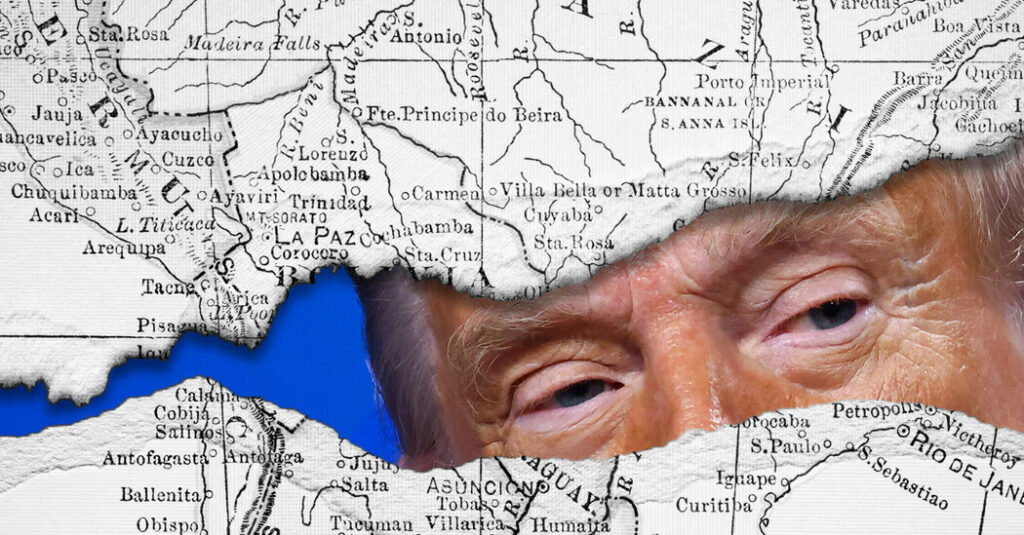
Illustration by The New York Times; source imagery by Getty Images.
The Times is committed to publishing a diversity of letters to the editor. We’d like to hear what you think about this or any of our articles. Here are some tips. And here’s our email: [email protected].
Follow the New York Times Opinion section on Facebook, Instagram, TikTok, Bluesky, WhatsApp and Threads.
The post The One Place Presidents Turn in Moments of Chaos and Uncertainty appeared first on New York Times.