When Brian Stonehouse was 24, he parachuted into France as part of a British military unit that was set up to work with the French Resistance. Using the code name Celestin, he worked as a wireless operator relaying messages to London.
He posed as an artist, and indeed had been educated as one before his induction into the British army. Now, though, his artist’s paint box concealed a clandestine radio transmitter and a cyanide tablet he could swallow if captured.
But only a few months into his mission, the Nazis tracked Stonehouse down and sent him to a series of concentration camps. In April 1945, he was in Dachau, where an estimated 40,000 prisoners had died, when the camp was liberated by American forces.
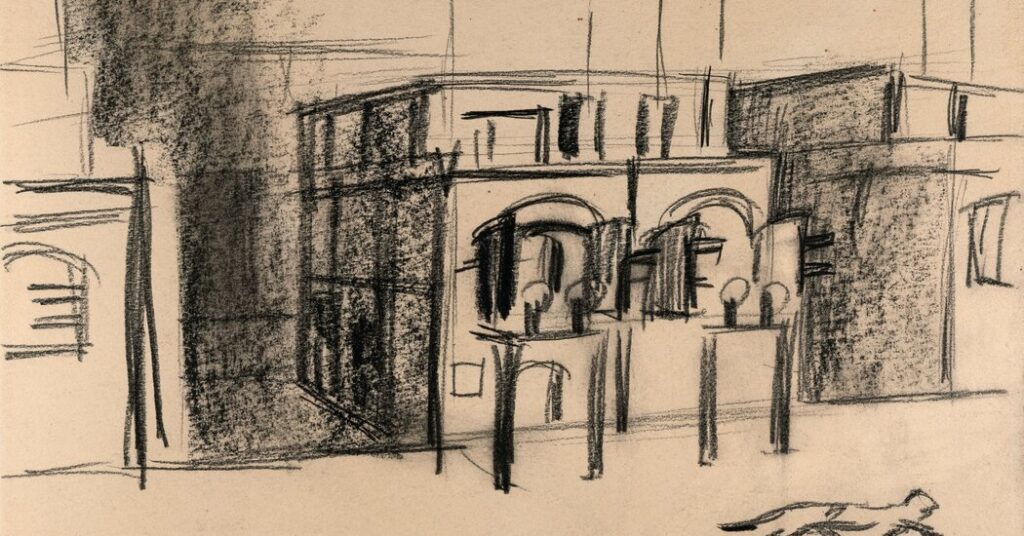
The next day, Stonehouse, using charcoal on paper, sat down and sketched the horrors he had witnessed, including the mortuary, the crematory and the gas chambers.
Four of Stonehouse’s images depicting the machinery of death and its victims will be exhibited and offered for sale this month by Abbott and Holder, a London gallery, at an art fair on the Upper East Side, Master Drawings New York.
Kyra Schuster, lead acquisitions curator at the United States Holocaust Memorial Museum, said that, while many G.I.’s and war correspondents like Lee Miller and David E. Scherman photographed the atrocities at Dachau, drawings by survivors are rare.
“You can’t not be moved by these images,” she said of Stonehouse’s drawings. “They’re very similar to the immediate post-liberation photography from Dachau, and I can certainly recognize Dachau in these images, but they’re from a slightly different perspective.”
The museum has a large collection of artworks made by Nazi camp and ghetto inmates, from a sketch of deportation trains made by a 4-year-old boy, to images by career artists. “People are often surprised that artists were able to make pictures in the camps,” Schuster added, but some managed to do so, even though materials were scarce.
“They could be on scraps of paper or materials they were able to smuggle in,” Schuster said. “It never ceases to amaze me when I see it because they were not only able to do it, but to keep their art hidden. It’s always incredible to hear a story about an artist who was able to save a work of art as well — often at great risk to themselves.”
Leo Haas and Peter Kien are often associated with drawings and paintings of Theresienstadt, a Nazi ghetto-labor camp where inmates had more access to art supplies in a graphics workshop. The French graphic designer Paul Goyard produced around 300 drawings of everyday life at Buchenwald concentration camp, during his imprisonment there, which are now in the Arolsen Archives in Germany.
The Polish artist Halina Olomucki managed to draw portraits of her fellow prisoners while in the Warsaw Ghetto and Auschwitz-Birkenau. A 22-page sketchbook created by an unknown artist and depicting extermination of Jews was also discovered stuffed into a bottle at Auschwitz in 1947; it is now in the collection of the memorial site and museum.
Stonehouse had been born in Devon, in southwest England, and spent his childhood in France. He was fluent in French, a skill that he could use in occupied France. After completing his education at the Ipswich School of Art, he was drafted into the British Royal Artillery.
After arriving in France, he found a chateau in the outskirts of Lyon from which to transmit encoded messages, but one night he was transmitting for so long that he told his superiors in London that he was, in effect, “committing suicide,” he said in an interview released in 1987.
The Gestapo located him and jailed him in Paris, where one S.S. man told him he would soon be shot. He was later transferred to Mauthausen in Austria, the first of five concentration camps in which he was incarcerated.
“Drawing was a pretty important part of his whole survival,” said Tom Edwards, owner and managing director of the Abbott and Holder gallery. “Because he had four months of interrogation, a long, long period of solitary confinement in Paris before he was moved to the death camps. It was very much a functional thing that helped him stay sane and stay alive.”
In a documentary made for a British television in the 1980s, Stonehouse recalled how he could barter his sketches in the camps, exchanging portraits for cigarettes, the camp currency, which he could use to buy extra food or other supplies. “That’s how I survived,” he said.
He ended up in Dachau, which housed prisoners of war, Jews, Roma and Sinti, and others in an abandoned munitions factory, about 10 miles northwest of Munich. When U.S. forces liberated the camp on April 29, 1945, they found emaciated prisoners and more than 30 railroad cars filled with decomposing bodies.
“I visited and made sketches of piles of corpses at the Krematorium,” Stonehouse wrote in his diary that night. “Not much time to sketch, as the place had been mined by the SS before they left, and the building was expected to blow up at any minute. The stench was almost unbearable, and a high percentage of the Americans who looked around the Krematorium had to vomit.”
A year after the war ended, Stonehouse was back in Germany as part of the Allied occupying forces. His job was to interrogate former Nazis to weed out war criminals who had escaped justice. One day he encountered a man who looked familiar. He recognized the German as the Gestapo figure who had told him in 1942 that he’d be shot.
“Word got around the camp like wildfire, some other interrogators, Americans, came to me and said, ‘We’ll give you a machine gun, we’ll close up the camp and you can do anything you want to with him,’” Stonehouse recalled in the documentary. “I was horrified. I said, ‘I can’t do that. I wouldn’t dream of it. If I did that, I would be no better than they are.’”
After the war, Stonehouse became a fashion illustrator, working for American Vogue. When the magazine switched to using mostly photography in the early 1960s, he became a freelance illustrator for department stores such as Saks Fifth Avenue and Lord & Taylor, and luxury brands like Elizabeth Arden.
Edwards first became aware of Stonehouse through his fashion illustrations. In 2014, his gallery acquired a large collection of his fashion drawings from his estate. Some were sold to a collector who donated them to the Boston Museum of Fine Arts.
Among them was a single charcoal drawing of Dachau that came from the series of five he’d made after liberation. It tipped Edwards off to the dramatic war experiences Stonehouse had endured. Last year, a man contacted Edwards, to say he had the four charcoal drawings, which he had bought from Stonehouse in the 1980s. The four drawings are being offered for $100,000 at the fair, which opens Jan. 30. Edwards said he hopes they will end up in a public collection.
Stonehouse died in London on Dec. 2, 1998, at the age of 80. Before he sold them, the Dachau drawings had been hanging in his studio.
“He was careful enough to take them to the States and get them framed,” Edwards said. “He didn’t just preserve them; he lived with them, and then he brought them back to the UK in the 1970s when he moved back. They were clearly an important part of how he remembered the war, or perhaps a cathartic element that helped him get through.”
The post He Survived Dachau. He Captured Its Horrors on Paper the Next Day. appeared first on New York Times.