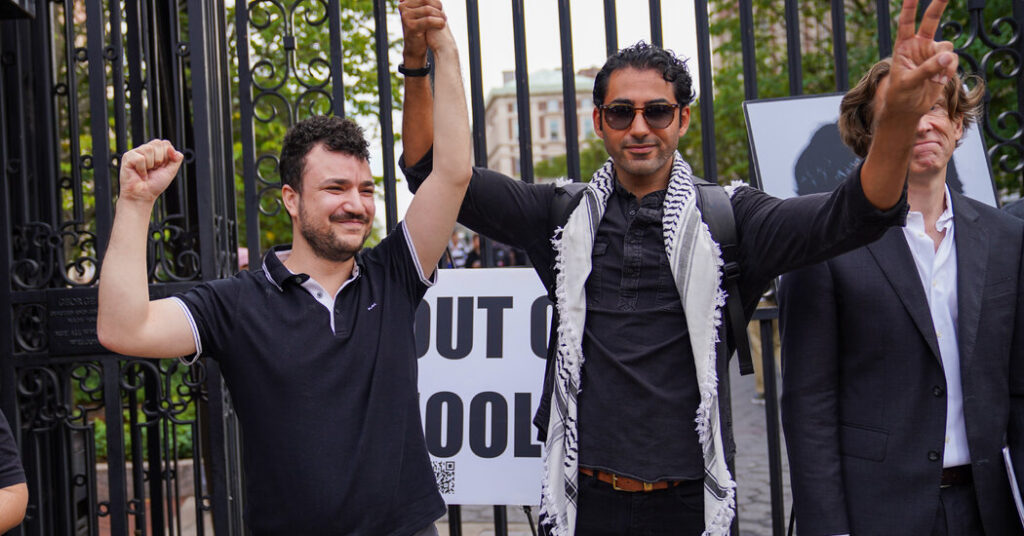
A federal judge in Boston last September issued a landmark ruling that the Trump administration deliberately chilled the speech of international students with a string of targeted arrests intended to “strike fear” in demonstrators and academics critical of Israel’s conduct in Gaza.
Now Judge William G. Young will decide what should be done about that violation.
Last year, he did not order the Trump administration to correct course right away, but asked the government and the academic organizations who sued to return to argue over how he could intervene.
In his ruling, Judge Young, who is 85 and has served as a federal judge for over 40 years, described the case as “perhaps the most important” of his career. Academic organizations that sued argued that the attempted deportations of a few prominent student activists — and broader threats by President Trump and Secretary of State Marco Rubio — had a silencing effect across academia and chilled speech about the war in Gaza and other contentious issues.
During a two-week trial, lawyers for the groups examined the cases of five prominent student activists: Mahmoud Khalil, Rumeysa Ozturk, Mohsen Mahdawi, Badar Khan Suri and Yunseo Chung. Though the students were in the United States legally, the administration accused them of undermining U.S. foreign policy interests through their activism.
In some cases, they were held for months, and federal officials attempted to deport them. The students successfully challenged their deportations in separate, individual lawsuits, and those who were detained were eventually ordered released.
The central question before Judge Young last year was whether Mr. Trump’s policies had suppressed academic speech on campus more broadly. In an extraordinary 161-page opinion, Judge Young found that they had. He upbraided the Trump administration and the president himself for cultivating what he cast as a climate of fear and repression, concluding that noncitizens had an equal First Amendment right to free speech.
Legal scholars said that deciding on a remedy was likely to be a harder task for Judge Young than excoriating the administration.
Michael Kagan, a law professor and the director of the University of Nevada, Las Vegas Immigration Clinic, said that Judge Young could focus on stopping the implementation of the executive orders and Department of Homeland Security policies that had authorized the wave of student arrests last spring.
But he said it would be challenging for Judge Young to craft a remedy that would predict and pre-empt other ways the administration may try to pursue noncitizen academics.
“This is all pretty dicey territory for the court to navigate in terms of solving the problem,” he said.
The groups behind the lawsuit have argued for broad relief that would prohibit the administration from pursuing any part of what they describe as an “enforcement policy” of revoking green cards and student visas based on anti-Israel or pro-Palestinian speech.
“The government’s unconstitutional actions have made many noncitizen students and faculty fearful of speaking out on issues that are important to them,” said Ramya Krishnan, a senior staff attorney at the Knight First Amendment Institute, which helped represent the academic organizations. “We want the court to grant relief that addresses that fear — starting with an order that expressly prohibits the government from pursuing its policy of deporting people based on constitutionally protected speech.”
But some legal scholars speculated that following his blunt ruling, Judge Young could opt for a narrower solution, to avoid overstepping in ways that could be questioned on appeal.
“One thing I could imagine is that the judge, having made that rather substantial departure from the norm, would get cautious at the remedy stage, and not purport to tell the government in too stark or precise terms what to do,” said Gregory P. Magarian, a law professor at Washington University in St. Louis.
Mr. Magarian said that Judge Young may want to avoid taking steps that would endanger his underlying landmark ruling on the First Amendment rights of noncitizens, which by itself was a major breakthrough for groups promoting freedom of speech on campus.
The administration has argued throughout the case that the court lacks the authority to interfere in the Trump administration’s foreign policy priorities, or curtail the “investigative and enforcement” power of agencies it tasked with reviewing the conduct of noncitizens and visa holders.
In filings, it has argued that threatening language from Mr. Rubio and other cabinet officials about investigating critics of Israel was also protected speech the court should not police.
Judge Young on Thursday will also consider requests from a variety of news organizations, including The New York Times, that he agree to unseal some evidence presented during the trial last year. The documents appeared to include details about how top officials justified arresting students and attempting to strip them of their visas or legal status.
During the trial, witnesses for the government described parts of the process through which the State Department and the Department of Homeland Security identified student leaders to target. They testified that they had relied in part on lists published by an anonymously run site that shared the personal details of academics it deemed hostile to Israel.
But other evidence Judge Young relied on to reach his decision, including memos and dossiers passed between the agencies authorizing the arrests of the five students, have remained sealed.
Judge Young provisionally agreed to keep certain documents private at the government’s request during the trial last year, citing caution over revealing confidential details about immigration enforcement. But he referred to many of them in his opinion.
Zach Montague is a Times reporter covering the federal courts, including the legal disputes over the Trump administration’s agenda.
The post Judge to Weigh Next Steps in Student Activist Deportations Case appeared first on New York Times.