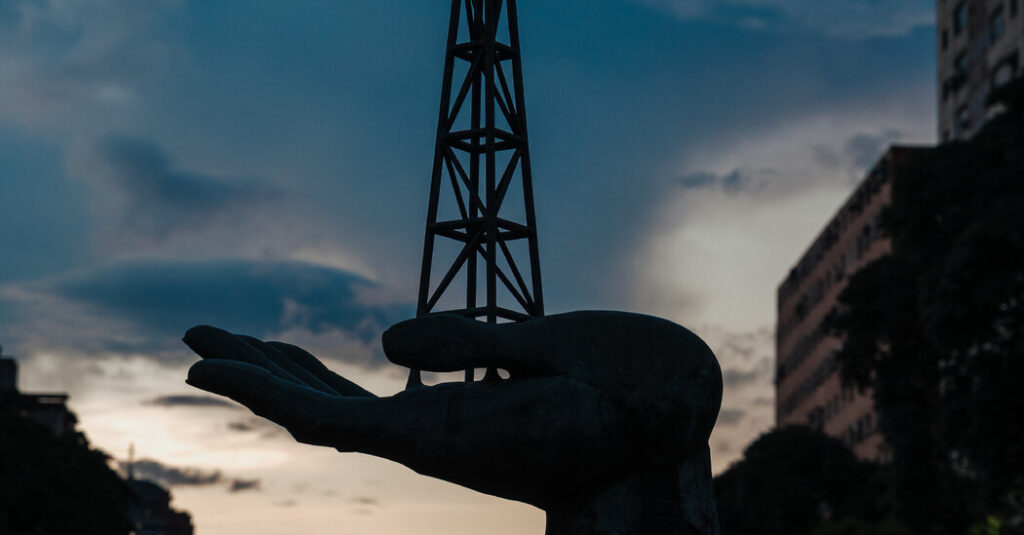
Venezuela appeared to be entering a capitalist golden age in the mid-1990s. The country was opening up its nationalized energy industry, attracting foreign capital and business know-how. “You couldn’t find an apartment in Caracas,” said Ali Moshiri, who worked for Chevron at the time and was frequently in the country to monitor its operations. “It was a gold rush.”
But in 1998, the price of oil plunged, blowing a hole in the government’s budget. The country’s leaders slashed spending, laying the groundwork for a political backlash and the election of the left-wing populist Hugo Chávez.
After the audacious U.S. capture of Mr. Chávez’s successor, the dictator Nicolás Maduro, early this month, President Trump painted a rosy economic picture for Venezuela. He promised that tens of billions of dollars of American capital would pour into the country, making Venezuela “very successful,” and said the U.S. intervention was “already making Venezuela rich and safe again.”
But the country’s history shows that foreign capital alone is far from a guarantee of success or stability. Venezuela’s economy has tended to function best when that investment is accompanied by high oil prices — something Mr. Trump has little control over — along with a government that is responsive to popular frustrations over corruption and inequality, issues that appear to be far down Mr. Trump’s priority list.
Simply rebuilding the oil industry without deeper political and economic change is unlikely to transform Venezuela into a country where affluence is widely shared, experts say. Most countries that depend on a natural resource like oil are vulnerable to booms and busts, and it is rare that they gain entry into the club of fully developed economies. But Venezuela has challenges even by those standards
“It’s a regime which is run mostly by ideology and a great deal of corruption,” said Jeffrey Davidow, who served as the U.S. ambassador to the country in the mid-1990s. “This ain’t Norway building up a great sovereign wealth fund for distribution.”
Nationalization is often greeted with horror by businesspeople and economists, but when the oil industry nationalization happened in the mid-1970s, it accompanied what Venezuelans often describe as an economic “bonanza.” With the price of oil soaring amid the embargo and supply shocks of the period, the Venezuelan economy regularly boasted one of the highest growth rates in Latin America.
“The currency was very strong, and as a result of that, imports were cheap,” said Néstor Carbonell, a PepsiCo executive at the time.
That was good for American companies like Pepsi. Mr. Carbonell recalled living with his family in a beautiful three-story villa with a lush garden on a cul-de-sac in Caracas. “Most businesses were very prosperous,” he added.
So prosperous, in fact, that Venezuelans credited the president who nationalized the oil industry, Carlos Andrés Pérez, with helping to transform their country into “Saudi Venezuela.”
But all that oil money bloated the state bureaucracy. Corruption flourished, and key sectors of the economy deteriorated. As the government became increasingly dependent on oil revenue, it grew more vulnerable to oil price fluctuations.
Not long after Mr. Pérez left office in 1979, the price of oil began to drop, and brutal recessions followed. Recalling the bonanza days, Venezuelans returned Mr. Pérez to the presidency a decade later, despite the stench of corruption that had long trailed him.
This time, Mr. Pérez shed his populist ways and hired a cabinet full of technocrats. They dialed back price subsidies and sold off state enterprises, as economists had long recommended. They also opened up the oil industry to foreign investment — much the same medicine that Mr. Trump is prescribing today. The business environment improved, attracting people like Mr. Moshiri of Chevron.
“Latin America is perceived to be booming,” said Bill Mullenix, who oversaw Pepsi’s Venezuela operations between 1996 and 2000, referring to the outlook at the time. “People are talking about how we’re going to have a Major League Baseball team in Caracas.”
Reassured by what they perceived as the government’s improving economic management, many businesses outside the oil industry also began to invest. Pepsi spent well over $100 million building a new plant and distribution network, Mr. Mullenix said.
More and more affluent foreigners arrived, holding forth at glamorous restaurants and hotels, like the Tamanaco InterContinental. “It was like the Fontainebleau in Miami Beach,” said Luis Montoya, a longtime Pepsi board member in Venezuela. “The Tamanaco, that was, in the 1990s, the place to stay.”
But the improving business climate masked a simmering frustration that periodically boiled over. Riots followed when the government removed subsidies for gas, and there were even attempts by Mr. Chávez and his supporters to overthrow the government by force.
The government appeared to be more preoccupied with courting foreign investors than defusing domestic unrest. “The cost of living was very high, and there was no social safety net, no social programs,” said José Guerra, an economist who worked at the country’s central bank at the time. “It was a mess.”
When the price of oil collapsed in 1998 and the government cut spending, it was like a spark that ignited the country’s political system. Venezuelans tended to believe that their country was rich, and that if they weren’t benefiting, it must be because the political elite were stealing from them, said David Smilde, a Venezuela expert at Tulane University who lived in the country in the 1990s. Mr. Chávez campaigned to claw back Venezuela’s oil wealth for the people of Venezuela and won the 1998 presidential election handily.
At least initially, Mr. Chávez’s brand of left-wing populism seemed to work for the economy. Though his presidency was riddled with corruption and inefficiency, the government did distribute the country’s oil revenue far more widely than before. Crucially, the price of oil was rising, and there was far more wealth to go around.
“You actually start to feel a little bit of momentum,” said Mr. Mullenix, the former Pepsi executive. “From our perspective, there is money on the street.”
His colleague Mr. Montoya recalled that Pepsi’s sales volumes under Mr. Chávez in the mid-2000s were around the highest they had ever been in Venezuela, and far higher than any time since. A gleaming Four Seasons hotel opened in Caracas in the early 2000s and seemed to signal another boom.
Then the oil curse came for Mr. Chávez as well. By the end of the decade, his economic miracle was undone by falling oil prices and dysfunctional policies. He had replaced technocrats at the state oil company with loyalists and leaned into his disdain for liberal democracy. He had consolidated power by rewriting the country’s Constitution and unilaterally enacting laws, and nationalized foreign oil assets.
But even critics acknowledged that Mr. Chávez had the right idea in at least one respect: the impulse to distribute Venezuela’s oil wealth more broadly.
“I think that in this matter Chávez was right,” said Mr. Guerra, who later represented an opposition party in the National Assembly. “People didn’t see that the oil boom benefited the working class and poor people.”
As Mr. Trump vows to help revive the Venezuelan economy, the country has experienced more than a decade of wide-scale corruption and extraordinary hardship for the large majority of its population.
The price of oil is not helping. It sits around $60 a barrel, far below where it stood for much of Mr. Chávez’s tenure, and Mr. Trump has indicated that he wants to drive the price lower.
Secretary of State Marco Rubio has said the United States will control future oil revenue to ensure it benefits the Venezuelan people, and some experts say there is reason to believe it would flow into the national budget and fund the schools and hospitals that the Chávez government erected but let deteriorate.
Others are more skeptical. They say pumping more oil under the current government would primarily benefit the elite, sustaining corruption and doing little to lift up the poor and working class.
The action Mr. Trump took is to be saluted, said Mr. Carbonell, who later became PepsiCo’s vice president of global government affairs and an author and commentator on Latin American politics, but “not the ultimate solution.”
That would require cultivating a truly democratic government that sought to attend to its citizens’ needs. If the current leadership remains in place, Mr. Carbonell added, “building up the economy will benefit more of those who are in power than those who are part of the population.”
Noam Scheiber is a Times reporter covering white-collar workers, focusing on issues such as pay, artificial intelligence, downward mobility and discrimination. He has been a journalist for more than two decades.
The post Trump Vows to Make Venezuela Rich. It Will Take More Than U.S. Cash. appeared first on New York Times.