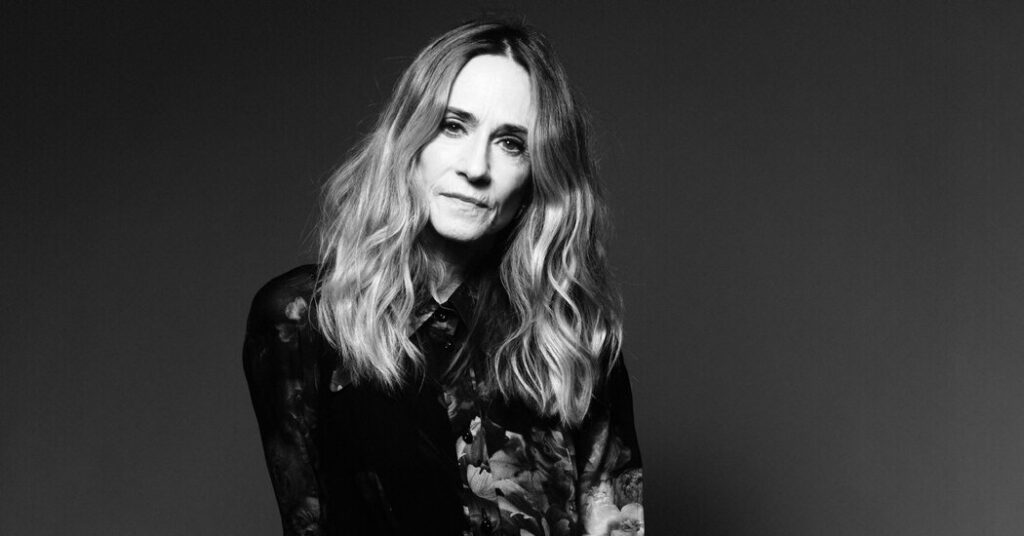
Recently, the actress Holly Hunter traded strange new worlds for a more familiar one, flying home to New York City and sliding into a corner banquette at a Midtown hotel. Hunter, who has won one Oscar and two Emmys, has built a career of unusual brilliance and variety. She considers this the luck of the draw, rather than any deliberate construction.
“That’s the fun thing about being an actor, it’s like playing the lottery,” she said. Her job, as she sees it, is “to show up and do the most you can and surrender.”
A couple years ago her number came up in a faraway place. In the new Star Trek series “Star Trek: Starfleet Academy,” which premieres on Paramount+ on Thursday, she boldly goes where few women have gone before, playing Nahla Ake, an exceptionally long-lived captain and the chancellor of the fleet’s academy.
The role — the lead in the franchise’s 12th television space opera — isn’t an obvious choice for Hunter, who has rarely suited up for science fiction. Then again, what is? Try to connect the dots between, for example, Ed, the baby-hungry ex-cop of “Raising Arizona”; Jane, the driven producer of “Broadcast News”; GJ, an enigmatic guru in “Top of the Lake”; Rhea, a manipulative executive in “Succession”; Elastigirl, the stretchy superheroine of “The Incredibles” and its sequel; and Ada, the mute pianist of “The Piano”.
Her Oscar is for “The Piano,” an exquisitely calibrated romance. Her second Emmy is for the wackadoo television movie “The Positively True Adventures of the Alleged Texas Cheerleader-Murdering Mom.” (The first is for another TV movie, the 1989 docudrama “Roe vs. Wade.”) Little unites them except for Hunter, who packs outsize force and certainty into each performance.
“Passion, toughness, talent, purpose, she has all that,” James L. Brooks, who directed her in “Broadcast News,” said.
In person, Hunter, 67, a lithe woman who stands just over five feet (“I like not to be noticed, my size has always worked to my advantage,” she said), displayed that same intensity. But she combines that zeal with a practiced reserve and a principle of never discussing her personal life. (A question about whether being a mother — at 47, she gave birth to twins — changed her approach to maternal characters went, predictably, nowhere.)
“There’s so much that I share as an actor,” she said. “The rest belongs to me.”
She also has a way of not so much avoiding questions as answering them associatively until she lands on a topic she prefers. A question about her character sidestepped into a discussion of femininity. Another about intensity led her to talk of female directors. Another about types of leadership swerved to the New York City subways, an ideal location for observing human behavior.
Hunter has never swerved in her devotion to acting. She grew up the youngest of seven children, on a cattle and hay farm in rural Georgia, which is about as far from Hollywood as an American girl can get. But she appeared in a play in the fifth grade and that was that. She says she remembers looking out at the audience and thinking, “Oh wow, we’re connected, almost viscerally.” Acting is the only thing she has ever wanted to do. “It was total love, just love,” she said. “It was easy.”
Alex Kurtzman, a co-showrunner of “Starfleet Academy,” considers himself a Hunter superfan. As a student writer, he would go into movie theaters to record screen dialogue in movies like “Broadcast News,” and then walk around playing back Hunter’s voice in his ears. “To say that Holly’s work has been a huge influence on me, would be the biggest understatement,” he said in a recent phone interview.
When he began writing the character of Nahla, he imagined Hunter, her face, her voice. He knew that he wanted a different kind of captain, one who led with empathy, who wore her authority firmly but lightly. And he wanted an actor who could sell the comedy and the quirks of life in the 32nd century. That meant Hunter. “Holly is literally incapable of not maintaining emotional reality,” he said.
They met on a video call. Hunter, who hadn’t had a significant role since the short-lived comedy series “Mr. Mayor” (2021-22), was immediately interested. She didn’t know the genre especially well, but the scripts seemed to her well written and the characters rich. While she does not usually enjoy stories that have a message, she felt drawn, she said, to the essential optimism of the Star Trek universe “because of the uncertainty of everything at this moment.”
And while actresses do not typically love aging up for a role, the idea of playing a character who had lived upward of 400 years had its appeal. “What would the possibilities be for life when you’ve seen people born and die and born and die and over and over?” she asked herself.
The character, as written and as played, doesn’t conduct herself like a usual starship captain. She is inclined to flowy robes and goes barefoot whenever possible. She doesn’t so much sit in a chair as drape herself across it. She pounds the table. She makes faces. She chides a group of cadets by yelling, “Grooowth!” and telling them to make their beds. She is a goofball and a sage, and she makes empathy a continuous practice.
“To put a woman at the helm of such power, it rides on the rails of a different sensibility — the empathy and the listening and the patience and the softness,” she said. “And that feels inherently female.”
The actor Paul Giamatti, who appears opposite Hunter in the show, described her in a recent video call as an emotional and intuitive actor. He used the words “intense” and “animal.” But she was also incredibly precise, he said. She held herself to high standards and expected that everyone else would too. Giamatti, who is also comparatively new to science fiction, thought that she was a natural fit for Star Trek.
“Something about the decency that she conveys, even if she’s playing hard-ass, there’s a goodness underneath whatever she’s doing that’s right for Star Trek,” he said.
For Hunter, acting has always been about connection, and she feels that Star Trek shares that same concern. “The whole legacy of 60 years of Star Trek is to make a connection within the Federation and outside of the Federation and within your own community,” she said.
She is currently shooting a second season, and after that, she doesn’t know what will come next. She’ll go where the work takes her, in this galaxy or others. That has always been a gamble. As an actor, she is joyously idiosyncratic, and it makes a kind of sense that the rhythms of her career have that same unpredictability.
“I do like the strange lack of security,” she said. “It’s a wild thing to like, but I do. It’s got its own mystery to me.”
Alexis Soloski has written for The Times since 2006. As a culture reporter, she covers television, theater, movies, podcasts and new media.
The post Holly Hunter Reaches for the Stars appeared first on New York Times.