They lived in a comfortable, spacious apartment in a fashionable neighborhood of Kyiv, what they called “our little fortress” through years of war. Even after it was damaged in a missile strike, they stayed put in the Ukrainian capital, renting another apartment.
But this week, Russian drone and missile strikes left Kyiv in the grip of its worst heating and electricity outage of the war. The couple, Yulia Mykhailiuk, a lawyer, and Ihor Honcharuk, a TV station manager, could see their breath indoors as temperatures outside peaked around 12 degrees Fahrenheit. Mr. Honcharuk jury-rigged a heater by placing a brick over a gas burner on the stove, to little avail. They had had enough.
They bundled their 1-year-old son in a car and abandoned Kyiv for a relative’s home in a village.
“I don’t want to say this is uncomfortable,” Ms. Mykhailiuk said before leaving town. Her son, Markiian, was swaddled in a ball of fleeces and vests, his arms jutting out awkwardly. “This is much more than uncomfortable.”
Just as Kyiv has entered a deep winter freeze, Russia has intensified a campaign to knock out the city’s heating and electrical infrastructure. The attacks are intended to dent the population’s morale and pressure the government to make concessions in peace talks brokered by the Trump administration.
This is not the first time that Kyiv, a city of three million, has endured power cuts as Russia has tried and failed to freeze Ukraine’s largest city. This year, though, Russian missile and drone attacks are having a serious impact. Power has been out for days on end. About 500 apartment buildings have no heat at all, city authorities said, the most dramatic breakdown so far in the war.
While most of the fighting has raged at a distance from Kyiv, in the country’s east, the capital is still a symbolic prize.
It is out of reach of Russian ground forces but within range of exploding drones and missiles. Russia’s goal is to render it uninhabitable. While Kyiv has carried on remarkably well through the years of war, it is most vulnerable when the weather turns cold.
In the first winter after the all-out invasion in February 2022, Moscow tried to bring down the nationwide grid. That proved too ambitious, as Ukraine coped by rerouting electricity around damaged equipment. Other strategies have included targeting transformer stations serving nuclear plants, major sources of power for Ukraine.
This year, Russia narrowed its focus to three cities — Kyiv, Odesa and Dnipro — said Oleksandr Kharchenko, director of the Energy Industry Research Center, a consulting company. Russia’s aim seems to be to isolate these cities from the national network and then blow up their power plants. Volleys are repeated about every two weeks, timed to disrupt repairs.
“They try to hit areas where maintenance is in progress,” he said. “We have a lot of wounded and killed energy workers.”
Last Friday, Russia hit transformer substations in and around Kyiv. Those strikes cut the capital from power elsewhere in the country. Russia also hit all three natural gas and coal-burning power plants in Kyiv, shutting down the city’s internal sources of heat and electricity.
Lights in the city blinked out. Kyiv became an icy tableau of trees coated in hoarfrost and snowbanks glistening in the winter sun.
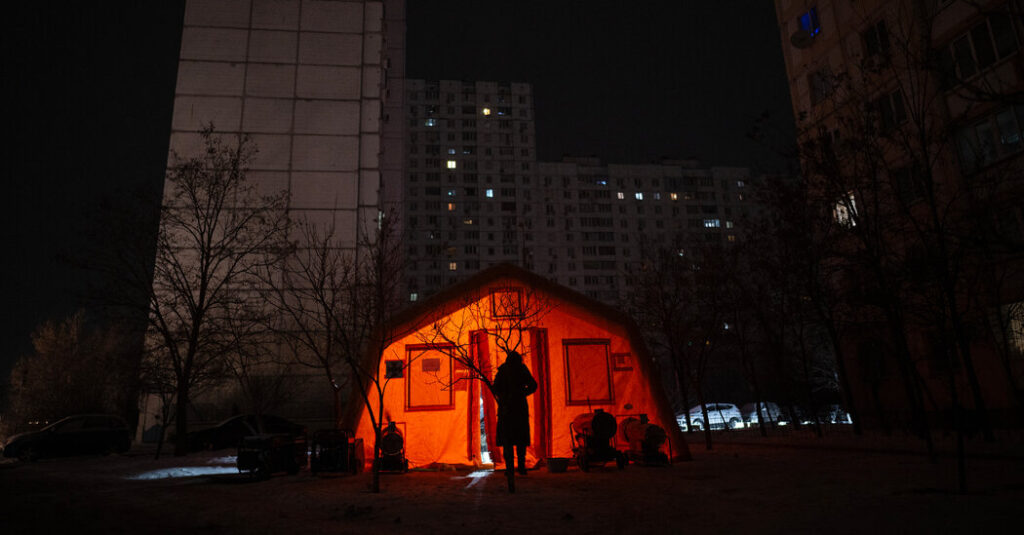
On Tuesday, the city, which typically consumes about 2,000 megawatts of electricity, was surviving on less than a tenth of that, Mr. Kharchenko said. The authorities routed what power there was to water pumps, the subway and other critical infrastructure. Most residential buildings were cut off.
As temperatures plunged, the heating, too, went out for many of Kyiv’s residents. The city’s power plants produce both electricity and hot water through a district heating system. The authorities rerouted hot water from a network of gas-powered boilers to compensate. They provide far less heat.
“We are fighting to survive,” Vitali Klitschko, Kyiv’s mayor and a former heavyweight boxing champion, said in an interview on Tuesday during a visit to a retirement home now heated by an emergency boiler. Russia, he said, “is trying to destroy the mood of the population.”
“Putin doesn’t need us as a population,” Mr. Klitschko said of President Vladimir V. Putin’s attempt to conquer the country. “He needs property. He needs Ukraine.”
The city’s air defense shield is running low on ammunition, he said, particularly American-made Patriot interceptors. He appealed to Ukraine’s Western allies to increase supplies.
“It’s a question of the lives of the civilian population,” he said. “Please help us.”
Repeated strikes are complicating repairs, Mr. Klitschko said. Some infrastructure that Russia hit in Friday’s barrage was hit again on Monday night, he said.
Mr. Klitschko has asked residents to temporarily move in with relatives in other towns if they can, in case conditions in the capital unravel. But he is not calling for a sweeping evacuation.
Russia’s strikes have stirred political infighting, reviving concerns that Ukrainians might turn on one another amid the hardship. President Volodymyr Zelensky said that Mr. Klitschko’s office had “done very little” to prepare for the Russian attacks. Mr. Klitschko said that city workers had done all they could, and that politics should wait. The two are longtime rivals.
One recent day in a Kyiv neighborhood, the sun glistened off shards of glass like thousands of tiny mirrors as residents swept up and nailed tarpaulins over broken windows. A Russian drone had apparently missed its target and hit a housing block.
Volodymyr Dorodko, 23, a lawyer, had slept the night before in his down parka. After the overnight explosion nearby, he was out looking at the debris, including wispy flakes of black carbon fiber composite from the drone’s wings.
This is now a daily scene in Kyiv.
“A lot of people are tired,” Mr. Dorodko said. The hardships, he added, are pushing some Ukrainians to argue that the war should be ended even at a steep cost like territorial concessions.
“The mothers of sons in the army are saying it directly: Let’s give them the Donbas, so people don’t die and we aren’t bombed,” Mr. Dorodko said.
He said he opposed handing over that eastern Ukrainian region, as Russia has demanded, because, he said, it would only whet the Kremlin’s appetite for more.
Ukrainians, Mr. Dorodko said, have little choice but to hang on. He said he saw one upside of losing heat in addition to electricity. His groceries don’t spoil when the refrigerator loses power. He simply puts them on a cold windowsill.
Ms. Mykhailiuk and Mr. Honcharuk, the couple with the toddler son,
kept trying to have a normal life throughout the war. Then came this winter. The apartment was unbearably cold. Ms. Mykhailiuk put on a sweater. She sheathed the baby’s feet in a second pair of socks.
“People think if a peace deal is near, the situation might be better,” Ms. Mykhailiuk said. “But that is not true. It’s not better. It’s getting worse.”
Evelina Riabenko contributed reporting.
Andrew E. Kramer is the Kyiv bureau chief for The Times, who has been covering the war in Ukraine since 2014.
The post Kyiv’s Cruelest Winter: Russia Knocks Out the Heat in the Bitter Cold appeared first on New York Times.