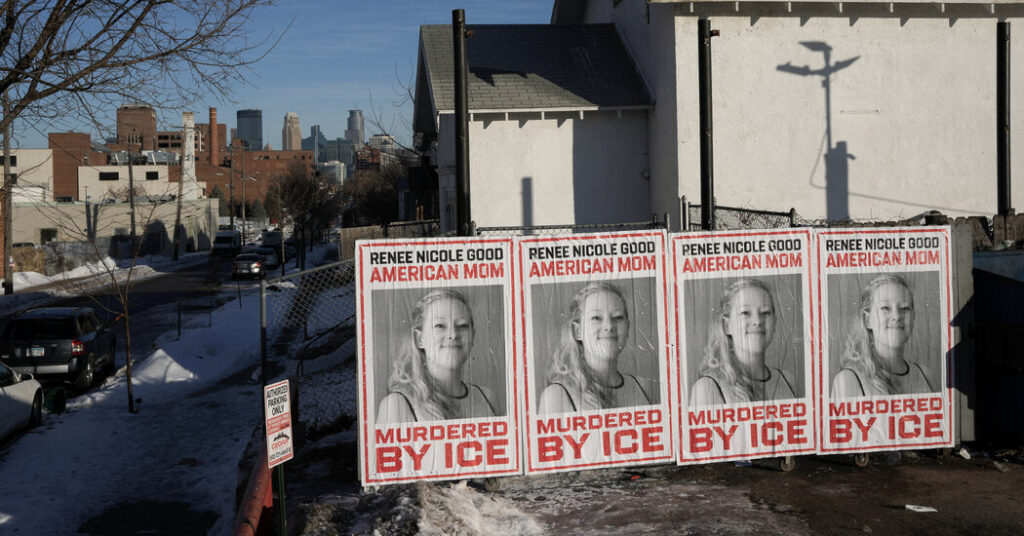
If Renee Good had been killed by a state or local police officer rather than an ICE agent, her family could sue the shooter for excessive force and violating her rights. But there is no law that allows federal officers to be sued for their constitutional violations. Congress should pass long-overdue legislation to fix this anomaly: a Renee Good Civil Rights Act.
Federal officials can be held criminally liable for their actions. But, because of the hole in federal law, civil suits against them struggle to move forward. In one case, the Supreme Court held that people who had been illegally thrown off the Social Security disability rolls and were left without income could not sue, even though they had been given no due process. In another, the court declared that a man dying of cancer after the prison repeatedly denied him any medical care could not sue. Similarly, the court ruled that people illegally detained after Sept. 11 and subjected to great abuse by prison guards had no remedy.
Yet for over 150 years, civil suits against state and local officials have been allowed. Soon after the Civil War, significant violations of civil rights, especially in the former rebel states, led Congress to recognize the need to empower federal courts to enforce the Constitution against state and local governments. The Civil Rights Act of 1871 makes it a crime for a state or local officer to use their authority “under color of law” to violate a person’s rights. The act also allows civil suits for monetary damages or injunctive relief against any state or local employee who, during their work, violates the Constitution or federal laws.
That second provision, known as Section 1983, is the basis for virtually all lawsuits against state and local governments and officials who violate the Constitution. If a city adopts an ordinance that violates the First Amendment, a citizen could sue the city under Section 1983. If a police officer uses excessive force, which the Supreme Court has held violates the Fourth Amendment, the victim could sue the officer under Section 1983. Section 1983 suits account for a significant part of the workload of federal courts.
But Section 1983 applies only to those acting under the authority of state law. That is why the Minneapolis police officer Derek Chauvin, who murdered George Floyd, could be sued under Section 1983. (Mr. Floyd’s family did sue Mr. Chauvin and others, and the lawsuit was settled for $27 million.) The ICE officer who killed Renee Good cannot be sued under that statute.
There is no comparable federal law that allows suits against federal officers who violate the Constitution. In light of this, in 1971, the Supreme Court came up with a fix of its own: allowing people whose constitutional rights had been violated to sue for monetary damages without needing a federal statute.
In that 1971 case, federal narcotics agents had subjected a man named Webster Bivens to a search and arrest that clearly violated his Fourth Amendment rights. The Supreme Court, recognizing that there was no statute that allowed him to sue the officers, said that he could do so directly under the Fourth Amendment. For a decade the court followed this precedent: It allowed a sex discrimination lawsuit against a congressman and a lawsuit by the estate of a federal prisoner for the cruel and unusual punishment that led to his death.
But after 1980, the court sharply shifted course. Not once since then has it allowed Bivens suits (as they came to be known) to go forward. In case after case, the court has precluded people whose rights have been violated from suing even when they suffered great injuries.
The Supreme Court repeatedly has said that if Congress wants to authorize such suits, it can enact a law, similar to Section 1983, that allows suits against federal officers who violate the Constitution. Such a law is important to ensure that those whose rights are violated can receive a remedy, including compensation for their injuries. Civil liability is also a crucial way of deterring wrongdoing.
A Renee Good Civil Rights Act could be simple. It need only copy Section 1983 and say that those acting under the authority of federal law can be sued for monetary damages or an injunction if they violate the Constitution or the laws of the United States.
Anyone who fears that such an act would be unfair to federal officers must remember that ICE agents would have the same defense to civil suits as state and local officers do now: qualified immunity. This means that officers can be held liable only if they violate a clearly established law that every reasonable officer should know. Although we believe that qualified immunity goes too far in protecting government officers who violate rights, fixing it should be left for another day and another law.
Long ago, Congress should have passed legislation that allows federal officers to be sued when they violate the Constitution. The death of Renee Good can be the impetus for finally closing a gaping hole in our constitutional protections.
Erwin Chemerinsky is the dean of the law school at the University of California, Berkeley. Burt Neuborne is a professor emeritus at New York University Law School, where he was the founding legal director of the Brennan Center for Justice.
The Times is committed to publishing a diversity of letters to the editor. We’d like to hear what you think about this or any of our articles. Here are some tips. And here’s our email: [email protected].
Follow the New York Times Opinion section on Facebook, Instagram, TikTok, Bluesky, WhatsApp and Threads.
The post Renee Good’s Family Should Be Able to Sue the Officer Who Killed Her appeared first on New York Times.