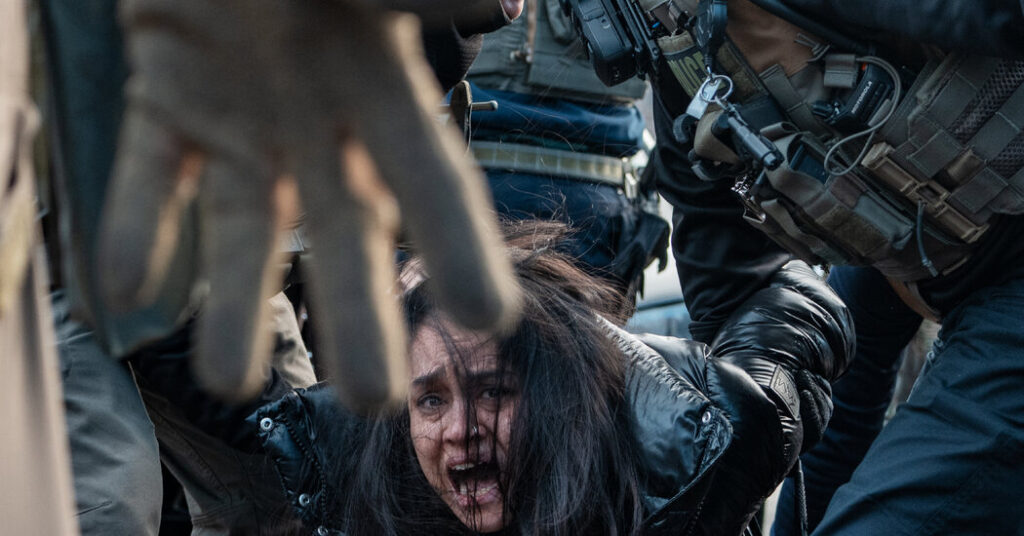
One of the differences between a free society and an authoritarian state is the relationship between security forces and citizens. In a democracy, police officers are assigned to protect the rights of civilians. When security forces are deployed against citizens, it’s often viewed as a sign of creeping authoritarianism.
Last week an American federal immigration agent shot Renee Good, a U.S. citizen, three times in the face. President Trump has sent ICE agents into cities across America, often to the dismay of local residents. The president of the Minneapolis City Council said the agents, with their assault rifles and combat gear, “feel like an occupying force.” Today my colleague Sam Sifton, who hosts The Morning, the U.S. sibling of this newsletter, writes about the fallout, and what may come next.
‘It feels like a military occupation’
By Sam Sifton
Minneapolis is on a knife’s edge. One week after a federal agent shot and killed Renee Good, aggressive arrests have enraged residents. The Trump administration has redoubled its effort to deport illegal immigrants, sending officers into residential neighborhoods and the parking lots of big-box stores in search of people to grab. They’ve also detained — and roughed up — several U.S. citizens, and social media is awash in viral videos of the confrontations.
Meanwhile, activists have sought to observe, document or impede the agents, Julie Bosman reports. On WhatsApp, neighbors watch out for immigration officers and run from their homes to shout at them. “It feels like our community is under siege by our own federal government,” State Representative Michael Howard, a Democrat, told The Times.
The encounters can be terrifying. My colleagues verified images circulating this week that show agents tackling a man at a gas station and shoving Elliott Payne, the president of the City Council. Payne told my colleagues that there were federal agents equipped with assault rifles and combat gear patrolling the streets, repeatedly unholstering their handguns. “It feels like a military occupation,” he said.
Urban strife
Some of the stops go beyond ordinary law enforcement. In a few of the run-ins, you can feel the animosity building between federal officers and citizens they serve. One man The Times spoke to said he was glad that there were other people around to film his encounter with federal agents, which occurred after they rammed their car into his, forcing him to a stop.
He said he believed the presence of people with cameras had helped lead the agents to let him go. But as the crowd grew — the crowds always seem to grow now — and began to yell at the officers, he worried that the situation could tip over into something darker, something violent. “It makes them act different, like they have more power,” he said.
President Trump does not seem interested in de-escalating anything in Minneapolis. This week, he said that one justification for the shooting of Renee Good might have been that she had been “disrespectful” to officers. Being disrespectful is a form of speech, though — one protected by the Constitution.
Now the government is sending 1,000 more immigration officers to Minnesota on top of the 2,000 already there. The administration also said it would end deportation protections for more than 2,000 migrants from Somalia. The state is home to the largest diaspora of Somalis in the world.
Minnesota filed a lawsuit on Monday alongside the cities of Minneapolis and St. Paul, asking a judge to block the federal government from “implementing the unprecedented surge in Minnesota.”
“FEAR NOT, GREAT PEOPLE OF MINNESOTA,” Trump wrote on social media on Tuesday, “THE DAY OF RECKONING & RETRIBUTION IS COMING!”
A tinderbox
It’s worth pausing on these encounters between federal officers and Minneapolis residents. They contain multiple truths.
On the one hand are people driving to work, walking out of a store, trying to get home. On the other are federal agents sent to a place they are unwelcome and told to round up people many locals want to protect. Some activists are throwing snowballs at officers, blowing whistles, chanting at them, parking in the way of their vehicles. Residents have honked car horns through the night next to a hotel where agents are staying and followed a commander into the bathroom to shout at him.
Agents respond with pepper spray, tear gas or worse.
Everyone is just mad — at the injustices they perceive, at the people performing them, at the awful facts on the ground. That’s as true of the masked federal agents as it is of the citizens and noncitizens they face. The steam pipe valve is screwed down tight in Minneapolis. The pressure only goes up. Good is dead, and more may follow.
Brian O’Hara, Minneapolis’s police chief, has been warning about this for weeks. More than five years ago, the killing of George Floyd by members of his department tore Minneapolis apart. O’Hara came in afterward to rebuild the force and re-establish trust with the city’s residents.
On Monday, Michael Barbaro interviewed him for “The Daily” and asked what his first thought had been when he heard about the Good shooting. O’Hara was measured throughout the interview, and you can hear the pause as he considers the question. “I just thought, Fuck, this is it,” O’Hara said. “You know? This is potentially 2020 all over again.”
“George Floyd all over again?” Michael asked.
“The destruction of the city,” the chief responded.
MORE TOP NEWS
The U.S. moved personnel out of Qatar as Iran tensions mounted
The Pentagon began moving some nonessential personnel out of an air base in Qatar, as Trump weighs a military response to Iran’s crackdown on antigovernment protests.
Rights groups and relatives said Iran planned to put a protester to death. But Trump said yesterday that the U.S. had been notified that “the killing in Iran is stopping, has stopped, and there’s no plans for executions.” Trump has threatened “strong action” if Iran carries out any such executions.
My colleague David Sanger described Trump’s options in Iran: Watch the video.
A ‘fundamental disagreement’ over Greenland
After a meeting in Washington, Denmark’s foreign minister said yesterday that the talks were “frank” but did not resolve a “fundamental disagreement” with the U.S. over Greenland’s future.
The foreign ministers of Denmark and Greenland met with Vice President JD Vance and Secretary of State Marco Rubio, the first meeting between the governments to discuss Trump’s repeated threats to buy or take Greenland. Those threats raise serious questions for NATO, of which Denmark is a member. The alliance’s founding treaty does not consider what happens if one ally attacks another.
OTHER NEWS
-
China announced the world’s largest trade surplus ever as it flooded the world with exports.
-
A crane fell on a passenger train in Thailand, killing at least 32 people.
-
Prime Minister Mark Carney of Canada began a state visit to China as he tries to repair a crucial relationship.
-
F.B.I. agents searched the home of a Washington Post reporter, Hannah Natanson, as part of a leak investigation, and seized her devices.
-
The U.S. is close to naming a panel of Palestinian technocrats to oversee daily life in the devastated Gaza Strip.
-
Four astronauts will leave the International Space Station early because of a medical issue involving one crew member.
-
BTS announced a colossal comeback tour: 79 shows across five continents.
SPORTS
Football: How Mohamed Salah and Sadio Mane went from teammates to rivals.
Tennis: An amateur player beat Jannik Sinner and won the Australian Open’s “One Point Slam.”
VIDEO OF THE DAY
— Sanae Takaichi, Japan’s prime minister and an amateur heavy metal drummer, invited Lee Jae Myung, the president of South Korea, to join her for a jam session. They played along to BTS and “KPop Demon Hunters.” Watch them bang out the beats.
MORNING READ
After the invasion of Ukraine in 2022, Russia adopted a new school curriculum that emphasized patriotism. Pavel Talankin, who worked at a school in the Urals, was ordered to film lectures, which became the basis for a documentary, “Mr. Nobody Against Putin,” that’s been shortlisted for an Oscar.
Talankin, who left Russia in 2024, said he was proud of his work documenting the Kremlin’s agenda. “Sooner or later, people will ask themselves: ‘What’s going on with the Russians? Why are they all so angry and aggressive again?’ And here’s the answer, because they go to school and are told that killing is normal,” he said. Read more.
AROUND THE WORLD
Clear skies, chilly villages
Last week, officials in China’s capital, Beijing, announced a victory: The city had recorded only one day of heavy pollution in 2025, a 98 percent drop compared with 2013. But there has been a human cost.
The burning of coal or firewood for residential heating was banned in many surrounding regions to reduce Beijing’s air pollution. Villagers now must use natural gas, which is cleaner but more expensive. Then, this winter, local governments cut back the fuel subsidies that eased the transition.
In one village a few hour’s drive from the capital, a retired farmer sat in the sun in a tattered black coat to save money on heat on a subzero day. He struggles to pay for gas that costs him up to a third of his monthly pension. “If it gets even more expensive and I can’t afford it, then I’ll stop using it,” he said. Read more.
RECOMMENDATIONS
Read: Karl Ove Knausgaard’s “The School of Night” follows an ambitious young photographer in London.
Moderate: Why is my alcohol tolerance declining with age?
Work: Organize your desk to feel more creative.
RECIPE
Variations of balilah are served throughout the Middle East, but they all have three components: plenty of lemon juice, good-quality olive oil and very soft chickpeas. With such simplicity, it’s important to give attention to details that make all the difference. Cook the chickpeas gently until they are extremely soft. Toast the spices until fragrant before grinding them.
WHERE IS THIS?
Where is this square?
TIME TO PLAY
Here are today’s Spelling Bee, Mini Crossword, Wordle and Sudoku. Find all our games here.
You’re done for today. See you tomorrow! — Katrin
Sam Sifton was our guest writer today.
We welcome your feedback. Send us your suggestions at [email protected].
Katrin Bennhold is the host of The World, the flagship global newsletter of The New York Times.
The post Minneapolis ‘Feels Like a Military Occupation’ appeared first on New York Times.