Denmark, Greenland and the United States have a “fundamental disagreement” over the future of the territory in the North Atlantic, Lars Lokke Rasmussen, the Danish foreign minister, said on Wednesday after a meeting with top Trump administration officials.
The meeting in Washington — hours after President Trump said the United States “needs Greenland” — was the first among the three governments to discuss Mr. Trump’s desire to buy or take the semiautonomous Danish territory.
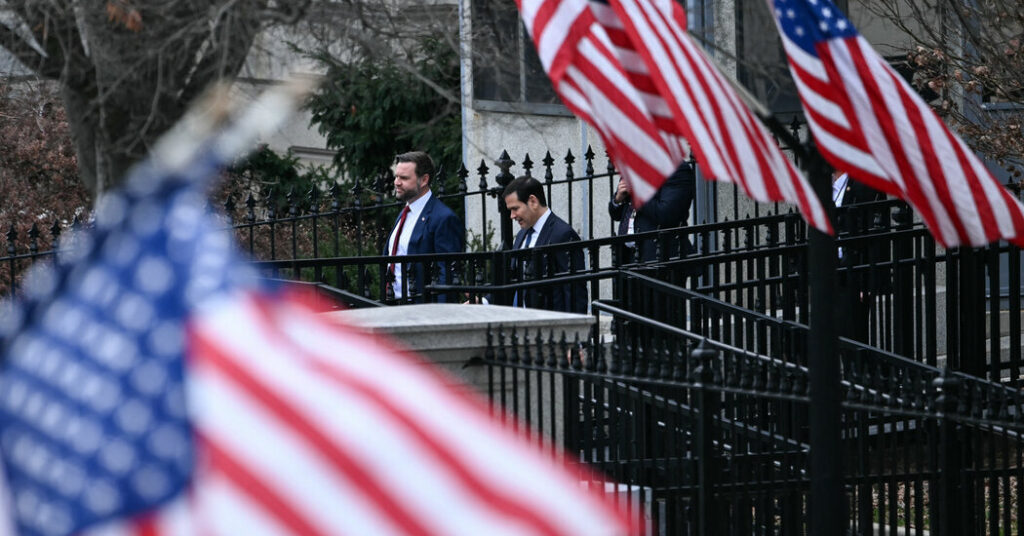
Mr. Rasmussen and Vivian Motzfeldt, the Greenland foreign minister, met with Vice President JD Vance and Secretary of State Marco Rubio. Afterward, Mr. Rasmussen called the discussion “frank” and “constructive” even as he underscored that Denmark has no interest in changing the status quo.
“Our perspectives continue to differ,” he said. “The president has made his view clear. And we have a different position.”
But, he said, there was also progress: The governments will form a working group, likely within weeks, to try to find a path forward that accommodates Mr. Trump’s security concerns, without violating the territorial integrity of the Danish kingdom or the Greenlanders’ right to self-determination.
And while the Americans did not apologize or back down from Mr. Trump’s threats, Mr. Rasmussen said that he hoped the governments could begin to “take down the temperature” after more than a year of trading barbs on social media instead of meeting face to face.
“We, therefore, still have a fundamental disagreement, but we also agreed to disagree,” he said. “We will, however, continue to talk.”
Mr. Trump has turned up the pressure on Greenland this year, apparently emboldened by the success of the U.S. military operation that led to the capture of Venezuela’s leader on Jan. 3. He said last week that he was “going to do something on Greenland, whether they like it or not.”
He repeated his claims hours before the closed-door meeting, saying that “anything less than” American control of Greenland would be “unacceptable,” in a post on Truth Social. “The United States needs Greenland,” he said, renewing his argument that it was necessary for national security. “NATO becomes far more formidable and effective with Greenland in the hands of the UNITED STATES.”
Denmark and Greenland have stood united in the face of Mr. Trump’s repeated threats.
Prime Minister Jens-Frederik Nielsen of Greenland told journalists on Tuesday that Greenland would rather remain with Denmark, its former colonizer, than join the United States under the Trump administration. It was his strongest statement yet on Greenland’s desire to remain a territory of Denmark.
“If we have to choose between the United States and Denmark here and now, we choose Denmark,” he said on Tuesday during a joint news conference in Copenhagen with Prime Minister Mette Frederiksen of Denmark.
Ms. Frederiksen has said that an American attack on Greenland — which, as a part of the kingdom of Denmark, is already under the protection of the North Atlantic Treaty Organization — would destroy the alliance.
On Wednesday, Denmark announced that it would increase its “military presence in and around Greenland in the coming period.” Swedish soldiers also arrived in Greenland at Denmark’s request, Ulf Kristersson, the Swedish prime minister, wrote on X.
Mr. Nielsen, Greenland’s leader, has been clear that the territory is not interested in an American takeover or purchase.
“The time has not come for internal discussions and division,” Mr. Nielsen said on Tuesday, speaking of its often fraught relations with Denmark. “The time has come to stand together.”
In part, that is because the security situation at the top of the world is changing. Climate change is melting the ice in the Arctic, opening previously unnavigable routes where superpowers are vying for military and commercial dominance.
That is why Mr. Rasmussen said that Denmark and Greenland share some of Mr. Trump’s concerns about defense, noting that Denmark allocated about $15 billion in recent years to military capabilities in the High North.
“There is definitely a new security situation in the Arctic,” he said.
“The big difference is whether that must lead to a situation where the U.S. acquires Greenland,” he continued. “That is absolutely not necessary.”
Mr. Rasmussen noted that Greenland, as part of the Danish kingdom, is already under NATO protection. And he pointed to a Cold War-era agreement, which already gives the American military wide access to Greenland.
“The long-term security of Greenland can be ensured inside the current framework,” he said.
But the three governments do not agree about what the threats even are.
President Trump has repeatedly said the United States needs to acquire the massive island to protect it from Russia and China.
Mr. Rasmussen said that there was no such imminent threat. “According to our intelligence, we haven’t had a Chinese warship in Greenland for a decade or so,” he said.
Independent researchers support that view.
Gabriella Gricius, a senior fellow at the Arctic Institute and a postdoctoral fellow at the University of Konstanz in Germany, said the Trump administration’s claims that Russian and Chinese ships are circling the island are “just not true.”
“The Russian and Chinese ships are not, in fact, in the North Atlantic,” she said. “They’re in the Bering Strait — which is on the other side of the U.S.”
Mr. Trump and top officials in his administration have given various explanations of how the United States might take control or ownership of Greenland. Mr. Trump has not ruled out taking Greenland with military force, but Mr. Rubio has said the president plans to buy it rather than invade.
But buying Greenland may be a nonstarter. Denmark does not have the authority to sell Greenland, and Mr. Nielsen has said repeatedly that the territory is not for sale.
Maya Tekeli contributed reporting from Nuuk, Greenland’s capital, and Jeanna Smialek from Brussels.
Amelia Nierenberg is a Times reporter covering international news from London.
The post Denmark Has ‘Fundamental’ Differences With U.S. Over Greenland, Diplomat Says appeared first on New York Times.