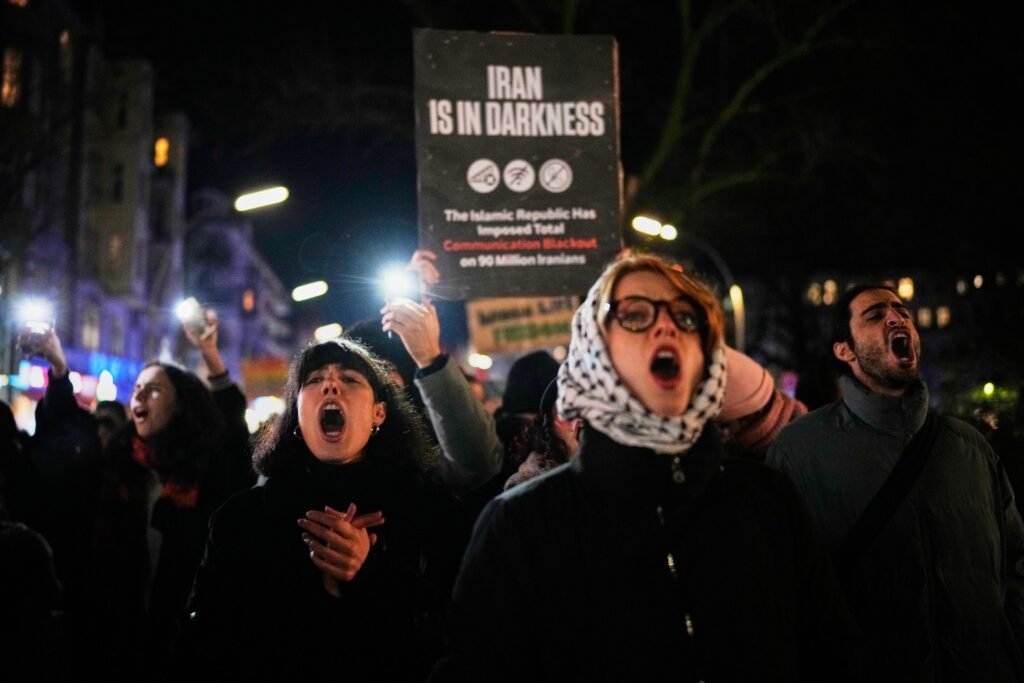
An ongoing communications blackout inside Iran has left Iranians outside the country scrambling to reach family and friends, as the toll from a crackdown on anti-government protests has climbed to more than 2,600 killed, according to the U.S.-based Human Rights Activists News Agency.
The unrest in Iran began late last month after shopkeepers protested the collapse of the country’s currency. The demonstrations soon morphed into wider protests against the Islamic Republic. As the crowds swelled, authorities cut off access to phone calls, texts and the internet.
The outage, which has lasted seven days, according to the monitoring group NetBlocks, is not total; The Washington Post spoke to several people who said they briefly connected with friends or relatives on the ground. But information is scarce and it is unclear when the country will come back online.
In Illinois, Shiva Rahmani, a professor at the University of Chicago, said she hasn’t spoken to her father in a week. The last message she received from him was on WhatsApp on Thursday, according to a screenshot of the exchange she shared with The Post.
“Baba joon,” he wrote, using a term of endearment, “the internet is really weak here and it keeps cutting out.”
She tried to video-call him hours later but he didn’t answer, she said. Four more messages attempting to reach him didn’t go through.
Rahmani, who is a U.S. citizen, has lived in Chicago for the past 11 years. But many of her family members and friends remain in Iran, she said. She also knew people who were killed during anti-government protests in 2020 and said she feels helpless watching another crackdown unfold from thousands of miles away.
“I just want to stay in bed,” she said, adding that she has been glued to her phone waiting for updates. “Is there any news coming out? Are people back online?”
It’s not the first time the Iranian government has disconnected its roughly 90 million residents from the internet. It jammed communications in 2019 after Iranians, grappling with soaring inflation, poured into the streets to protest the government’s decision to cut fuel subsidies.
Iran shut off communications again in 2022 as part of a brutal crackdown on demonstrators protesting the death of Mahsa Amini, a 22-year-old Kurdish woman who had been arrested in Tehran that September for allegedly wearing her hijab “improperly.” Rights groups have accused the Iranian government of using such outages to conceal human rights abuses and suppress demonstrations.
Igeen Nazari, 28, was born in London to Iranian parents. But most of her extended family lives in Iran. She said she last spoke to her cousin on WhatsApp on Jan. 7 and hasn’t heard from the family since.
The cousin said that life in Iran was becoming more difficult financially and that the family was struggling to stay afloat. But it was unclear whether any of Nazari’s family members had participated in the protests.
“We have no idea if they are part of the protests or part of the casualties,” she said. “It’s scary to think there’s an entire nation that is plunged into darkness and they cannot be heard.”
When some calls get through, they are often brief.
On Tuesday, the call Azam Jangravi had spent days longing for finally came.
“When they called me, I started to cry,” said Jangravi, who lives in Toronto. Her family lives in the north of Tehran.
The call lasted “just two minutes” before it was disconnected, she said, but her mother described hearing gunshots every night and said some people the family knew had been killed or injured amid the protests.
It’s “exactly like hell,” Jangravi quoted her mother as saying.
Jangravi, an activist who opposes Iran’s government, was arrested in Tehran in 2018 after protesting the mandatory hijab. She thinks often of her family members still in Iran, who she says have been targeted and are “under a lot of pressure” because of her activism.
Waiting for news from afar during the blackout has been particularly hard as she, like many other Iranians in the diaspora, is still trying to work amid the constant “anxiety” over what is happening to loved ones, she said.
“Tell everybody I love them,” Jangravi said, as her mom ended the phone call. “And please take care.”
The post Iranians abroad wait for news from loved ones amid communications blackout appeared first on Washington Post.