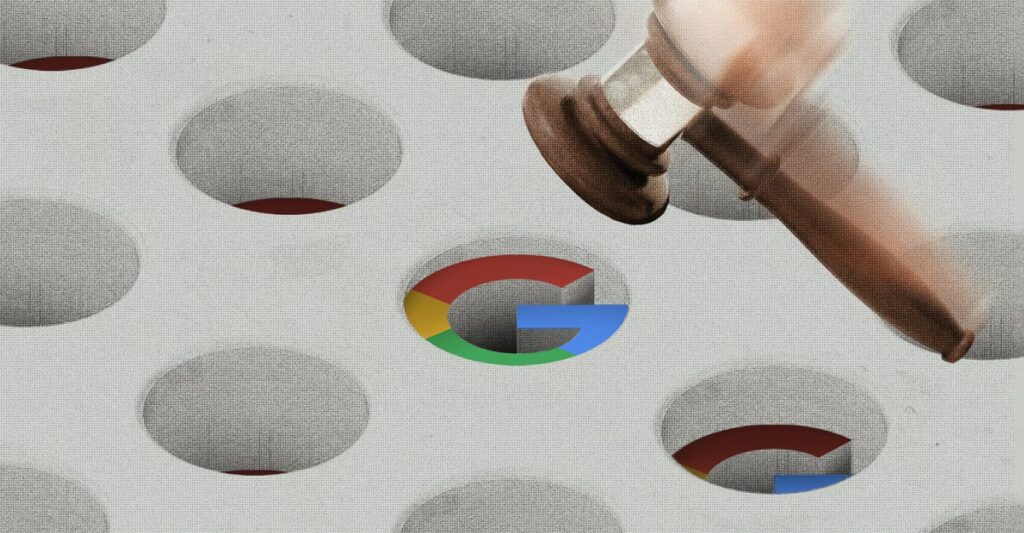
If the story of journalism’s 21st-century decline were purely a tale of technological disruption—of print dinosaurs failing to adapt to the internet—that would be painful enough for those of us who believe in the importance of a robust free press. The truth hurts even more. Big Tech platforms didn’t just out-compete media organizations for the bulk of the advertising-revenue pie. They also cheated them out of much of what was left over, and got away with it.
As someone who has written quite a bit about this dynamic over the years, I was interested to learn that The Atlantic filed an antitrust lawsuit yesterday accusing Google of illegally depriving the company of advertising revenue over the past decade. (The editorial team had no involvement in the decision, and I learned of details through public court filings.) Like similar cases filed by publications including Slate, Business Insider, and—just today—Vox, along with the publishers McClatchy and Advance, this one builds off of a federal judge’s ruling last year that Google had illegally established a monopoly in ad tech.
[Kate Lindsay: Something went terribly wrong with online ads]
I will now attempt to explain the concept of an ad-tech monopoly with as little legal or technical jargon as possible. We’re talking about the ads that load when you open an article page, like the one you’re reading right now. The process of delivering those ads turns out to be extraordinarily complex. In general, whichever ad you see had to win an automated auction to reach your eyeballs. On one side of the transaction are advertisers, who bid to show their ad according to how valuable they think a particular reader is, based on data about them and what they’re looking at. On the other side are publications, such as The Atlantic, that use a publisher-side ad platform to list their ad space and hope to sell it for the highest possible price. The two sides meet in an ad exchange, which runs the auction in a fraction of a second in order to match advertisers with available ad-space inventory.
In theory, to maximize revenue, a publisher can use any number of platforms to put its ad inventory up for sale and can solicit bids via any number of exchanges. In practice, as Judge Leonie Brinkema of the Eastern District of Virginia found in her ruling last April, Google has made doing that extremely difficult. Google accounts for more than 50 percent of the global ad-exchange market and 90 percent of the publisher ad-platform market, making it by far the dominant player at each layer. This creates a clear conflict of interest—as if “Goldman or Citibank owned the NYSE,” in the words of one Google employee—and one the company has routinely exploited. (Meta and Amazon are also huge players in the ad business, but not in the type of advertising at issue here.)
The simplest example is Google requiring publishers that want to receive bids through Google’s exchange to use its publisher platform. This is called “tying” in antitrust law, and as Brinkema ruled last year, it’s illegal, because it unfairly uses dominance at one level of a market to lock out competition at another level. (The famous 1990s antitrust case against Microsoft also revolved around tying.) As The Atlantic’s legal complaint alleges, the publication “does not have an alternative way to access advertising spending from the long tail of small- or medium-sized advertisers who buy mostly, or exclusively, through Google Ads.” It has no choice but to use Google’s platform. This prevents rivals from competing on price or quality, which helps explain that 90 percent market-share number.
Google in turn uses its control of the publisher side to entrench the dominance of its ad exchange, called AdX. The key thing to understand is that a digital-ad auction occurs in two steps. First, advertisers place bids through various exchanges. Second, those exchanges each submit their respective winning bid. In a fair market, those winning bids would be treated equally. But because publishers are all using Google’s platform, Google can give its own exchange special advantages—and it does. Broadly speaking, this prevents other exchanges from increasing their market share and lets AdX win auctions with lower bids than it would have to submit in a competitive market. That, in turn, costs publishers money in the form of lost ad revenue.
In a statement, Google told me, “These allegations are meritless. Advertisers and publishers have many choices and when they choose Google’s ad tech tools it’s because they are effective, affordable and easy to use.”
Brinkema reached a different conclusion, however, in her ruling in a case brought by the Department of Justice and 17 states. Her opinion describes many self-preferencing schemes that Google has deployed over the years, including: giving AdX the right to place an ad before any other exchanges can bid on it, letting AdX peek at the bids submitted by rival exchanges in supposedly sealed auctions, and selectively lowering its commission rate just enough to undercut what would otherwise be another exchange’s winning bid. These and other techniques, Brinkema concluded, have helped Google preserve its dominant position even as it charges a high average commission and rolls out product changes over publishers’ objections. Neither of those things should be possible in a competitive market. (Google plans to appeal Brinkema’s decision.)
Whether Brinkema’s ruling leads to any real change is still an open question. Consider what happened in a separate antitrust case against Google. In 2024, a different federal judge, Amit Mehta, ruled that Google had illegally monopolized the search-engine market, including by paying Apple and Samsung to be the default search engine on their phones. But when the time came to impose legal remedies—such as breaking up the company—Mehta essentially let Google off with a warning. He could have forced the company to spin off its Chrome browser or its Android operating system, but he didn’t. He didn’t even ban it from paying to be the default search engine. Instead, he imposed only the most minimal requirements, such as limited data-sharing.
In his ruling, Mehta suggested that the emergence of generative-AI firms was putting so much competitive pressure on Google that going any further would be unwise. In fact, the AI market is already heavily concentrated among the handful of firms with the resources to invest in it, and Google’s overlapping monopolies have set it up to dominate the AI economy too. On Monday, Apple announced a partnership making Google’s technology the foundation for Siri and other AI products. The news pushed Google’s market cap above $4 trillion for the first time.
[Richard R. John: The tech giants’ anti-regulation fantasy]
Brinkema has yet to rule on the proper remedy for Google’s ad-tech monopoly. For now, individual publishers can seek compensation in individual civil cases, as The Atlantic is doing. (The Atlantic lawsuit also accuses Google of having lied about how its ad products work; Google denies the allegation.) Winning meaningful redress for a decade’s worth of ad-tech-related harm would be a big deal for publishers. Aside from the financial upside, it would set a precedent after all these years that Big Tech companies can be held accountable for their actions.
And yet, in some ways, the ad-tech cases might be fighting the last war. As Mehta seemed to only half-grasp, generative AI is where the real action is. The damage caused by Google’s ad-tech abuses has been eclipsed by the growing threat of AI to journalism’s business model. Google’s pivot to showing users AI-generated search results, instead of links, has been a disaster for traffic. Meanwhile, OpenAI is reportedly preparing to get into the advertising business. A number of publishers, most notably The New York Times, have sued OpenAI, alleging that the company broke the law by training its models on copyrighted materials. (Other publications, including The Atlantic’s corporate leadership, have instead signed deals in which OpenAI pays for access to their content. The Atlantic’s editorial team does not report to the CEO, and corporate partnerships have no influence on stories, including this one.) OpenAI argues that the training counts as legally permissible “fair use.” Such litigation will take years to play out. Perhaps a federal judge will rule a decade from now that a monopolistic AI firm owes money to media organizations. One hopes that media organizations are still around to collect it.
The post Will Google Ever Have to Pay for Its Sins? appeared first on The Atlantic.