Lawyers representing the family of Renee Nicole Good, the woman killed by a federal immigration agent in Minneapolis last week, announced on Wednesday that they were pursuing what they described as a civil investigation of the shooting.
The law firm Romanucci & Blandin, which said that it and another firm were representing Ms. Good’s partner, parents and siblings, also provided the family’s fullest accounting of what happened on Jan. 7, when Ms. Good engaged in a dispute with immigration agents that ended with her being fatally shot in her vehicle.
The firm said Ms. Good and her partner saw federal agents after dropping their child off at school and stopped “to observe, with the intention of supporting and helping their neighbors.” A spokeswoman for the firm did not immediately respond to questions about whether the couple had been involved in any prior activism related to immigration enforcement.
President Trump and top federal officials have repeatedly defended the actions of the Immigration and Customs Enforcement agent who shot Ms. Good, describing it as self-defense, while state and local officials have dismissed the federal narrative.
Antonio M. Romanucci, a lawyer for the Good family, said his firm intended to provide updates to the public about what it learned as it gathered more information about the case.
The F.B.I. is conducting the official investigation of the shooting. Federal officials have resisted calls for the Minnesota Bureau of Criminal Apprehension to participate in that inquiry, as was initially planned in the hours after the shooting.
Mr. Romanucci said in a statement that people “want to know what could and should have been done to let Renee live and pick her child up safely from school that afternoon.” In another statement, Ms. Good’s parents and siblings described her as “relentlessly hopeful and optimistic.”
CBS News reported on Wednesday that the agent who shot Ms. Good sustained internal bleeding. A Department of Homeland Security official confirmed that the agent had internal bleeding after the encounter but did not specify further or answer detailed questions.
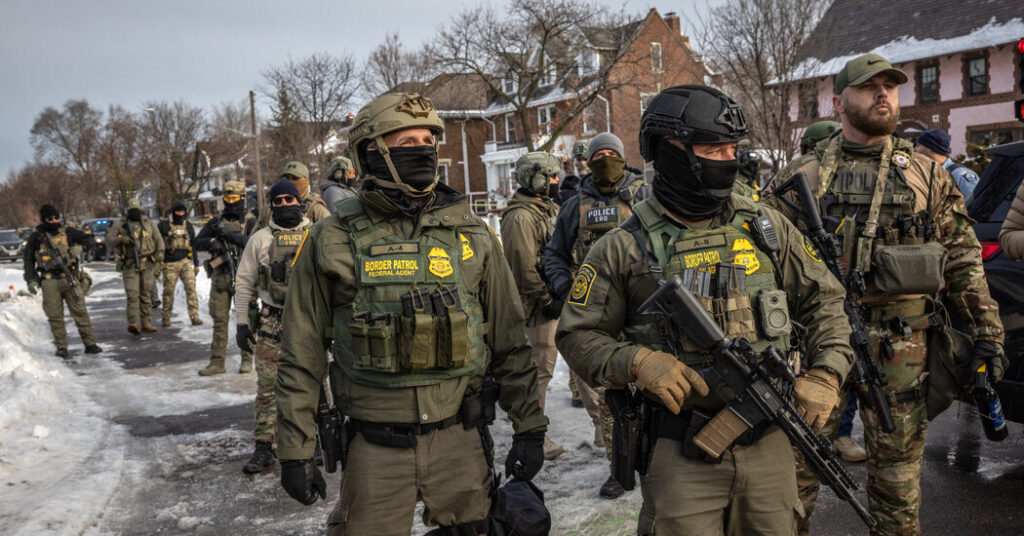
The descriptions from the Good family, who had said little publicly in the week since the shooting, came as immigration agents continued to operate on Minnesota streets, part of a campaign that started in late November and ramped up last week. Federal immigration officials have said that they have arrested around 2,400 people in Minnesota since Nov. 29, many of whom they said had been convicted of serious crimes. Some 3,000 federal agents were said to be working in Minnesota or on their way to the state, a mobilization that federal officials have described as their largest so far.
Earlier on Wednesday, a federal judge in Minnesota declined to rule immediately on a request by state and local officials to temporarily block the surge of immigration agents.
The Minnesota Attorney General’s Office had asked Judge Kate M. Menendez to issue a temporary restraining order that would curb the Trump administration’s mass deployment of immigration agents to the state, claiming that the federal action was unconstitutional and violated state sovereignty.
Instead, Judge Menendez gave Justice Department lawyers until Monday to respond in writing to the state’s lawsuit, and she suggested that she might hold another hearing on the issue later in January.
Scenes of federal agents in masks, detaining immigrants and clashing with protesters, have angered residents and politicians in the heavily Democratic Twin Cities of Minneapolis and St. Paul. Tensions intensified last week after the killing of Ms. Good.
Local officials described a region that was paralyzed by fear and disruption, and called for an end to the surge. Aurin Chowdhury, a Minneapolis City Council member, described “an unconstitutional, violent and brutal ICE occupation” that had left schoolchildren scared and immigrants unable to go to work.
The Trump administration has defended its broader surge to the Minneapolis area as necessary to crack down on illegal immigration and root out fraud in Minnesota social service programs. In a statement on Wednesday, Tricia McLaughlin, a Department of Homeland Security spokeswoman, criticized what she described as “dangerous sanctuary policies” in Minnesota that release “criminal illegal aliens from jails and put them back on the streets to victimize more innocent Americans.”
During the court hearing on Wednesday, Brian Carter, a lawyer for the state, urged Judge Menendez to act quickly on the request to block the surge. He described violent encounters between agents and residents, saying that “the harm here is ongoing, your honor, and it is intolerable.”
“The temperature needs to be lowered,” said Mr. Carter, who called for a “pause.”
A lawyer for the Trump administration, Andrew Warden, asked the judge to take a slower approach. He described portions of the state’s proposed order as vague, and another section as “extraordinarily intrusive.”
Judge Menendez, who was nominated to the federal bench by President Joseph R. Biden Jr., said she was not going to make an immediate decision and wanted to give the federal government time to more fully reply to the state’s claims. She described the issues raised in the lawsuit as “grave and important matters,” but said they “are somewhat frontier issues in constitutional law,” with a limited amount of precedent to draw upon.
Officials in Illinois, another Democratic-led state that has been a target of the administration’s immigration enforcement campaign, filed a separate federal lawsuit on Monday with claims similar to those in Minnesota. A judge has not yet ruled in that case.
Madeleine Ngo contributed reporting.
Mitch Smith is a Chicago-based national correspondent for The Times, covering the Midwest and Great Plains.
The post Lawyers for Renee Good’s Family Plan to Investigate Minnesota ICE Shooting appeared first on New York Times.