“Star Trek: Starfleet Academy,” premiering Thursday with back to back episodes on Paramount+, takes on the necessary assignment of going where no “Trek” has gone before, while also recalling all the places it has. Created by Gaia Violo, the new series, which might cynically be regarded as a bid to bring younger viewers to a franchise a decade older than “Star Wars,” goes down to Earth and back to school. But it is always best to park your cynicism at the door when approaching “Star Trek.”
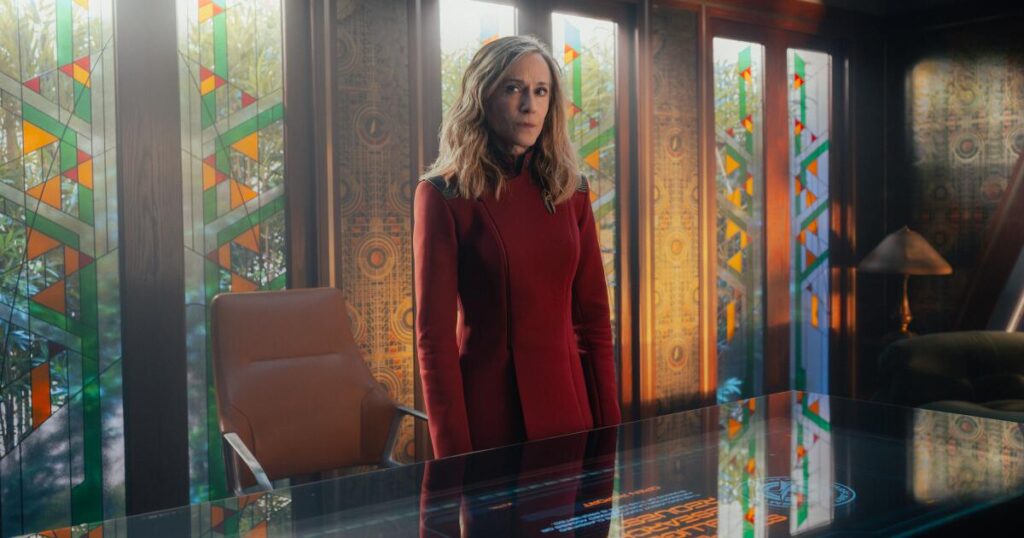
We’re in the 32nd century, post-”Burn” timeline established in “Star Trek: Discovery,” among the cadets at the eponymous San Francisco campus, newly rebuilt after “more than 120 years” to train Starfleet officers. (None of your redshirts here.) Holly Hunter plays Nahla Ake, both captain of the USS Athena and chancellor of the academy, where the starship’s detachable saucer docks, forming the school’s main building and giving the producers two locations for the price of one. (With its curvy lines and greenery, its atrium recalls nothing so much as a high-end shopping mall or hotel.)
(It’s of no importance, except to a pedantic Californian TV critic like myself, but I would point out that the campus is technically in Sausalito, with San Francisco seen across the bay. The Golden Gate Bridge, so often destroyed in science-fiction films, is still standing, as is the iconic Ferry Building, wrecked by a giant octopus in “It Came From Beneath the Sea.”)
Ake is 422 years old, half-human, hafl-Lanthanite (like Carol Kane in “Star Trek: Strange New Worlds”). We meet her in a prelude 15 years before the show’s main business, as little Caleb Mir is separated from his mother, arrested alongside Nus Braka, a bad-news space pirate played with relish, mustard and ketchup by Paul Giamatti. Guilt over her part in this has led Ake to quit Starfleet and become a kindergarten teacher, but Admiral Vance (Oded Fehr, back from “Discovery”) talks her back into service, selling it as a chance to help repair a Federation much in need of reform. Hunter is a new flavor of “Star Trek” skipper; casual and compact, she curls up in her captain’s chair, stretches out wherever convenient and goes about barefoot. An old-fashioned girl, she plays LPs on a Victrola and wears spectacles to read.
Caleb, meanwhile, has grown up, after years on the run and in and out of prison, played by Sandro Rosta. Ake, who has thought about him “every single day” for 15 years, tracks him down and busts him out of custody, bringing him to the academy with promises to help him find his mother. Caleb, not the only character here who must learn to trust, is a moody, arrogant sort of hunk, like James Dean with Duane Johnson biceps, who’ll clash with authority and with privileged rival and roommate Darem Reymi (George Hawkins). Darem is a Khionian (not to be confused with a Koinonian, a different “Trek” race I discovered while Googling), who cloaks his (not unpleasing) alien form in good-looking human skin, the better to visually balance with Caleb.
Also in the charter class, filling out a quickly forming clique; Genesis Lythe (Bella Shepard) is a Dar-Sha, an admiral’s daughter, a military brat who has only lived in space; she’s got a teasing sense of humor. Kerrice Brooks plays Sam (for Series Acclimation Mil), a cheerful Kasqian — a holographic race, don’t ask, I don’t know — who is there on a mission to explain “organics” to her “makers.” Sam is just a few months old, but programmed as a teenager. (The role was reportedly rewritten to fit Brooks, who has twice the personality of any of her classmate castmates.) Jay-Den Kraag (Karim Diané) is a nonviolent Klingon whose hobbies include birdwatching. (“My mother taught me to see the beauty in things.”) He’s interested in medicine.
Joining them in the second episode are a couple of Betazoids — empaths, like Deanna Troi in “The Next Generation” — who have come to Earth as part of a “youth delegation” in one of those “diplomatic” episodes common to “Star Trek,” where alien races meet hoping to ink a new treaty or arrange a marriage. Zoë Steiner plays Tarima Sadal, the daughter of the Betazed president; her delicate beauty guarantees that mutual attraction will spark with Caleb, the series’ hottest dude. (As her brother, Romeo Carere adds a welcome touch of nerdy goofiness.) This is a series featuring college kids, so adjust your behavioral expectations accordingly.
They’ll feel each other out like the cast of any starting-semester TV show. Indeed, to some degree your enjoyment of “Starfleet Academy” may depend on how interested you are in a show about college kids, even one set in the future and, at times, in space. (The pilot episode is titled “Kids These Days.”) They pull pranks, play hacky sack in the quad, get rivalrous with students from the War College next door. (All the Vulcans seem to be on that team.) They talk about hooking up and having game. (“Klingons do not do game,” says Jay-Den. “We do complex and violent mating rituals, that end in bloodshed. And poetry.”) Things do heat up in a more familiar way when they get off the planet to face situations more dangerous than the self-replicating mucus they’re required to cart around in a 32nd century version of Taking Care of an Egg Like It’s a Baby.
Of course, our young heroes are all enormously talented. Caleb, who has picked up a lot of useful knowledge along the way, can get inside a starship’s brain faster than I can write “inside a starship’s brain.” But they’re really in school to learn about teamwork, patience, discipline and whatever else separates the mature from the immature. “A smart mouth isn’t worth a damn without wisdom,” says Tig Notaro’s engineer Jet Reno, back from “Discovery,” and now teaching physics.
And in fact, I did find the company of the adults more interesting — which, sure, might be my own generational prejudice, but they do get the funnier lines. (Humor, as ever, is essential to the “Star Trek” aesthetic.) Along with Jet, the faculty includes first officer/cadet master Lura Thok (Gina Yashere), part Klingon, part Jem’Hadar, which gives her a colorfully glorious look, and Robert Picardo, way, way back from “Star Trek: Voyager” as the sentient, independent holographic Doctor (again, not sure how that could be a thing), desperately trying to get the new students to join his opera club.
Not least, there’s Trekkie Stephen Colbert, living a dream as the voice of the Digital Dean of Students, delivering announcements like, “Make sure to visit [the mess hall] because sometimes hanger is the greatest enemy of all,” and the odd joke I am too modest to reprint here.
Will “Starfleet Academy” be everyone’s cup of raktajino? (Klingon coffee, they serve it at the Replicafe.) Obviously not — “Star Trek” fans can be very particular, and this is something different from the different “Treks” some already don’t like. But I am soft-hearted — you may say soft-headed — regarding this good-hearted TV galaxy, willing to go wherever the cosmic winds do blow, always hoping for it to live long and prosper. And, having seen six of its 10 episodes, I can declare that I like “Starfleet Academy” fine.
The post ‘Star Trek: Starfleet Academy’ brings the franchise down to Earth and back to school appeared first on Los Angeles Times.