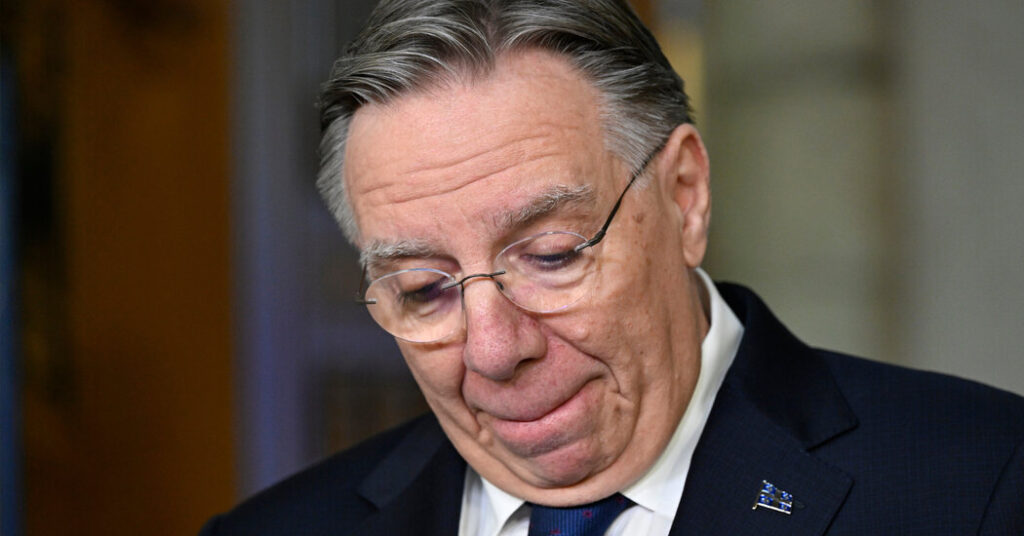
The deeply unpopular premier of Quebec, François Legault, said on Wednesday that he would resign after seven years in power, acknowledging after months of desperate attempts to revive his standing in the polls that “Quebecers want change.”
The announcement — only weeks after Mr. Legault’s pledge to run for a third term — could upend the political dynamics in Canada’s French-speaking province ahead of a general election likely to be held next fall.
Mr. Legault said that he would step down after his party, Coalition Avenir Québec, a pro-business, center-right party, selects a new leader.
It could now mount a more solid challenge to the party currently leading in the polls, the pro-separatist Parti Québécois, which has vowed to hold a referendum on independence from the rest of Canada. Mr. Legault’s party opposes separatist efforts.
“For the good of my party and especially for the good of Quebec, I’m announcing that I will resign as premier,’’ Mr. Legault said during an 18-minute news conference in Quebec City, declining to take follow-up questions from journalists.
By resigning, Mr. Legault, 68, said he hoped that the next election would be decided “not on a simple desire for change’’ but on the great challenges facing Quebec, including restructuring its economy and stopping the decline of the French language, especially in Montreal.
Mr. Legault rose to become one of Canada’s most popular premiers during the pandemic thanks to his reassuring, avuncular presence. He was overwhelmingly elected to a second four-year term in October 2022. But in the past three years, the failure to establish a high-profile battery plant, the troubled digitizing of some government services and other missteps sank Mr. Legault and his party in the polls.
As Mr. Legault, according to several polls, became Canada’s most unpopular premier, he grasped unsuccessfully at policies designed to give him a rapid boost. In September, Mr. Legault compared himself to the fictional boxer Rocky Balboa, posing with his fists clenched, and said that he would triumph .
But most of his attempts, including recent hardball negotiations over pay with the province’s medical doctors, backfired and left him little leeway in launching a campaign for a third term.
A businessman who co-founded a budget airline before entering politics, Mr. Legault offered a third way in Quebec politics, which was historically dominated by the pro-separatist, social democratic Parti Québécois and the pro-federalist, pro-business Quebec Liberal Party.
Mr. Legault’s party was staunchly pro-business and, though opposing independence, tapped into a French Québécois nationalism that appealed to the province’s majority, especially among older and rural voters.
Under Mr. Legault, Quebec banned public employees from wearing religious symbols in the workplace, saying that the law was necessary to safeguard the province’s secular identity. Critics said the move was meant to score political points by targeting Muslims.
Mr. Legault’s government also passed legislation further strengthening the use of French in business, education and government — at the expense, critics said, of English speakers. Mr. Legault and his allies have said that the use of French has declined in the province, especially in its biggest city, Montreal. But critics say that Mr. Legault’s assertion relies on a narrow, ethnic-based definition of French speakers.
Quebec’s next general election must be held by Oct. 5, but could be held earlier.
Today, the Parti Québécois enjoys a strong lead in the polls. Its charismatic leader, Paul St-Pierre Plamondon, has said that if his party takes power, he will hold a referendum on independence during his first term. The pro-federalist Liberal Party is languishing in the polls after revelations of campaign misdeeds recently forced its newly elected leader to step down.
Polls show that the majority of Quebecers do not back independence. Quebec has grown more international since two failed attempts at secession, in 1995 and 1980.
A separatist movement is also brewing in Alberta, the oil-rich province in western Canada, where separatists and others believe that the federal government wields too much power over them.
Norimitsu Onishi reports on life, society and culture in Canada. He is based in Montreal.
The post Quebec’s Unpopular Leader to Resign Ahead of Elections appeared first on New York Times.