Republican leaders in the Senate are mounting a last-minute effort to snuff out dissent within their own party and block a resolution that would require President Trump to seek congressional approval for any U.S. military action related to Venezuela.
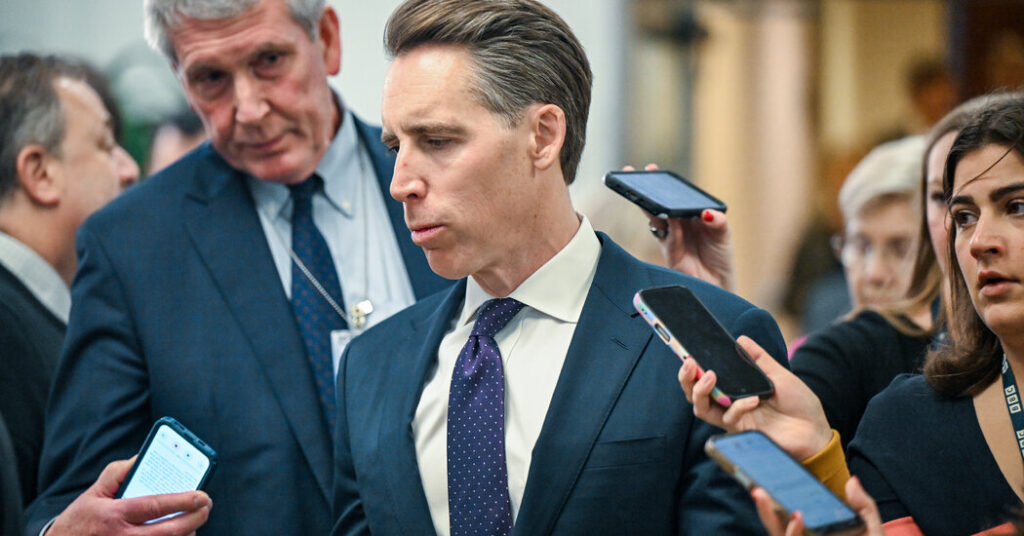
The effort has already succeeded in changing one mind, that of Senator Josh Hawley of Missouri, who last week voted with four other Republicans and all Democrats to advance the measure aiming to curb the president’s war powers.
Their dissent enraged Mr. Trump who, in a social media post, condemned their “stupidity” and said they should lose their seats in Congress. White House officials and Republican leaders have been pressing the five defectors to change their votes.
If the lobbying effort succeeds, party leaders could avoid a vote on the issue altogether.
The attention has now turned to Senators Todd Young of Indiana and Susan Collins of Maine, who could provide the additional vote needed for Republicans to defeat the resolution.
Two other Republicans, Senators Lisa Murkowski of Alaska and Rand Paul of Kentucky, are seen as less likely to concede. They previously supported similar efforts to reassert congressional authority over Mr. Trump’s ability to use military force.
The effort to derail the vote has centered on arguments that U.S. forces were no longer operating in Venezuela and that the mission was complete. Administration officials and Republican leaders have sought to portray the military action as a discrete one rather than a protracted open-ended engagement, downplaying concerns raised by lawmakers about what could come next.
On Tuesday, Senator James R. Risch, Republican of Idaho and the chairman of the Foreign Relations Committee, asked the White House in a letter to confirm that Operation Absolute Resolve had ended and that “U.S. military personnel are no longer involved in hostilities in Venezuela.”
In a response sent Wednesday morning, Secretary of State Marco Rubio emphasized the limited scope of the operation and assured Mr. Risch that “there are currently no U.S. armed forces in Venezuela.” He also said that any future military actions that placed American forces into hostilities would be undertaken “consistent with the Constitution” and that Congress would be notified in accordance with the War Powers Resolution.
Such notifications from the Trump administration have come only after military operations have been carried out, including the dozens of strikes on vessels in the Caribbean and Pacific Oceans and the operation to capture Venezuela’s president, Nicolás Maduro.
Mr. Hawley said that assurances from Mr. Rubio in the letter, and in phone calls from both the secretary and Mr. Trump, had convinced him that the resolution was no longer needed.
The resolution, led by Senators Tim Kaine of Virginia, Adam B. Schiff of California, and Chuck Schumer of New York, the minority leader, all Democrats, together with Mr. Paul, would “direct the removal of United States armed forces from hostilities within or against Venezuela that have not been authorized by Congress.”
If the measure were to pass the Senate, a vote would be required in the House, which rejected two similar resolutions last month. And even then, Mr. Trump would be all but certain to veto it.
Last week, Mr. Hawley said that efforts to reassure senators in classified briefings that Mr. Trump did not plan to put U.S. boots on the ground did not sway him.
“He thinks that’s unlikely, which is great — that’s terrific,” Mr. Hawley said at the time. “But what I had to vote on today was: Does Congress need to authorize future in-country military operations? And I think we probably will need to under Article One.”
Now, he said that recent assurances from Mr. Rubio to “follow the relevant statutes in the Constitution” and not place U.S. ground troops in Venezuela without consulting Congress were enough.
“Nobody knows what will happen,” Mr. Hawley said Wednesday morning, “and that is why the commitment today from him to follow the relevant statutes, the notification procedures and to come back to Congress, I think, is really significant.”
Republican leaders are seeking additional support for a procedural move that would defeat the resolution before it comes up for a vote by arguing that because U.S. troops are not currently in Venezuela, the issue is not germane.
“It’s pretty clear, in my view at least, that there are no hostilities that exist today, which, as I’ve suggested before, means that it shouldn’t be accorded privilege on the floor,” Senator John Thune of South Dakota, the majority leader, said Wednesday morning.
If at least one more of the five G.O.P. senators changed their vote, it would trigger a tie that could be broken by the vice president to effectively kill the bill.
Such a move, a procedural sleight of hand to cut off debate and avoid the possibility of an embarrassing defeat for Mr. Trump, provides the Republican defectors an offramp without fully appearing to abandon their objections.
Mr. Paul, Ms. Collins and Ms. Murkowski affirmed their positions. Mr. Young did not disclose whether or not his position had changed.
Democrats argued that the U.S. military remained involved, and they insisted that congressional oversight was required.
“There are U.S. military seizing Venezuelan oil every day. There’s U.S. military striking Venezuelans on boats in the water every day. We’re not occupying their country without the military,” Mr. Kaine said. “We just went in and deposed their government. We are controlling who governs the country. We are controlling when Venezuelans are entitled to have elections again, we’re controlling their chief economic asset. That’s all being done by the U.S. military.”
Robert Jimison covers Congress for The Times, with a focus on defense issues and foreign policy.
The post Republicans Move to Block Effort to Check Trump’s Power in Venezuela appeared first on New York Times.