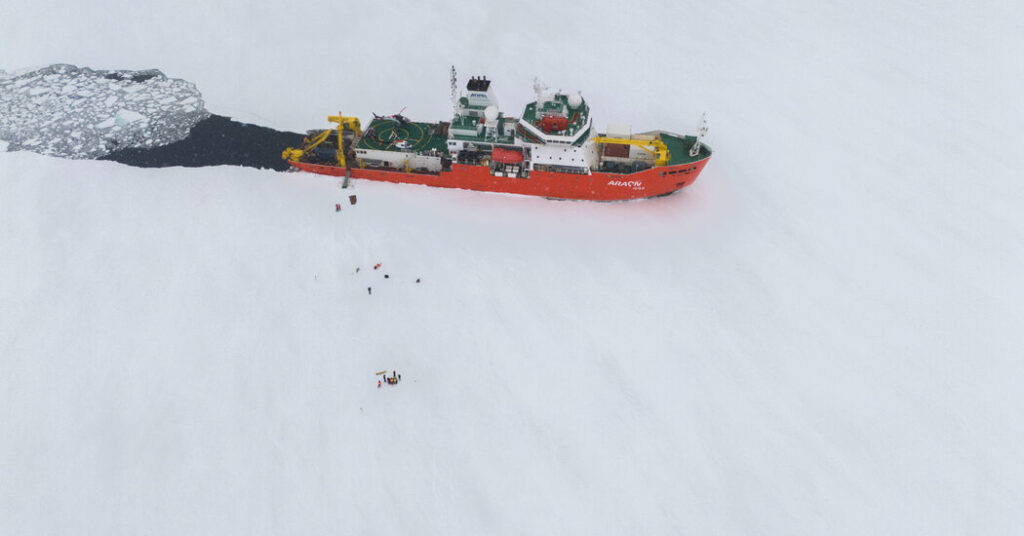
The icebreaker Araon had been parked nose-to-nose with Antarctica’s massive Thwaites Glacier for days, but stubborn low clouds made it impossible to land helicopters on the glacier and start the expedition’s main research project.
So the ship set sail for nearby Pine Island Glacier on Tuesday, with plans to come back in a few days to make more attempts to get onto Thwaites.
In 10 years of flying scientists in helicopters at Thwaites, Dominic O’Rourke, one of our expedition’s two pilots, said he couldn’t recall another field season that began with so many days of uncooperative weather. “It’s a gnarly start, for sure,” he said.
As the ship traveled north, it encountered an especially vast and sturdy plate of frozen sea, so we plowed a path through and stopped in the middle.
The world around us felt unreal. Snow fell from a perfectly smooth ceiling of white clouds. The sea ice stretched to the horizon in all directions. There was no sky, no ocean, just a universe of white. The first time we step off the ship in more than two weeks, and we step into this?
Siobhan Johnson, an expert on sea ice, was ready to venture onto the floe.
The crew extended the gangway, and Ms. Johnson, a doctoral candidate at the University of Cambridge and the British Antarctic Survey, walked down to the ice with two field guides, Taff Raymond and Seokju Woo. Mr. Woo strode ahead, jabbing a pole into the ice beside him to test it. Where the ice was weak, Mr. Raymond made an X with two red flags. The message was clear: “Don’t tread here.”
Once they had walked about 600 feet, Ms. Johnson beckoned, and three teams of scientists joined them on the ice.
Nathan Teder, a postdoctoral researcher at the University of Melbourne, and Victoria Beveridge, a student at Adelaide University, helped Ms. Johnson collect samples of the sea ice. With a power drill, they rammed a metal cylinder down to pull out long cross-sections of the floe, with all its layers of snow and slush and crystals of varying textures and structures.
Another team calibrated the compass on a robot that was to be deployed later in the seas near Pine Island Glacier. The calibration would help ensure the robot could be steered accurately. The third group surveyed the ice’s inner structure with a device towed on a snow tube.
Under our boots, the ice felt as solid as land, at least in the area the guides declared safe. According to Ms. Johnson’s ice cores, the floe was about two-and-a-half feet thick.
Nothing about the scene suggested it was unfolding atop seawater. In fact, after an hour or so, it all felt as normal as a snow day in the park: Once the scientists wrapped up their work, they strolled, took photos and threw snowballs.
Ms. Beveridge had just pulled a seawater sample from the hole where her team had extracted an ice core when she cried out: “Penguin, penguin, penguin!”
It was a lone Adélie penguin, waddling and sliding on its belly around this gaggle of scientists horsing around. It eyed us in a way that suggested, perhaps rightly, that we were the strange ones.
Raymond Zhong reports on climate and environmental issues for The Times.
The post Walking Off Into a Universe of White appeared first on New York Times.