Pipaluk Lynge knows the history of how Indigenous people have been treated in the United States. And she’s well aware of the holes in the country’s health care system and its yawning economic inequality.
Ms. Lynge, one of Greenland’s top officials and the leader of the Parliament’s foreign and security policy committee, chafes at President Trump’s offer to buy Greenland, an autonomous territory of Denmark, and his insistence that Greenlanders would be better off as Americans.
“We’re not going to sell our soul,” she said. “We’re not stupid.”
As President Trump seems to toy with Greenland’s fate, a kaleidoscope of feelings swirl in Greenland itself. People are shocked, angry, confused, humiliated, insulted and, most of all, scared.
For centuries, the world has mostly ignored this gigantic slab of ice and rock poking into the Arctic Circle and the Inuit people who learned to survive on it. It has been a distant part of the Danish Realm for more than 300 years, and now Greenlanders are trying to insert themselves into the discussions about their future before it’s too late.
On Wednesday, Greenland’s foreign minister is set to take part in a high-powered meeting in Washington, the first time this island has ever been directly involved in something of this magnitude. Secretary of State Marco Rubio and Vice President JD Vance are holding talks with Greenlandic and Danish officials in the shadow of escalating threats from Mr. Trump, who recently vowed to “do something on Greenland, whether they like it or not.”
Interviews in the past few days with Greenlanders from different parts of the territory and different walks of life reveal that people on the island don’t want to be recolonized by a new outside power, and that only a small minority has even the faintest flicker of interest in joining the United States.
They like their Scandinavian welfare system, with its free health care, free education and strong safety net. They feel connected to Denmark even if there are still raw feelings about earlier eras of colonialism and abuse.
And they certainly don’t want to be bought by anyone, but acknowledge that economically they can’t stand on their own two feet.
“It’s not the time to be independent,” said Nielsine Lange, a special-education teacher in Ilulissat, a town on the west coast. “It would be too dangerous, and people wouldn’t be responsible enough. We need to pull ourselves together first — independence is a goal, but there’s a long way to go.”
Though Denmark has long ruled Greenland, the territory has steadily been gaining more confidence and autonomy. Under Danish law, the island has the right to call for a referendum on independence and split off. But that hasn’t happened yet, in part because Greenland still relies on hundreds of millions of dollars each year in Danish subsidies.
Part of the discomfort of this moment is that the island has been thrust into a geopolitical maelstrom it is ill equipped for. Despite its vast area, bigger than Mexico’s, Greenland, the world’s largest island, has just 57,000 people. Once again, decisions that could drastically affect it will be made in offices thousands of miles away.
Mr. Trump and his team are attracted to Greenland for a host of reasons: its size, its minerals and its strategic location bordering Canada, the Arctic Ocean and the Atlantic. The United States has been interested in Greenland for more than 150 years, for many of the same reasons.
Under a Cold War treaty, American forces already enjoy almost unfettered military access, which many Greenlanders were quick to point out. So why, they wonder, does Mr. Trump keep citing “national security” as a rationale for seizing the territory?
Instead of trying to win hearts and minds, Mr. Trump’s approach to Greenland seems to reflect a view that in global affairs the strong act, vying with each other for dominance, and the weak live with the consequences. Just as he justified seizing control of Venezuela’s oil output in part by saying that otherwise China or Russia would do so, he has claimed that if the United States does not take over Greenland, one of those other powers will.
Trump Administration: Live Updates
Updated
- Denmark sends more military forces to Greenland after Trump’s threats to seize control of it.
- Some U.S. personnel are moved from a Qatari air base as tensions mount with Iran.
- F.B.I. agents searched the home of a Washington Post journalist for classified material.
Greenlanders don’t like that outlook, and especially his vow to simply “get” their island.
“We’ve never heard anyone talk like that about another country before,” said Ellen Frederiksen, a retired doctor in Narsaq, a town in the south.
Greenlandic officials are trying to kick into high gear. They are working to overcome internal political differences and speak in one voice. They’ve shuttled back and forth between Nuuk, the capital, and Copenhagen. They’ve made increasingly blunt statements that they don’t want to become part of the United States.
“If we have to choose between the United States and Denmark,” the island’s prime minister, Jens-Frederik Nielsen, said on Tuesday, “we choose Denmark.”
But relations with Denmark remain touchy.
An online meeting last week between Danish and Greenlandic officials exploded into accusations and shouting, according to Ms. Lynge and numerous reports in the Danish news media. Ms. Lynge said that she was furious when she found out that Danish officials were excluding her from other meetings about Greenland and that she raised her voice and pounded the table, accusing her Danish colleagues of acting “neocolonialist.”
“I’d had enough,” Ms. Lynge said. “We’ve raised the same issues for years, and if I had stayed diplomatic nothing would have happened.”
She also said the Danish officials had later agreed to include Greenlanders in more discussions.
The row hit upon one of the most contentious underlying questions: Should Greenland still be part of the Danish Kingdom?
“It makes no sense,” said Vittus Qujaukitsoq, a former Greenlandic minister. “We’ve been ignored long enough.”
Still, he said, he didn’t want to become part of the United States. He prefers independence.
Polls and interviews show that there’s a small contingent of pro-American Greenlanders, including a bricklayer who attended Mr. Trump’s inauguration. But a majority of the population fears being absorbed into the United States and seems to be drawing closer to Denmark, viewing it as the best protection from Mr. Trump.
It’s a feeling shared in Nuuk, which resembles a small, modern Danish town with its big supermarkets and razor-straight roads, and in remote outposts like Kulusuk, in the east, where a few hundred people live in brightly painted houses huddled along the sea.
“I hunt whales and seals,” said Kunuk Abelsen, who lives in Kulusuk. “In the United States they think whales and seals are cute and shouldn’t be hunted. That’s what I’m afraid of.”
He wants to stay with Denmark.
One idea floating around as a potential compromise is a free association agreement with the United States, like those some Pacific island nations have with Washington. Such arrangements allow small countries to be independent, with seats at the United Nations, while the United States provides subsidies and its military provides for the nations’ defense.
Ms. Lynge said she didn’t want such a relationship and feared her homeland, under the United States, could become “a mining island.”
She speaks forcefully, but the pressure shows. She has been sleeping badly, she said, and feels an enormous weight of responsibility.
“I don’t want to look back and think I should have done more,” she said.
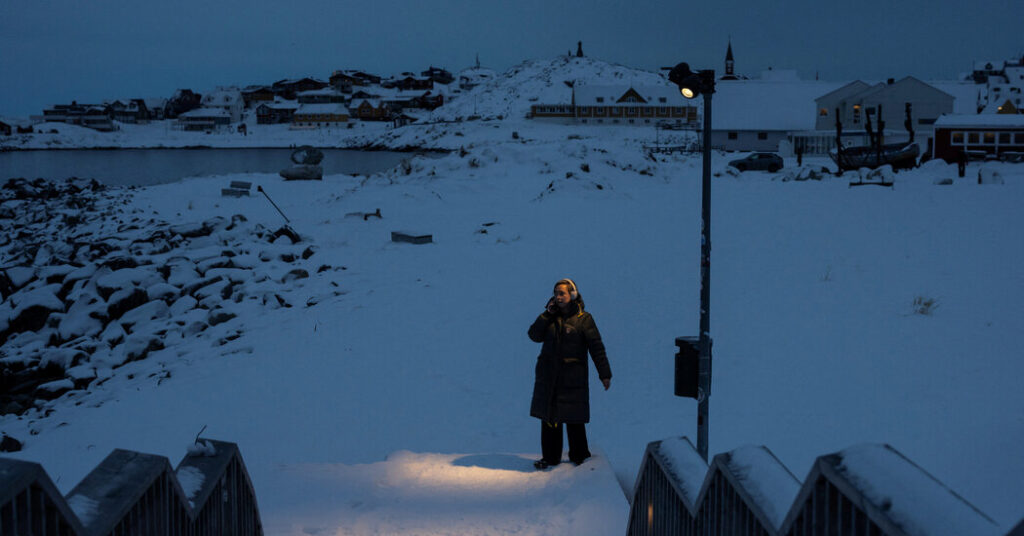
As the interview wrapped up, she pulled on her coat and stepped outside, into the gathering snow. She parted with a message to the world: “Stand with us.”
Jeffrey Gettleman is an international correspondent based in London covering global events. He has worked for The Times for more than 20 years.
The post ‘We’re Not Stupid’: What Greenlanders Would Say to Trump appeared first on New York Times.