Call it the year of the mega initial public offering. Or the year of the I.P.O. supercycle. Or the monster listing mania, perhaps.
At least three of the most valuable and highest-profile tech companies are preparing to list their shares on the public market, setting up a watershed moment for Silicon Valley and its artificial intelligence boom.
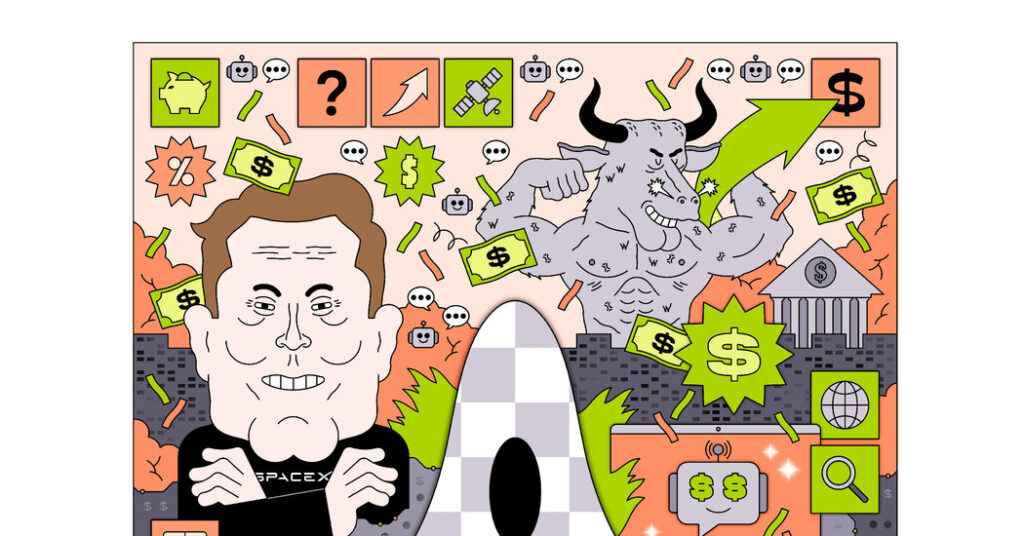
Anthropic and OpenAI, two prominent A.I. companies, have taken early steps to go public, people familiar with the companies said. And SpaceX, Elon Musk’s rocket company, has interviewed banks to lead an I.P.O., according to two people with knowledge of the situation.
Any one of those private companies would be among the most valuable to go public, after Saudi Aramco’s 2019 debut valued the energy giant at $1.7 trillion. Anthropic is in funding talks that would value it at $350 billion, while OpenAI is worth $500 billion and SpaceX was most recently valued at $800 billion.
“We’re going to get into a period of potentially unprecedented I.P.O. deal sizes,” said Eddie Molloy, global co-head of equity capital markets at Morgan Stanley, not referring to any companies in particular. “But we are confident they’re executable given the scale of these companies and the investor interest.”
These listings could create an enormous bonanza for Wall Street and Silicon Valley after years of lackluster offerings. They could set off a feeding frenzy among public market investors who have been waiting to get a piece of the A.I. boom, and Wall Street banks stand to make hundreds of millions facilitating the listings.
That is stoking more excitement for the A.I. boom as it enters its fourth year, even as the question of a bubble intensifies.
“In two decades, I haven’t seen private companies that are this meaningful and are this impactful,” said Jeremy Abelson, an investor at Irving Investors, a firm that backs start-ups before they go public. “Not only are they bigger and more relevant, but they’re incredible companies with numbers that we’ve never seen before, ever.”
Any increase in volatility, geopolitical risk or uncertainty around the midterm elections — or if they simply are not ready — could mean the companies do not go public until later. Anthropic and OpenAI in particular are very early in the process. In December, Anthropic, which is based in San Francisco, asked the law firm Wilson Sonsini to help it begin preparations to go public, a person familiar with the situation said. The move was reported earlier by The Financial Times.
OpenAI, also based in San Francisco, spent 2025 converting from a nonprofit to a for-profit company with the goal of going public. In a December podcast interview, Sam Altman, the chief executive, said that he was “zero percent” excited about leading a public company, but that OpenAI needed to keep raising more money.
SpaceX, founded 24 years ago, has made the most concrete moves toward going public. The company, incorporated in Texas, has interviewed banks and announced its I.P.O. intentions to shareholders. It has emphasized the A.I. angle of its business, telling investors that it plans to use the proceeds from a listing to build A.I. data centers in space.
OpenAI and Anthropic declined to comment. SpaceX did not respond to a request for comment. (The New York Times has sued OpenAI and its partner, Microsoft, over copyright infringement of news content. Both companies have denied wrongdoing.)
I.P.O.s have been in a slump since 2021, when 397 companies raised $142 billion in the United States, according to Renaissance Capital, which tracks listings. Last year, 202 companies went public in the United States, raising $44 billion. Momentum was hurt by uncertainty around tariffs and the government shutdown last fall, said Jeff Thomas, the head of listings at Nasdaq.
Even one giant I.P.O. in 2026 could encourage others to take the plunge. Some smaller start-ups have already taken steps to list their shares this year. Motive Technologies, which provides A.I. software for the trucking industry, filed a prospectus last month for a public offering, and Kraken, a crypto exchange, submitted a confidential filing in November.
“When these megadeals happen, it takes some of the air out of the room,” Mr. Thomas said. “You want to try to get ahead of it.”
The I.P.O.s could end the A.I. bubble debate by providing a detailed look at the businesses, investors said. Just as Facebook’s initial public offering in 2012 solidified social media as a large business, these I.P.O.s could bring A.I. and space into the mainstream and test their moneymaking viability. So far, the companies have shared only limited information about their growth, deal-making and spending.
“There is such a big information gap right now,” said Jeff Richards, an investor at Notable Capital, a venture capital firm that has backed Anthropic. “The biggest positive for this entire market would be if a bunch of these companies went public and people could actually see the numbers.”
For more than a decade, tech start-ups have put off going public for as long as possible. New sources of private capital rushed to invest in Silicon Valley’s billion-dollar “unicorn” start-ups, providing the young companies with an alternative to the expense and spotlight of going public.
Companies that can grow privately “will choose to do that almost every time, because it’s an easier place to grow,” said Ian Schuman, who leads the I.P.O. practice at the law firm Latham & Watkins.
The A.I. boom changed that strategy, partly because the companies need far more money than past generations of start-ups to pay for data centers and cloud computing. OpenAI has raised more than $60 billion in funding, breaking private funding records. Anthropic has raised at least $40 billion and is in talks to collect an additional $10 billion.
They and their peers have ramped up quickly. OpenAI, which charges subscription fees for its ChatGPT chatbot and other software, hit $13 billion in revenue last year and expects to triple that this year, a person with knowledge of the company said. Anthropic, which primarily sells A.I. software to other businesses, hit a monthly pace last year for $8 billion to $10 billion in annual revenue, its chief executive, Dario Amodei, said in December. It is unclear if the companies can sustain these growth levels.
They are also spending at an astonishing rate. OpenAI plans to shell out $115 billion between 2025 and 2029, the person familiar with the company said. To pay for the outlays, the companies have raised huge back-to-back funding rounds at valuations that continue to soar. Tapping the public markets is a way to raise an enormous amount of money in one shot.
The fast growth of A.I. companies has also changed the expectations of start-up employees, said Jeremy Kranz, an investor at Sentinel Global, a venture capital firm. Instead of waiting seven or eight years to cash out on their valuable stock, many engineers at A.I. start-ups expect a payout in two to three years, he said.
The public listings of OpenAI, SpaceX and Anthropic could mint more than 16,000 millionaires, according to an estimate compiled by Sacra, which provides research on private markets. Sacra based its estimate on the companies’ valuations, their stock option practices, and their numbers of current and former employees. Such a widespread windfall would only accelerate the Silicon Valley circle of life, in which employees of one successful start-up use their newfound wealth to fund the next generation.
Offerings of these sizes will require all hands on deck at Wall Street banks, with advisers seeking to line up investors that can write large enough checks for the listings.
That requires extensive global coordination across “mutual funds, hedge funds, sovereign wealth funds, pension funds” and retail investors, said David Bauer, a co-head of equity capital markets in the Americas at JPMorgan Chase. The large offerings will most likely look to get at least a few large-scale investors on board ahead of time, advisers said.
But there are skeptics. Paul Wick, a public market tech investor for the last 30 years at Seligman Investments, said he was not impressed so far by the A.I. companies’ business models. While Facebook and Google, which went public in 2004, were “profit machines with huge growth and great barriers to entry” before their I.P.O.s, the A.I. companies appear to be losing a lot of money and have a constant need to raise more, he said.
“That doesn’t fill me with confidence,” he said. “It doesn’t leave me clamoring to get my hands on these when they go public.”
Cade Metz contributed reporting.
Erin Griffith covers tech companies, start-ups and the culture of Silicon Valley from San Francisco.
The post 2026 May Be the Year of the Mega I.P.O. appeared first on New York Times.