At some point, the internet broke our ability to trust anything, including landscapes. If a place looks too strange, too dramatic, or too perfectly wrong, the instinct is to assume it’s AI. Then you realize it’s real, it has a name, and people are standing there right now taking photos that look completely made up, and quite frankly, otherworldly.
Here are 8 real locations that look like they belong on a far-off planet or a wild sci-fi set.
1. Wadi Rum, Jordan
Sunset in Wadi Rum, Jordan [OC] [1800×1294]
byu/Anton_AA inEarthPorn
A red desert packed with towering cliffs, natural arches, and canyons that look like they were designed for a space movie, because they basically were. It’s also loaded with petroglyphs and evidence of human life stretching back thousands of years, which feels pretty damn cool for one place.
2. White Sands National Park, New Mexico
It’s a blinding white ocean of dunes made from gypsum, not your standard sand. The National Park Service calls it the world’s largest gypsum dunefield, which explains why it looks like you stepped onto another planet and immediately lost your sunglasses.
3. Grand Prismatic Spring, Yellowstone
What the Grand Prismatic Spring of Yellowstone would look like if all man-made objects were removed – Akin Bilgic [OC] [5000×3275]
byu/AkinBilgic inEarthPorn
This is the hot spring that looks like a neon eye staring back at you. It’s Yellowstone’s largest hot spring, and it’s massive enough that it looks like CGI from above, except it’s microbial mats and superheated water doing their weird little science thing.
4. Socotra Archipelago, Yemen
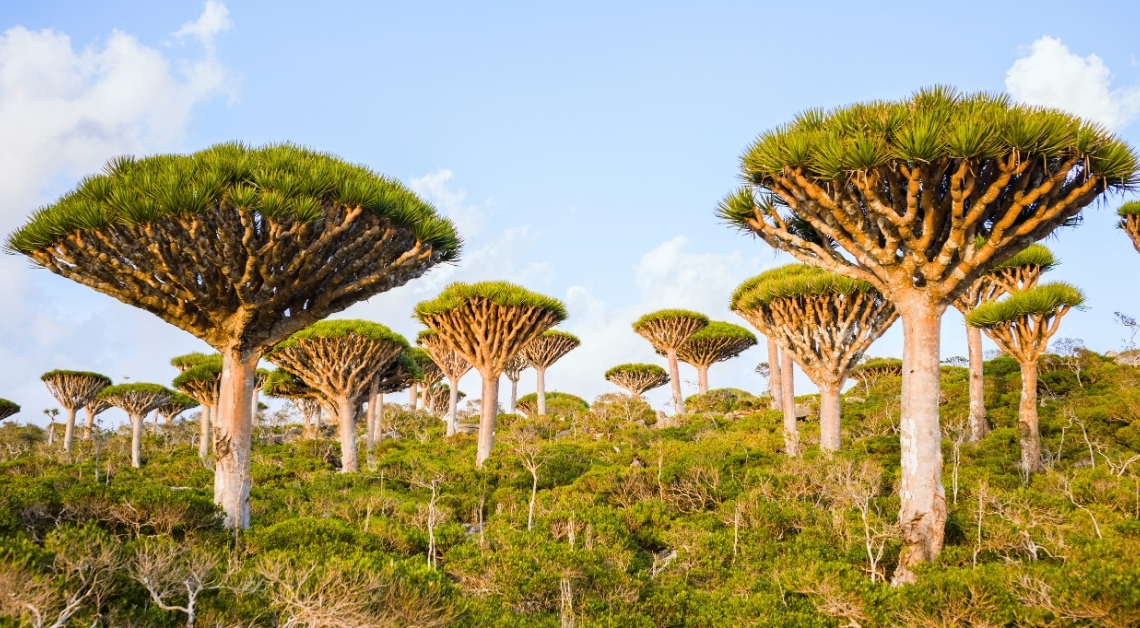
If Dr. Seuss wrote a field guide, it would look like Socotra. UNESCO notes the islands have extreme plant endemism, including the famously alien-looking dragon’s blood trees that make the whole landscape feel slightly unreal.
5. Giant’s Causeway, Northern Ireland
This natural phenomenon is called the Giant’s Causeway in N.Ireland
byu/fingers ingeology
Forty thousand-ish basalt columns, stacked like nature got obsessed with geometry and refused to stop. UNESCO describes it as a “pavement” of polygonal columns, which is accurate, but it still feels like you’re walking across a fossilized Minecraft map.
6. Salar de Uyuni, Bolivia
“The largest mirror in the world”, the Salar de Uyuni in Potosí, Bolivia is the largest salt desert in the world and is over 10,000 square kilometres in area. Following rain, a thin layer of water transforms the flat desert into a 129 kilometer mirror, the largest on Earth.
byu/TheGreatSilverFang ininterestingasfuck
NASA calls it the largest salt flat in the world, stretching about 10,000 square kilometers. In the rainy season, water turns it into a giant mirror, so the horizon disappears and you start questioning your depth perception.
7. Dallol, Ethiopia (Danakil Depression)
Dallol sits in the Danakil Depression, and the Smithsonian’s volcano program describes it as a volcanic area rising above a salt plain below sea level. Translation for normal people: it’s an otherworldly salt-and-mineral landscape that looks chemically aggressive.
8. Namib Sand Sea, Namibia
Where the Namib Desert meets the Atlantic Ocean
byu/buyerforever321 inNatureIsFuckingLit
UNESCO calls it the only coastal desert with extensive dune fields influenced by fog, which is such a specific flex. The result is towering dunes, shifting shapes, and a landscape that looks like Mars with mood lighting.
These places aren’t IG backdrops. They’re real locations that survive in spite of us, not because of us. Acting like a responsible human when you get there is the bare minimum.
The post 8 Very Real Places You Can Visit That Look Like Another Planet appeared first on VICE.