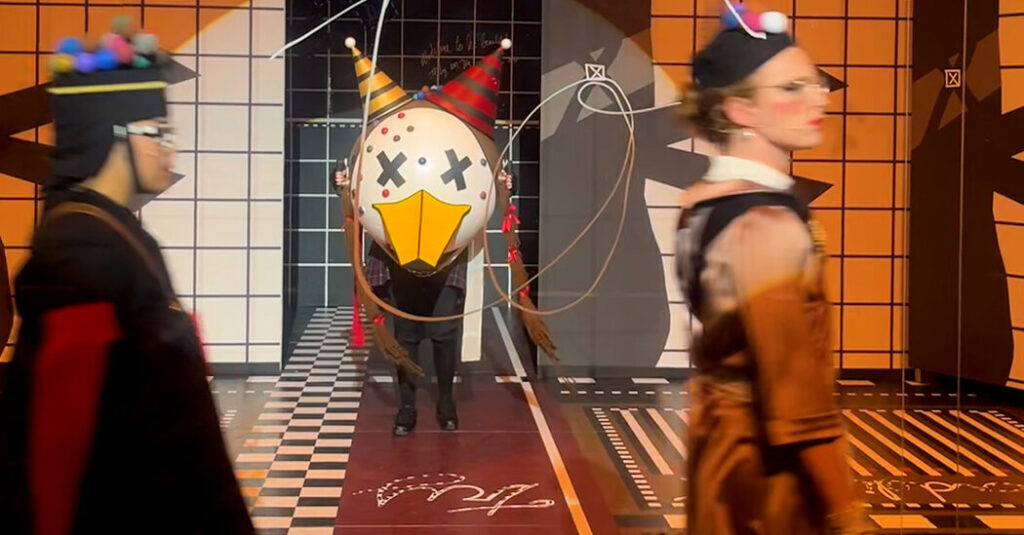
Summing up a Richard Foreman show is a fool’s errand, but the composer Michael Gordon gave it a shot. “It’s a piece with four Madeline Xs,” he said of the opera “What to Wear,” his collaboration with Foreman. “They’re trying to find things to wear, they are undergoing analysis, experts are confused about them and there’s a duck.” Actually, there are a lot of ducks: “a giant duck, a great duck, an ugly duckling, a roasted duck,” Gordon added. “There are amusement park rocking ducks.” A pause. “And that’s really what the piece is about.”
Why a duck? Gordon knows only that it was important to Foreman, the experimental director and theater impresario who wrote the opera’s Surrealism-drenched libretto, then staged and conceptualized the original production at CalArts, in 2006.
“He gave me complete freedom to use any of the words I wanted, and not use any of the words or scenes,” Gordon, 69, said at the Brooklyn Academy of Music, where a remounted version of the show opens on Thursday and runs through Sunday. Well, maybe not complete freedom. “When he gave me the libretto he said: ‘There’s a duck. I need the duck.’ That was his only instruction.”
Regardless of how you interpret it, “What to Wear” was well received. A review in The Los Angeles Times remarked that it was “what opera in America might have been like if the Virgil Thomson/Gertrude Stein model in the ’30s had become mainstream and kept evolving.”
It looked as if the duck might stop there. But shortly before Covid hit, a weakened Foreman (who died in 2025 at 87) asked Paul Lazar and Annie-B Parson of Big Dance Theater to stage “What to Wear” for its belated New York premiere.
“He was just like, ‘Do whatever you want with it,’” said Parson, a longtime Foreman fan who called him and George Balanchine her favorite choreographers. “At first I heard it as an older artist being generous, but later I realized it’s kind of a choreographic directive, in a sense. At the end of the day we are not changing anything, because it’s perfect.”
Featuring the musician St. Vincent as Guest Madeline X, the new iteration closely shadows the first one. (The 70-minute work is produced by Beth Morrison Projects in a collaboration with BAM, the Prototype festival and Bang on a Can.) In addition to Gordon, Lazar and Parson had access to video of the Los Angeles production and benefited from the participation of the soprano Sarah Frei, the technical director Michael Darling and the costume designer E.B. Brooks, all of whom had been at CalArts. “It’s our archaeological thread back to the original,” Lazar said.
Beyond introducing New York to the pleasures of “What to Wear,” the show’s return allows audiences an opportunity to experience the conflagration that happens when Foreman’s aesthetic — off-kilter yet requiring heightened rigor and virtuosity — meets music, an aspect of his career that has been overlooked in recent decades.
Foreman, who directed major works like “Threepenny Opera” on Broadway in 1976 and Johann Strauss’s “Die Fledermaus” at the Paris Opera in 1983, also created several music-theater pieces, most in collaboration with the composer Stanley Silverman. Their musical “Doctor Selavy’s Magic Theater,” for one, had a healthy Off Broadway run, a cast album and a reboot in 1984. A review in The New York Times praised it as “‘Marat/Sade’ as if executed by Marcel Duchamp, Soupy Sales, Mack Sennett, Busby Berkeley, the cast of ‘Hair,’ Julius Monk and Sigmund Freud.”
It was not surprising, then, when in 2004 Foreman reached out to Gordon to ask if he would consider teaming up on an opera. A founding member of Bang on a Can whose style often incorporates repetition and rocking electric instrumentation, Gordon had seen “Doctor Selavy” in 1973 when he came to New York from Florida to visit his sister. His teenage take? “Whoa.”
Foreman, Gordon said, was extremely knowledgeable about music, with ecumenical tastes. At the start of their collaboration, Foreman sent him a note in which he wrote that he had listened to Gordon’s albums “Weather” and “Trance” and hoped the score for “What to Wear” would incorporate “lots of that kind of bass-driven beat with chanting etc.” He then added, “But of course I realize you have to respond as you will.”
Foreman did not submit a typical libretto or lyrics, which suited Gordon just fine. He described Foreman’s writing as having “a rhythm, and as a composer you’re looking for something that speaks to you and says ‘I want to be sung.’” Gordon quoted a line as an example: “‘A duck says, I am a duck who would prefer a roast beef sandwich to eat, I would prefer cream cheese on toast or rolls to eat with butter, and spaghetti.’”
“A text like that,” Gordon added, “is incredibly liberating because there are no boundaries.”
Fittingly for work that can feel free-associative and often engages with the unconscious, Foreman’s visions have a way of worming themselves into the brain. During our conversation, Parson mentioned that she had just had a dream that Joan Rivers was doing a stand-up monologue about Creon and Eurydice’s marriage. “I was like, ‘Oh, my God, I would have never dreamed this if I hadn’t been working on this,’” she said. “It really stimulates your mind.”
Parson said she thought that St. Vincent, one of her collaborators from the pop world, would be simpatico with the show’s sensibility, and she invited her to join the team. “She’s almost an angel that flies in and sings this very lonely, sad and yet extremely arrogant song,” the choreographer said with a laugh. “We just thought it’d be cool because she has such amazing theatrical bones and she was willing to do it.”
St. Vincent enjoys working with Parson so much that she immediately agreed to participate. “My first impression was just being totally blown away by the music,” she said over the phone. Then the reality of the show hit.
“I got to see a run-through yesterday with no props, no staging, just the raw material, and it was astounding,” she said. “I was just delighted — I laughed. I was moved. I can’t even describe to you how exhilarating it was.”
There is a contagious giddiness to the controlled chaos unfolding onstage, even if you have no idea what those ducks are up to.
“I hope the piece is fun,” Gordon said, laughing, “I think people will come and go, ‘I don’t know what just happened, but I had a great time.’”
The post Applying Richard Foreman’s Off-Kilter Aesthetic (and Ducks) to Opera appeared first on New York Times.