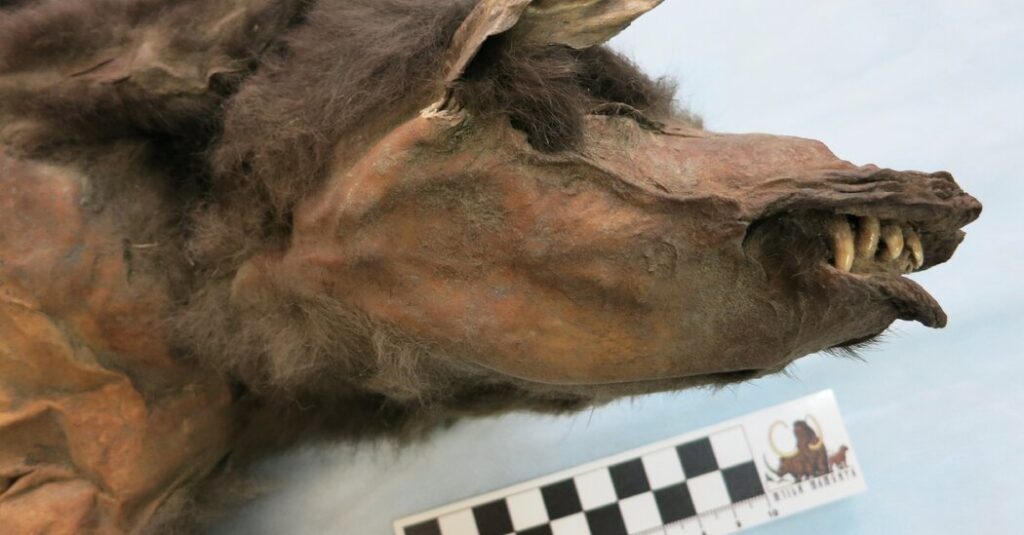
It’s not every day that one gets to hold a chunk of hide from an extinct woolly rhinoceros in their hands.
“I don’t think I will ever forget that,” said Sólveig Guðjónsdóttir, who studied the specimen in 2022 and 2023 while she was a graduate student in evolutionary genomics at Stockholm University. “That was so incredibly exciting. The thing I remember most clearly is the fur.”
Woolly rhinoceroses resembled today’s rhinos. Just add thick hair and a large hump. They went extinct about 14,000 years ago during a period that coincided with a sudden warming of the northern hemisphere.
The place where the tissue fragment was found was even more extraordinary: inside the stomach of an ancient wolf pup preserved in the permafrost of northeast Siberia. The wolf probably feasted on the rhino right before it, too, succumbed.
Both animals are some 14,400 years old, suggesting that this woolly rhinoceros lived only several centuries before its species’ extinction.
In a paper published on Wednesday in the journal Genome Biology and Evolution, Ms. Guðjónsdóttir and her colleagues report that they managed to use the partially digested hide to produce a high-quality genome sequence of the ancient woolly rhinoceros — even more complete than they had managed several years prior.
J. Camilo Chacón-Duque, who is one of the report’s authors and is now a bioinformatician at Uppsala University in Sweden, believes this is the first time that a genome of an animal was obtained from a sample found inside the stomach of another animal.
The researchers, including Dr. Chacón-Duque’s former colleagues at the Centre for Palaeogenetics in Stockholm, compared this genome with those of two older rhino specimens that were 18,000 and 49,000 years old and had been sequenced previously. The specimen from the wolf’s stomach showed no signs of genetic decline or inbreeding as the species approached extinction. This means that whatever wiped out the woolly rhino most likely happened quite suddenly, within its final centuries on Earth.
Extracting the DNA and sequencing a high-quality genome of such an old specimen, even one reasonably well preserved in a permafrozen wolf gut, was a daunting task. Dr. Chacón-Duque recalled struggling to cut through the sample with a scalpel, likening it to a tough piece of meat, “something like beef jerky,” he said.
The research team spent months carefully sampling multiple locations of the tissue, searching for and then sequencing the best-quality DNA, then stitching it together to achieve robust coverage of the full genome — all while avoiding genetic contamination from the wolf pup.
Given that the researchers found no signs of even subtle erosion of genetic diversity, nor changes in the frequency of harmful mutations, the woolly rhinoceros’ population appears to have remained reasonably stable until at least several hundred years before the animal vanished.
The researchers argue that early humans most likely weren’t the main driver of the woolly rhinoceros’ disappearance. That’s because people had already been living in the region long before the extinction unfolded, human density was low at the time and there’s little evidence that people were hunting the ancient rhinos.
Instead, Dr. Chacón-Duque believes that the changing environmental conditions of the northern hemisphere were likely responsible for the extinction. “We put our bets on a climate-related event,” he said.
Laura Epp, who is an environmental genomicist at the University of Konstanz in Germany and wasn’t involved in the research, agreed that a shifting climate was most likely responsible for the woolly rhinoceros’ demise. She’s not convinced that it was warming that finished them off, however. Perhaps it got too wet, or the rhinos went hungry when their preferred vegetation changed.
Dr. Epp applauded the study’s ability to gather so much information from such a difficult sample, even as she acknowledged that this kind of analysis is quite costly. “Not all groups working in ancient DNA have the possibilities to do this type of sequencing,” she said.
The fate of the woolly rhinoceros thousands of years ago may offer a cautionary tale to modern-day organisms. Circumstances can change rather suddenly, making a once successful species vulnerable to extinction.
“It does seem that only a few hundred years are probably enough to just wipe off a species,” Dr. Chacón-Duque said, “even if they seem to be doing OK for a long time.”
The post What a Wolf Pup’s Stomach Revealed About the Woolly Rhino’s Extinction appeared first on New York Times.