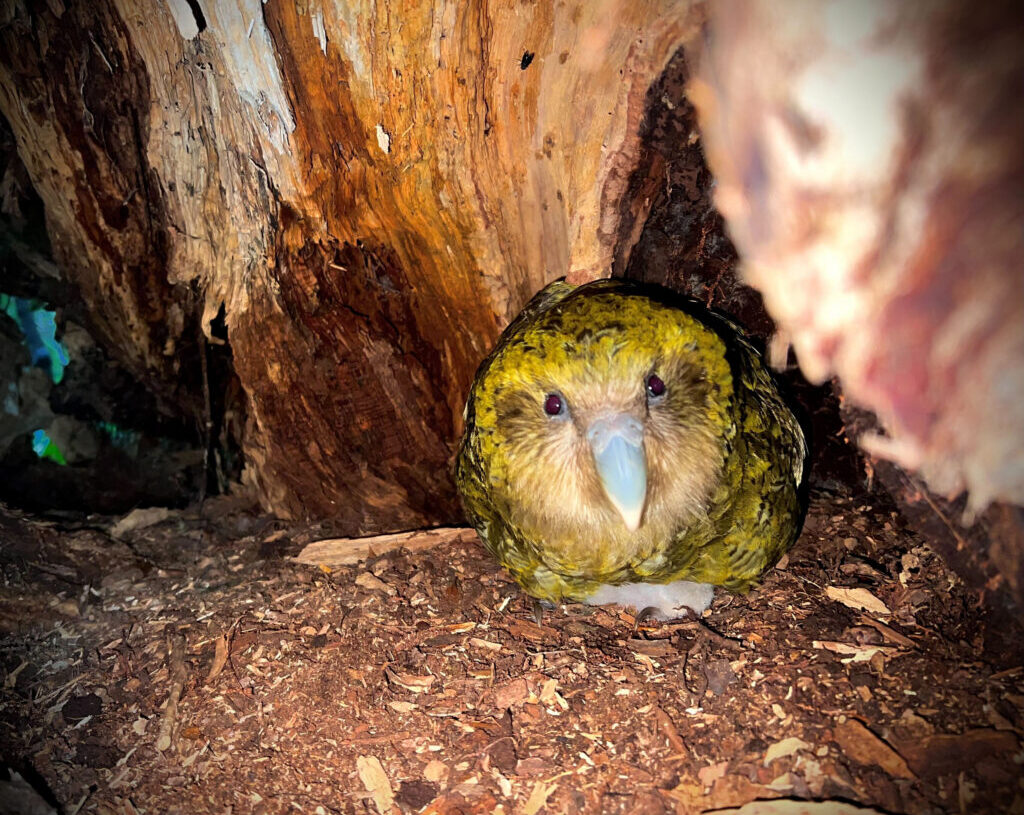
Deep in the New Zealand forest, the booming thud of the kākāpō’s ancient mating ritual sounds more like a bass speaker than birdsong. What’s more, it risks falling silent forever.
This sound comes from no ordinary green bird. The astonishingly rare kākāpō is the world’s heftiest parrot, weighing up to 8 pounds and living for as long as 90 years despite being flightless and almost blind.
With a population of just 236 across New Zealand, efforts to rebuild their numbers by physically shielding them from predators have been painstakingly slow and hindered by an obscure breeding schedule. (The parrot only mates every few years when the native rimu tree undergoes a mass fruiting event, which last took place in 2022.)
So conservationists were relieved this year to observe a bumper crop of the tree’s berrylike fruit, a crucial source of calcium and vitamin D. The mass fruiting has lent kākāpōs a much-needed lifeline, leading — officials hope — to a prodigal mating season that could help stave off the risk of extinction.
Andrew Digby, a biologist at New Zealand’s Department of Conservation who has studied kākāpōs for over a decade, said a feast of rimu fruit is spurring a flurry of breeding activity. The crop has been so plentiful that he anticipates over 50 new chicks to hatch, marking the species’ most prolific mating season on record.
“Technically, it’s a bird,” Digby said in a phone interview Wednesday, likening their appearance to a lump of slow-moving moss with the face of a wizened old man. “But really, they’re more like the bird version of a badger.” When not waddling around the forest floor, these ancient creatures can climb up to 100 feet into the tree canopy to fetch fruit.
Kākāpōs’ predecessors branched off from other bird species some 30 million years ago, lending them many of the distinctive features that only a creature native to New Zealand could achieve. Without the presence of mammalian predators, the birds gained weight and gradually lost their ability to fly as they roamed blissfully for millennia.
When waves of human settlement arrived in New Zealand accompanied by non-native animals, the kākāpō’s vulnerabilities were exposed: the parrot had evolved neither the ability to fight a threat or fly away from it. At one point in the 1970s, officials couldn’t locate even a single bird.
Thankfully, conservation efforts have proved somewhat successful, because the unique sight of a bobbing kākāpō is one to behold. If it seems familiar, that’s because the parrot is also internet-famous. A 2009 clip of a frisky male gyrating on the head of a BBC nature documentary presenter — an ill-fated attempt to mate — is credited with inspiring the party parrot emoji. Sirocco became such a star that the bird was named “Official Spokesbird for Conservation” by New Zealand’s then-prime minister John Key.
Conservationists keep track of kākāpōs using a fleet of tiny transmitters that track their health, nesting status and even who they’ve mated with, likened by Digby to fitness trackers. In December, a flurry of activity indicated that the long-awaited breeding season had started.
And their mating rituals are peculiar. Kākāpōs are the only “lek-breeding” parrot in the world, meaning the males gather in a communal area to parade in front of females. “It’s pretty much a singing competition,” Digby said.
Ahead of the ritual concert, males spend months preparing networks of cleared paths that help resonate their signature boom and “chinging” calls across wide areas.
When they’re ready to attract a female, the males position themselves in holes they cleared in the ground to resemble bowl-like cavities. “They’ll inflate themselves like a football and then they’ll boom,” Digby said. The low-frequency singing lasts for months.
The parrots were once abundant in New Zealand, but dwindled after the arrival of Polynesian settlers around 700 years ago, who hunted them for meat and feathers. The arrival of European settlers accelerated their demise by clearing forest habitats and introducing deer and possums, competing with them for forest resources.
By the mid-1970s, feral cats, stoats and rats had pushed the kākāpō to the brink of extinction. After a large population was located in southern Rakiura, an island off the country’s southern tip, conservationists embarked on a daring effort to stave off extinction. Between 1980 and 1997, all locatable surviving birds were evacuated to three offshore sanctuary islands, which were gradually eradicated of non-native predators.
So far, the effort has proved successful. Their numbers have slowly increased from 51 in 1995, when the latest conservation effort began, to over 200, including 83 breeding-age females. The parrots are spread across three protected breeding sites and two smaller trial sites, which are populated by males only.
As their population climbs, conservationists are struggling to find new protected spaces for the parrot to thrive in, as the longer-term goal of reintroducing the kākāpō to the mainland seems increasingly achievable. “They used to be the fourth most common bird in New Zealand, they were absolutely everywhere,” Digby said. “And we want to get them back.”
This year’s first chicks are expected to hatch in February.
The post World’s fattest parrots set for mating bonanza after bumper berry crop appeared first on Washington Post.