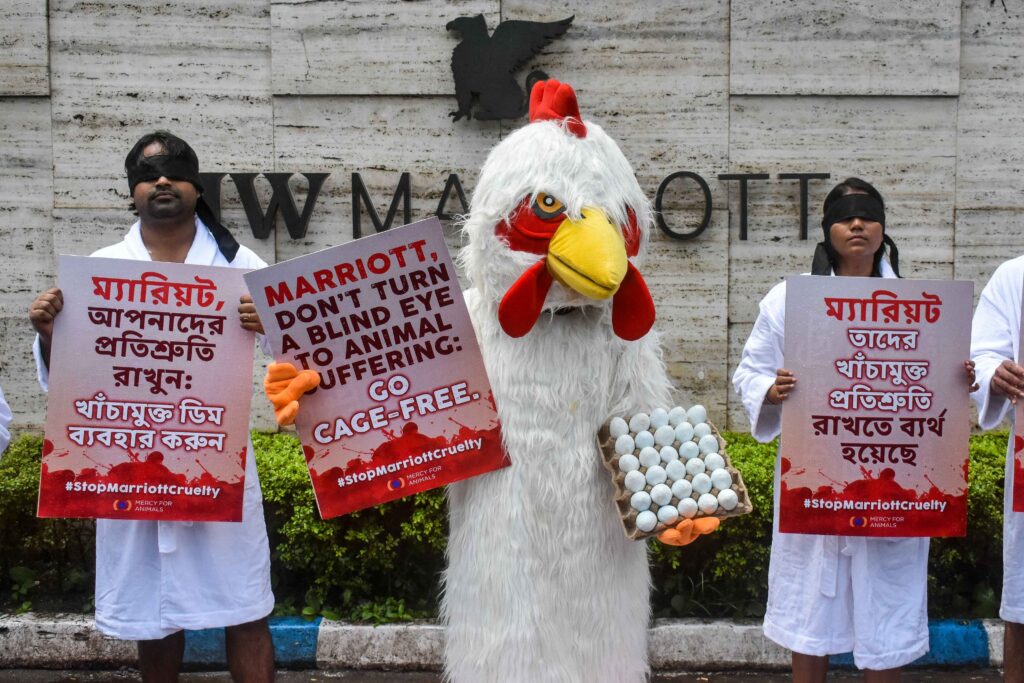
On Dec. 19, the limestone columns of the Ritz-Carlton Philadelphia lit up with the flashing lights of a cop car. Police officers and hotel staff stood guard before the entrance as a small group of protesters paced outside.
“Ritz-Carlton has blood on their hands!” a woman yelled through a megaphone.
On the sidewalk, the activists scrawled messages in chalk such as “Ritz abuses animals” and “Boycott Marriott” — the parent company of the luxury hotel brand. Their posters demanded that Marriott “stop caging chickens.”
The battle cry traces back to a promise that the world’s largest hotel chain made in a different era of corporate responsibility — and is an issue that goes far beyond Philadelphia.
In 2013, Marriott announced it would transition to cage-free eggs at all of its properties worldwide. It renewed the pledge in 2018, vowing to meet the goal by the end of 2025. But as the deadline approached, activists began to question whether the company would keep its word. Then they began to protest, with demonstrations as far-flung as Thailand, India and Brazil.
Marriott released an update in May that said the company was “working closely” on its cage-free-egg sourcing efforts and was “pleased with the progress that has been made,” but it had not achieved its goal. In fact, it was not even close. The company, which has a portfolio of more than 9,300 properties and 30 brands in 144 countries and territories, alluded to challenges posed by avian flu and the global supply chain.
Activists were not satisfied.
Organizations and grassroots groups started ramping up awareness campaigns. They staged more protests in the United States and abroad. They built a website that featured grotesque AI-generated images of Marriott International CEO Anthony Capuano surrounded by bloody feathers and dead chickens.
They flooded the comments sections of Marriott social media pages. They sent mailers accusing the brand of perpetuating animal abuse. They disrupted Marriott executives’ speaking events.
Marriott wasn’t the only company to make such a pledge; there was a wave of corporate cage-free promises in the 2010s. It’s also not the only major company facing activist pushback, but it is one of the most visible.
Marriott declined interview requests and said it did not have more information to share beyond a recent statement that reported that 47 percent of egg purchases in its franchised hotels in the U.S., Canada, and the Caribbean and Latin America were cage-free by the end of 2024. The statement said 92 percent of egg purchases for Marriott-managed properties in the U.S. were cage-free. (In its 2024 year-end filings to the U.S. Securities and Exchange Commission, Marriott reportedthat 7,192 of its properties were franchised, licensed or part of another third-party arrangement.)
Until the company fulfills the pledge, activists say there’s more to come. They see the failure as another example of corporate greed and greenwashing.
Hospitality experts and egg industry insiders say it’s more complicated.
A low-risk promise
Marriott’s first cage-free pledge came at a moment when animal welfare was the social issue du jour.
Chipotle launched “sofritas,” its first vegan protein, nationwide in 2014. The documentary “Blackfish” sent SeaWorld’s stock price tumbling. Undercover videos of alleged animal cruelty and cramped living conditions often made the news. Initiatives on livestock conditions began popping up on state ballots.
At the time, the vast majority of “layer” hens in the U.S. were raised in wire cages with about 67 to 86 square inches of space — a bit smaller than a standard piece of printer paper. Some states began passing legislation to increase cage sizes, or to transition to cage-free farming altogether.
For eggs to be classified as “cage free,” the Agriculture Department requires that they be “laid by hens that are able to roam vertically and horizontally in indoor houses, and have access to fresh food and water,” among other criteria. Proponents say it’s a more humane alternative to the conventional cage method. But critics argue that it’s more expensive for farmers, and not much better for animal welfare.
Emily Metz, president and CEO of the American Egg Board, a promotional group funded by U.S. egg producers, says it wasn’t just consumer demand that caused the shift to cage-free. She said that many state ballot initiatives were “driven largely by activist groups.”
Metz said the groups were also campaigning for major corporations to make their own animal welfare commitments. Many companies pledged to transition to cage-free eggs, including McDonald’s and Starbucks, Walt Disney Parks and Resorts, and Carnival Cruise Line.
Nicolas Graf, associate dean of the Jonathan M. Tisch Center of Hospitality at New York University, said it made sense that Marriott would join the cause. The cage-free pledge seemed in line with company’s values of “trying to be good neighbors,” he said, describing the decisions as “economically viable.”
“We know that there’s a growing number of people who care about sustainability, and that includes animal welfare,” he said.
As far as sustainability pledges go, the egg promise was a lower lift and less controversial than other options, said Bryan Younge, a managing partner at Horwath HTL, an international consulting brand that has worked with hotel clients facing the cage-free-egg deadline.
“Making this kind of commitment isn’t going to knock over a balance sheet the way that, like, Silver LEED building designs would,” he said.
While the change would increase costs, Younge said that switching to cage-free eggs was a “manageable expense,” and that egg costs represent a relatively small portion of total food and beverage spending in a hotel. In his research, retail pricing has shown cage-free eggs costing approximately $1 to $2 more per dozen than conventional eggs in the U.S. It’s a smaller difference in states where cage-free is mandated.
It also helped that the period of pledges “was really the golden era of travel,” Graf said, when hotel companies were in a period of expansion and flush with tourism dollars.
Marriott was thriving. From 2013 to 2018, the company grew from 3,900 properties to more than 6,900. The next year continued with more of the same, as the company reported “steady growth and strong profitability” buoyed by its franchise and management model.
“And then the perfect storm happens,” Graf said.
A tale of two outbreaks
After years of growth and profit, Marriott’s streak came to a halt. The coronavirus pandemic arrived, and the entire industry stalled.
Marriott reported losing $267 million in 2020, and laid off tens of thousands of employees. As the world reopened, hotels faced new challenges, from labor shortages to inflation to political crises.
Egg producers were also struggling.
To meet mandates and growing demand for cage-free eggs, Metz said, farmers had to build new barns, buy new hens and retrain employees.
Meanwhile, a new strain of bird flu was impacting the egg industry, from commercial farms with millions of chickens to free-range operations and hobbyists. Farmers had to keep spending, investing in biosecurity measures like sanitization equipment and buying new flocks.
If one chicken tests positive for bird flu, the entire flock must be killed to stop the highly contagious disease from spreading. There is a federal program that pays farmers for the cost of culled birds, but not for the protective measures they take or the income they lose while rebuilding their flock, The Washington Post reported.
Metz said the industry lost almost 70 million hens between October 2024 and February 2025, or about a fifth of the total U.S. flock.
Egg prices skyrocketed. Hotels were spending at least 25 cents more per egg, “and then cage-free on top of that was at least another dime,” Younge said.
What’s taking so long?
Visit a handful of hotels in a typical American shopping center and you’ll find mixed results for chain locations that follow through on their parent company’s pledge.
During a reporter’s December stay at the TownePlace Suites by Marriott off Interstate 20 in Florence, South Carolina, a sign in front of a domed serving dish read, “scrambled cage-free eggs.”
All five of the Marriott-affiliated hotels in the same complex either advertised that they serve cage-free eggs or their staffers said they did when reached by phone.
Around the bend at the Staybridge Suites Florence – Center by IGH, staff said the eggs were not cage-free (InterContinental Hotels Group also made such a pledge). The same was true at the three-star Hilton Garden Inn Florence (Hilton made a pledge, too).
And at the Hampton Inn & Suites Florence Center, another Hilton property, someone who answered the front desk phone said, “Ma’am, those eggs are frozen; they are not fresh.”
Metz, the president of the egg board, said many companies have delayed or changed their cage-free commitments following the bird flu outbreak. But she thinks there are other factors at play, too.
“I don’t think those [companies] saw the same demand for cage-free eggs or the same reaction to their commitment for cage-free eggs as they were led to believe they would,” Metz said.
Graf agrees. Between the pandemic recovery, labor costs, egg prices and a softening of the economy, it’s a tough environment to make upgrades, particularly when Marriott asks third-party operators to foot the bill.
“At the end of the day, it’s the operator or the owner that pays the cost of what they purchase,” Graf said.
Younge, the hotel consultant, expects some hotel brands to ultimately meet their goal. Over time, he said, cage-free-egg availability will continue to improve and pricing will gradually stabilize.
Time to ‘follow through’
More than a decade after Marriott’s first cage-free pledge, activists have different takes on the outcome.
Chrystine Liptrot is the founder and CEO of the International Council for Animal Welfare, one of the main organizations targeting Marriott. She said she expected the company to be further along than “hovering around 50 percent” of properties.
“If they needed more time to fulfill this commitment,” she said, “why not communicate that publicly or be transparent about how you intend to fulfill that commitment?”
Karla Dumas, vice president of U.S. farm animal protection at Humane World for Animals, said many of the country’s largest companies made “major strides for farmed animals” in 2025. For example, Walt Disney Parks and Resorts says all of its eggs are cage-free, except at its operations in Asia. Carnival Cruise Line was expected to reach 90 percent by the end of 2025, but is still finalizing its year-end assessment.
“We urge companies that have failed to meet their cage-free goals to listen to their customers and follow through on promises to slash animal cruelty in their supply chains,” Dumas said in an email.
People for the Ethical Treatment of Animals, or PETA, does not support cage-free or conventional egg production, claiming both “cause abominable suffering to chickens,” Colleen O’Brien, senior vice president for media relations, said in an emailed statement.
The new gold standard for eggs goes beyond cage-free, something along the lines of organic, pasture-raised eggs from a brand (or farm) that has been vetted. Some luxury hotels are getting eggs from regenerative farms, or have eggs collected by hand on their own farms.
At the Kimpton Armory Hotel in Bozeman, Montana, executive chef Steven De Bruyn says buying organic, free-range eggs from a local farmer costs 29 cents more per egg compared with a conventionally farmed one. He said in an email that it’s a worthwhile cost “because of the higher nutrient content, less pesticides and a better, richer, creamier taste.”
Activists aren’t acting on behalf of flavor, just follow-through. They say protests will continue until the pledges are met.
The post Marriott ruffles feathers by failing pledge to use only cage-free eggs appeared first on Washington Post.