The first message appeared on Kestrel Feiner-Homer’s phone as she was settling in at work on the morning of Jan. 7: It looks like someone was shot. Her phone kept buzzing, messages flooding the Signal chat where Feiner-Homer and her neighbors shared information about U.S. Immigration and Customs Enforcement activity in their south Minneapolis community. The reports quickly grew more definitive: Someone did get shot. By early afternoon, she knew it was a 37-year-old woman who had been killed by an ICE officer, just a few blocks from the preschool where Feiner-Homer had dropped off her 3-year-old that morning.
She couldn’t fully absorb it while she was at her job as a school social worker, surrounded by students. Then she was picking up her kids, and then she was attending a long-planned dinner with other school families, where the parents maintained composure because their children were present. It was only later, after Feiner-Homer returned to the home she shares with her husband, their children and two housemates, that she leaned against her kitchen counter and opened her phone. Scrolling Facebook, she saw a report that Renée Good had been killed after taking her 6-year-old son to school.
Feiner-Homer started to cry. She remembers turning to her housemate: Oh, my God, she said. She was a mom.
The fact that Renée Good was a mother — her three children are ages 15, 12 and 6 — spread through text threads and Signal chats and social media posts with a particular, anguished emphasis among the parents who, like Good, have been trying to help protect their community members from ICE enforcement. Good’s wife, Becca Good, said in a statement that the couple had stopped “to support our neighbors” when the officers approached.
“We had whistles,” she wrote. “They had guns.”
In communities across the country, parents with whistles — or lanyards, or neon vests, or pamphlets about immigrants’ rights — have stood watch outside schools and patrolled neighborhood streets. They have formed rapid-response teams, marshaling donations for families whose loved ones have been detained or deported. They’ve offered rides and delivered groceries for families afraid to leave their homes. They’ve honked car horns at ICE officers and raised their phones to record them. Mothers have led many of these community response efforts, and several told The Washington Post that they’ve deliberated over how to balance their engagement and their safety: What is at stake, and how much can they risk?
Feiner-Homer watched the viral witness video of Good’s killing. She thought about the ways she’d been supporting her community: She’d just given a ride to an immigrant mother who needed to take her baby to day care but was afraid to leave the house alone. She’d joined volunteers standing watch for ICE outside a local mosque, to make sure their neighbors could worship in peace. She imagined what she would have done if she’d encountered ICE officers near her home, like Good did, and Feiner-Homer knew she would have stopped to try to observe and record what was happening. “There is a sense of, ‘I could have been in that driver’s seat,’” she says.
It’s a sentiment reverberating among parents who have seen themselves in Good’s story. Erin Tobes, a mother of 4- and 6-year-old children in Chicago, says she can’t stop thinking about the images taken through the passenger-side door of Good’s Honda Pilot, the blood-soaked air bag and the fuzzy stuffed animals spilling from the glove box. “I immediately thought of my own car, my kids’ car seats in the back seat and their little toys that they keep in their cup holders,” Tobes says. Her voice breaks. “And I thought, ‘Thank God there wasn’t a kid in her car.’ And then I thought of the kid, of the child at school, having a normal day, playing with their friends, unaware that their mother has died. And I started crying.”
Tobes is a stay-at-home mom who had never been involved in immigration-focused activism before September, when she became co-chair of a mutual aid committee to support vulnerable families in her children’s school community. As ICE activity escalated in October, the community’s Signal chat group swelled to more than 500 members. “It’s been one and a half full-time jobs,” Tobes says: The group assembled and distributed informational packets and whistles to more than 1,800 homes in their neighborhood. When the father of one of the school’s students was detained, the committee raised more than $30,000 to help pay for his bond and support his wife and children. Tobes and her fellow parents walked the streets of their city, blaring whistles whenever they saw ICE vehicles. As news of Good’s killing spread, Tobes says, “several concerned family members started calling me, saying, ‘Please be safe, please be careful, we thought of you immediately.’”
She does feel scared, she says, but mostly she feels enraged. “I want to scream, I want to keen with my fellow mothers,” she says. “We’re all feeling it could have been us. And it has been other mothers. Women of color have been shouting from the rooftops, ‘This will happen to you, it’s not just happening to Black and Brown bodies.’ You’re not safe just for being a White mother in the suburbs, and I think that’s been a wake-up call for a lot of people.”
Maxime Groen heard the news of Good’s killing on the radio as she drove to the YMCA in Minneapolis with her 6-month-old daughter. When her baby was born, Groen says, she gave up her smartphone; she wanted to be more present with her family. But after last week, Groen says, she’s decided to reverse course: Right now it feels essential to be alert and able to respond to her community, even as she parents her infant.
“I don’t feel like I can risk arrest if I want to continue breastfeeding,” she says. “So we won’t be at the big protests.” But their family is committed to finding other meaningful ways to help, she says: donating money, offering rides, providing child care to other parents who want to join protests or patrols.
In the past few months, Audra Wunder, a mother in Chicago, has spoken to many concerned parents in her community about the level of involvement that feels safe for them. “I tell them: You need to assess your risk tolerance,” she says, a phrase that came to her mind again when she saw the footage of the shooting. She wondered what Good’s risk tolerance was — if she even realized she was putting herself in danger by stopping her car that morning.
Wunder watched the video as she folded laundry, while her children were at school, and she allowed herself a few moments to grieve. “But I feel like, as a mom, there isn’t a lot of time to process — it’s on to the next thing,” she says. “I had to put the laundry away. I had to go pick up my kids. I can’t sit in the processing, because if I process then I’m going to cry and be emotional, and your kids are attuned to that and ask about it, and I don’t want to lie, but I certainly don’t want to tell them.”
This, too, is part of a parent’s calculation of risk — how to protect their children, not just physically but emotionally. For Tiffany Enríquez, a mother in Minneapolis, this has meant stepping back from more active involvement, at least for now. Hours after Good was killed, Enríquez arrived at Roosevelt High School to pick up her 16-year-old son at afternoon dismissal, and she saw lines of parents and community members in bright-colored vests waiting there, braced for the possibility of ICE’s arrival. (ICE did later arrive at the school, where the Minneapolis Federation of Educators said agents deployed tear gas and briefly detained an educator.)
In normal circumstances, Enríquez says, she would have been among those mobilized community members, “but it’s just not in my capacity right now.” Her oldest son died in an accidental drowning just over a year ago, she says, and her priority has been caring for her younger son as they grieve. Her sons’ father, she adds, was deported to Mexico 12 years ago; their family has already been profoundly affected by the country’s immigration policies.
“As a mom of color, raising boys of color and still fighting the fight — taking a break from the action has felt scary,” she says. “I felt overwhelmed with gratitude to see all these White people in their vests, putting their bodies on the line.” This sense of unity felt notably different from other traumatic moments in her city’s history, she adds, including the movement sparked by the murder of George Floyd by police officers, less than a mile from the place where Good was killed.
“It was so complicated, after the George Floyd killing,” Enríquez says. “There was a lot of looking around at White women and thinking: ‘Really? I thought we were making progress, I thought we were in it together, as moms.’ And that was really hard.” As ICE’s actions have intensified, she says, “there has also been relief in seeing the White and middle-class community in Minneapolis, especially moms, stand up and say, ‘We are in solidarity.’”
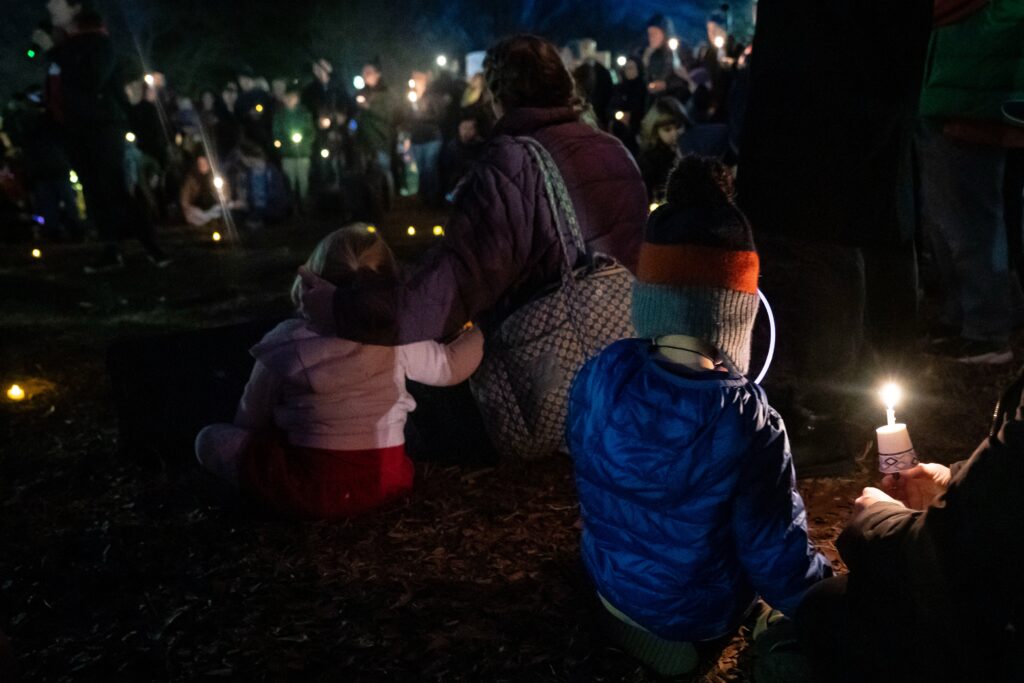
The recent escalation of violence is spurring more parents to speak out against what is happening, says Alex Dodds, a co-founder of Free DC, a campaign focused on protecting home rule. On the evening of Jan. 7, Dodds attended a candlelight vigil for Renée Good that was planned not by veteran organizers but by a nonpartisan neighborhood group for parents of newborns.
“This is a group for parents who are home on parental leave,” Dodds says. “They are not activists. But they were so furious about this that they organized a vigil on six hours’ notice. Parents don’t organize vigils out of fear, they organize vigils out of anger. If anything, what is happening is radicalizing parents across the country.”
Liat Olenick, a climate organizer and mother of two who has become involved in the work of Hands Off NYC, sees this same resolve in the parents who have handed out whistles and “Know Your Rights” cards alongside her at playgrounds in New York. Her sorrow over Good’s killing feels cumulative, she says, alongside her grief “about how many people have died in ICE detention in the last year,” she says. “These are all families that are being destroyed.”
Mothers understand what’s at stake, she says, which is the world their children will inherit: “It’s scary, and there is a lot of grief, and it’s a very intense moment, but I’m much more scared of what happens if we don’t fight back,” Olenick says. “And I want to be able to tell my kids, when they’re older — I want to tell them that I tried my best.”
In the days since Good’s killing, Tobes has been talking constantly with other moms about what comes next. “There is nothing we will not do to help our community, and every child is our child,” she says. “In this moment in time, there is a fury, and it’s a fury that has been building in us for months, and years, and generations.” Mothers have always been the organizers, she says — of movements, of communities, of their own families. “And we have to keep going.”
So that’s what she plans to do, she says. She will coordinate playdates for her children, and aid for her immigrant neighbors. She will take her kids to school, and watch for vehicles with tinted windows. Wherever she goes, she will carry a whistle in her pocket.
The post ‘She was a mom’: Renee Good’s killing amplifies the stakes for parents appeared first on Washington Post.