

The great middle manager flattening is in full swing, and those who remain are seeing their dominions balloon.
It’s the era of the megamanager, driven by cost cutting, leaner bureaucracy, and slow hiring. A new Gallup survey reveals how teams are evolving and the factors that contribute to manager burnout.
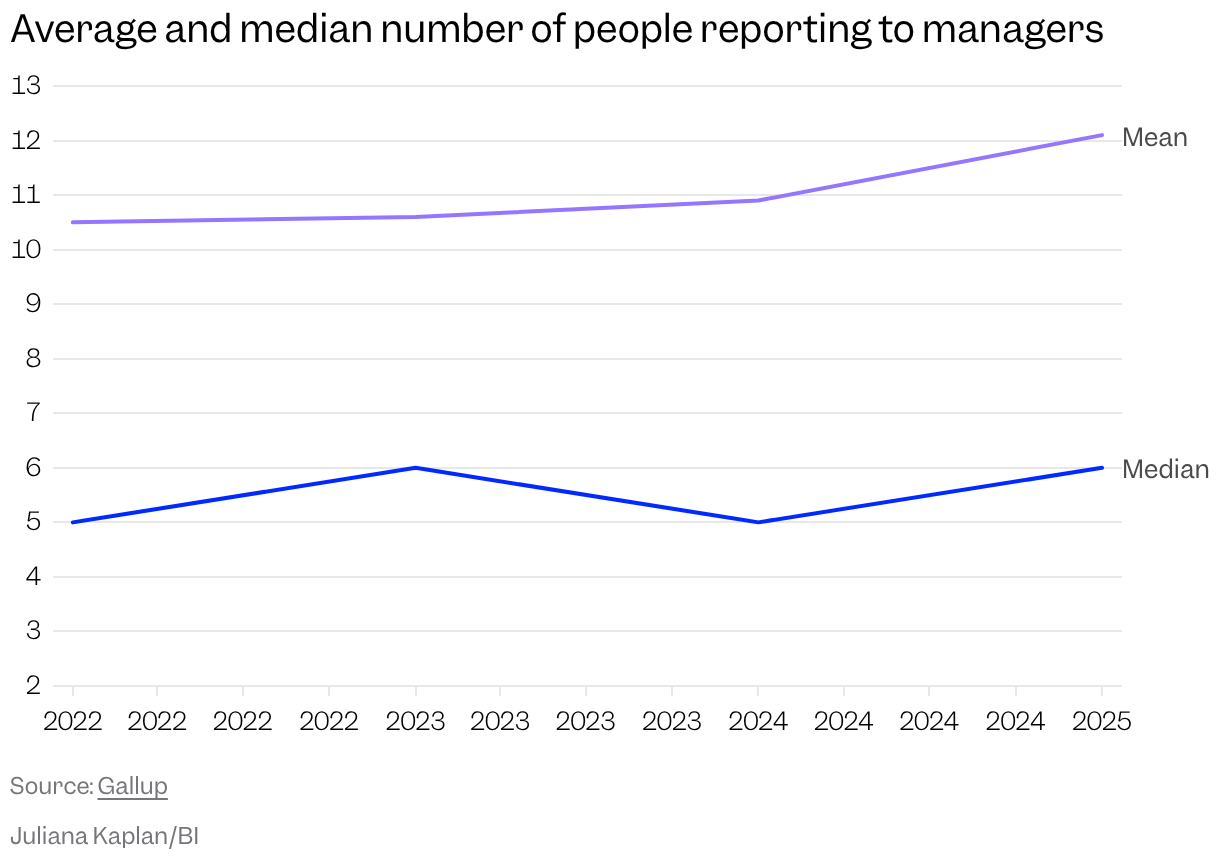
Managers’ average number of reports — their “span of control” — has grown over the past year, rising from 10.9 in 2024 to 12.1 in 2025. It’s also a marked increase from pre-pandemic levels; in 2013, managers had an average of 8.2 people reporting to them, and by 2019, this number had increased to around 9.
Are you a manager with 25 or more direct reports, or have been asked to take on more reports in the “Great Flattening?” Contact this reporter at [email protected].
That’s driven primarily by an increase in teams with 25 or more people, which saw a two percentage point rise over the past year. Around 13% of managers have 25 or more direct reports. At the same time, 97% of managers are taking on individual contributor work that falls outside of their leadership purview.
“I don’t think increasing span of control blindly is going to work very effectively if those conditions aren’t taken into account,” Jim Harter, Gallup’s chief scientist of workplace management and well-being, said of the balance between individual contributor tasks and leadership responsibilities.
In recent years, layoffs at firms like Intel, Amazon, and Meta have trimmed middle managers to rectify what they viewed as excessive layers of bureaucracy.
“Having fewer managers will remove layers and flatten organizations more than they are today,” Amazon CEO Andy Jassy wrote in a 2024 memo. “If we do this work well, it will increase our teammates’ ability to move fast, clarify and invigorate their sense of ownership.”
How to flatten management the right way
Flattening management layers is a concept that experts previously told Business Insider is sound, provided that remaining managers have support, training, and the right mix of responsibilities.
In 2024, Yvonne Lee-Hawkins, a middle manager, told Business Insider that she had gone from managing zero to 21 direct reports and ultimately quit due to burnout.
“Our meetings became transactional because we only had time to discuss the most urgent issues,” Lee-Hawkins said. “We no longer had time to get to know each other, ask questions, seek advice, or work on career development.”
What’s key in trimming layers, as the Gallup survey illustrates, is how engaged workers already feel, and how these new megamanagers spend their time. For instance, managers who spend less time on individual contributor work — tasks outside their leadership duties — typically have more engaged teams, regardless of the team’s size.
“When you have employees increasingly detached from their employer, and then you suddenly start increasing span of control without putting the right conditions in place, I think you run a risk because they’re already increasingly feeling detached,” Harter said. “We found that managers that have at least one weekly meaningful conversation with each employee do substantially better.”
Tanuj Deora, a Gen X vice president for deployment at clean energy firm Sparkfund, said that the trend around being more “thoughtful” about bureaucratic structure within companies has value. He’s held management roles since the late 1990s, advising on structures for teams of up to 50. He said it’s essential to consider a manager’s level of experience.
“If they’re relatively new managers, you probably want to give them five or six people. You want to give them a couple of people,” Deora said.
Gallup’s Harter said that there are often two reasons someone becomes a manager: They’re a strong individual contributor, or they have a long tenure at their company. However, neither of those factors necessarily relates to how effective they’ll be in a managerial role.
“What happens is in organizations, people stay a while, and they feel a need to promote people continually. And the avenue for promotion tends to be, we’re going to give you a managerial role because it tends to be associated with more money and status,” Harter said. “I would say the most effective organizations think about how they create high-status individual contributor roles so that people don’t feel like they have to become a manager to be effective.”
Read the original article on Business Insider
The post Welcome to the era of the megamanager appeared first on Business Insider.