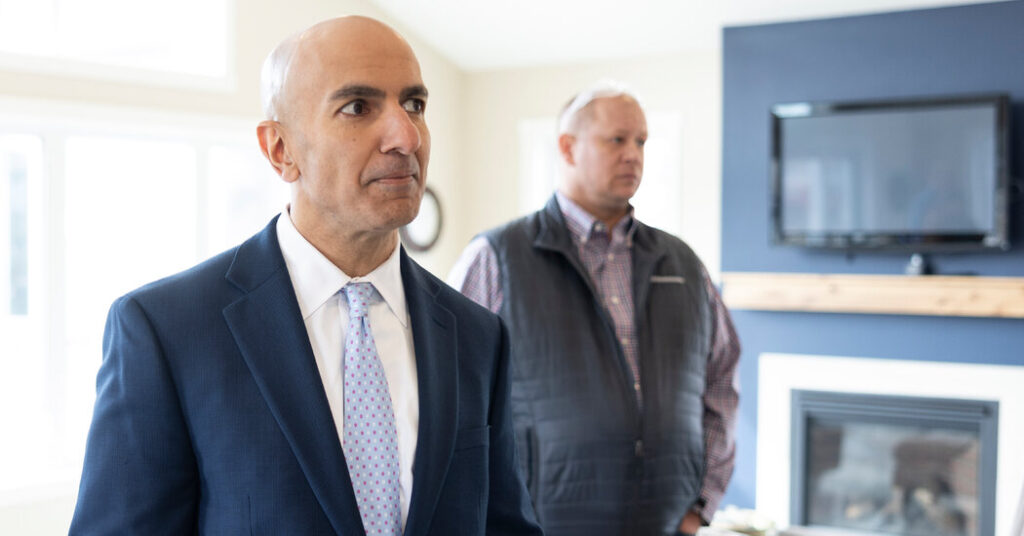
Neel T. Kashkari, president of the Federal Reserve Bank of Minneapolis, said the Trump administration’s actions against the central bank in the past year were “really about monetary policy,” as he came to the defense of Jerome H. Powell, the Fed chair, in the wake of a criminal investigation led by the Justice Department.
The Justice Department on Friday served the Fed with grand jury subpoenas, prompting a forceful response by Mr. Powell. In an extraordinary video message after the investigation was revealed by The New York Times on Sunday, Mr. Powell accused the administration of seeking to leverage costs related to the Fed’s renovation of its headquarters in Washington as “pretexts” for a criminal inquiry to coerce the central bank into lowering borrowing costs.
“The escalation over the course of the past year is really about monetary policy,” Mr. Kashkari said in an interview. “I thought the chairman explained that accurately.”
Mr. Kashkari said this moment was an opportunity “to explain to our constituents and the American people why Fed independence is so important to the health and the vibrancy of the American economy.”
The latest broadside against the central bank has generated significant blowback from not only global economic policymakers but also Republican lawmakers and even close allies of President Trump, who warn that it risks jolting financial markets and complicating the process to replace Mr. Powell when his term as chair ends in May.
Financial markets have been relatively sanguine in response to the investigation, which Mr. Kashkari said reflected some “comfort” taken from the fact that a bipartisan group of lawmakers had come out in support of Mr. Powell and the notion that the central bank should be able to set interest rates free from political meddling.
The Minneapolis Fed president also noted “repeated gestures” from the Supreme Court over the year that he said signaled it viewed the Fed differently from other independent agencies, over which the justices have granted the Trump administration more authority.
The Supreme Court will hear arguments next Wednesday related to how much sway the president should have over the central bank when it takes up the case of Lisa D. Cook, a Fed governor whom Mr. Trump tried to fire last year over allegations of mortgage fraud.
The Federal Reserve Act, which enshrined the central bank’s independence, stipulates that a president can remove a Fed official only for “cause,” which is broadly interpreted to mean malfeasance or a dereliction of duty while on the job.
If the Supreme Court sides with Mr. Trump, he and future presidents would be able to remove officials at the central bank essentially at will, undermining what Mr. Kashkari described as a “foundational element of Fed independence.”
The Supreme Court will hear those arguments just a week before the Fed is set to gather for its first policy meeting of the year. After three quarter-point reductions last year, rates hover between 3.5 percent to 3.75 percent, a level that Mr. Kashkari said put the Fed in a “pretty good spot right now.”
“I don’t see any impetus to cut in January,” he said, adding that there could still be some scope to cut later in the year. Right now, he said, it is “just way too soon.”
Mr. Kashkari is a member of the 12-person Federal Open Market Committee this year, meaning he will cast a vote on interest rates at each of the eight meetings. The committee comprises three other presidents from the 12 regional banks, the president of the New York Fed and the seven members of the board of governors in Washington.
Recent rate decisions have become highly divisive, stemming from differing views among the policymakers on the best course for monetary policy when the labor market is showing some cracks but inflation is stuck well above the Fed’s 2 percent target.
Three officials voted against December’s quarter-point cut — two in favor of standing pat and one backing a larger, half-point move. Four others indicated their opposition to a cut in the form of a “soft” dissent. That entailed submitting a forecast for rates to end the year at the previous level of 3.75 percent to 4 percent. Mr. Kashkari was one of those officials.
Mr. Kashkari’s confidence that the Fed can move cautiously with further cuts stems from his view that the economy is on firm footing. Companies have scaled back on hiring, he conceded, but they also have not engaged in mass firings.
“If monetary policy is really so tight, we should not see an economy that is exhibiting such resilience,” he said.
Mr. Kashkari said he was also wary about cutting rates because of elevated inflation and his expectation that Mr. Trump’s tariffs would continue to push up prices over time.
“It’s entirely plausible that we are sitting here well above our target for two to three more years,” he said. “Then we’re looking at seven or eight years of elevated inflation. That’s very concerning to me.”
A jump in the unemployment rate, which in December fell back to 4.4 percent, would prompt Mr. Kashkari to change tack, however, especially coupled with easing inflation.
This gradual approach is at odds with what Mr. Trump wants from the Fed. The president has called for rates as low as 1 percent and said he would only select a chair to replace Mr. Powell who supported significantly lower borrowing costs. That prerequisite has prompted concerns about how credible the next chair can be.
Asked about that challenge, Mr. Kashkari said, “The credibility that is most important is with the rest of the committee, because that person is going to have one vote.”
“They have to persuade the rest of the Federal Open Market Committee with their recommended monetary policy action,” he said. “Whoever the chair is is going to have to bring forward the best arguments that he or she can and then win the votes based on the data and the analysis that they bring forward.”
Colby Smith covers the Federal Reserve and the U.S. economy for The Times.
The post A Top Fed Official Says the Trump Administration’s Threats Are ‘About Monetary Policy’ appeared first on New York Times.