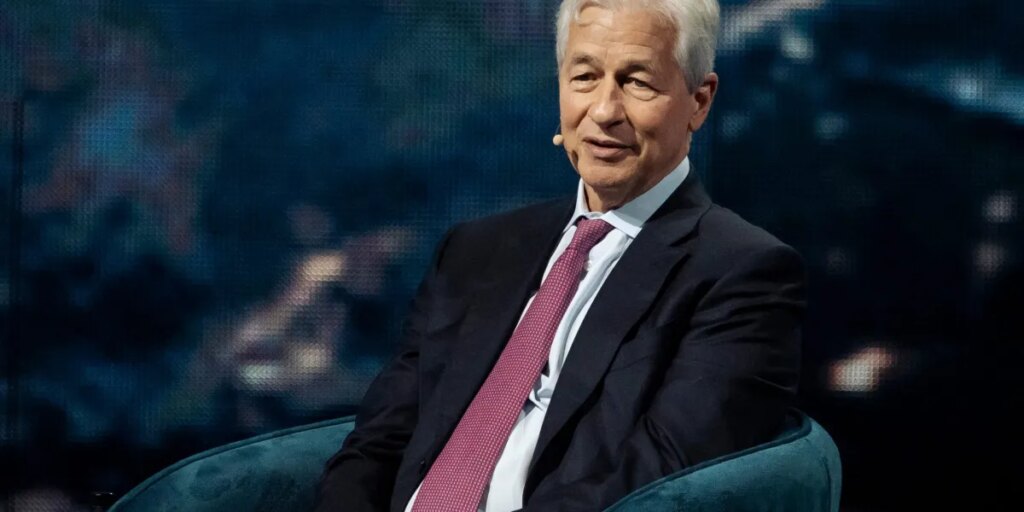
JPMorgan Chase CEO Jamie Dimon had a dose of reality for analysts and investors tuning into his company’s earnings call this week: At some point, governments around the globe are going to have to examine their spending habits. Shares in America’s largest bank declined following its Q4 2025 earnings call yesterday, which reported revenue of $45.8 billion and assets under management of $4.8 trillion, representing an 18% year-over-year increase. On the call, Dimon shared a mixed outlook on the economy, saying that “while labor markets have softened, conditions do not appear to be worsening.” He added that consumers remain resilient in their spending and “businesses generally remain healthy.” That’s despite upheaval in markets, which last year had to wrangle with rapidly changing foreign and trade policy from the White House.
While the billionaire banker was bullish on artificial intelligence, he also reiterated his warning that a looming shadow over the macroeconomic outlook is government debt. He has previously cautioned that Washington faces a market “rebellion” over the issue.
When asked about his outlook for 2026, Dimon said the short-term looked good. He explained: “Call it six months and nine months and even a year, it’s pretty positive. Consumers have money. There’s still jobs, even though it’s weakened a little bit. There’s a lot of stimulus coming from the One Big Beautiful Bill. Deregulation is a plus in general, not just for banks, but banks will be able to redeploy capital.”
However, the macro “backdrop” must also be considered, he added, and these work on different timelines: “Geopolitical is an enormous amount of risk … It’s just a big amount of risk that may or may not be determining the fate of the economy.”
He continued: “The deficits in the United States and around the world are quite large. We don’t know when that’s going to bite. It will bite eventually because you can’t just keep on borrowing money endlessly.”
That doesn’t seem to have trickled through to government, which spent $276 billion on interest payments on the national debt in the final three months of 2025 alone. In its most recent budget review released Friday, the Congressional Budget Office reported that the deficit totaled $601 billion in the first quarter of the fiscal year 2026 (October to December), $110 billion less than the deficit recorded the same period last year.
Following the release, Maya MacGuineas, president of the Committee for a Responsible Federal Budget, said the U.S. government is already on track for a $2 trillion deficit in 2026. “Meanwhile, despite being more than a quarter into [fiscal 2026], our government is still not fully funded for the rest of the fiscal year, with another funding deadline around the corner in just over two weeks,” she added. “Lawmakers should come to an agreement on appropriations that avoids increasing our debt even more, restores the caps on discretionary spending, and maintains flat funding from the last fiscal year.”
White House officials have argued that tariff revenue will offset some of the government’s borrowing (despite the president also promising it for other uses), but Dimon remained realistic. “We have to deal with the world we got, not the world we want,” he said, adding his focus is not to guess economic outcomes but serving clients.
Who owns America’s debt?
One of the paths out of a potential debt crunch is that a central bank could simply print more money. By increasing the supply of money, the value of a currency is pushed down, making the interest payments on borrowed money relatively cheaper. However, this comes with inflationary, or hyperinflationary, side-effects.
Moreover, buyers of debt may realise the returns they are getting are decreasing in value, and so demand higher interest payments in the future.
This would be less of a concern for some buyers than others. For example, according to Treasury data analysis by the Peter G Peterson Foundation, which focuses on maintaining a stable fiscal future, the Federal Reserve System is the largest single holder of U.S. debt, owning $4.5 trillion as of March 2025. State and local governments own $1.7 trillion, and mutual funds own $4.4 trillion.
A problem may come from further afield, particularly if geopolitical tensions continue to rise, tempting foreign governments to order their central banks to ditch U.S. debt in protest. That would hurt the value of the dollar, generate inflation, and force the interest yield on U.S. debt upward—all scenarios that would make life more expensive for the federal government.
Investors in Japan, China, and the U.K. are among the highest buyers of U.S. debt, owning $1.1 trillion, $779 billion, and $765 billion, respectively. “While the holdings of U.S. debt by both [Japan and the U.K.] have declined over the past decade, China’s purchases of U.S. Treasury securities have declined more than Japan’s,” the foundation wrote.
The post ‘You can’t just keep borrowing money endlessly’: Jamie Dimon warns $38 trillion national debt is going to ‘bite’ eventually, it’s just a case of when appeared first on Fortune.