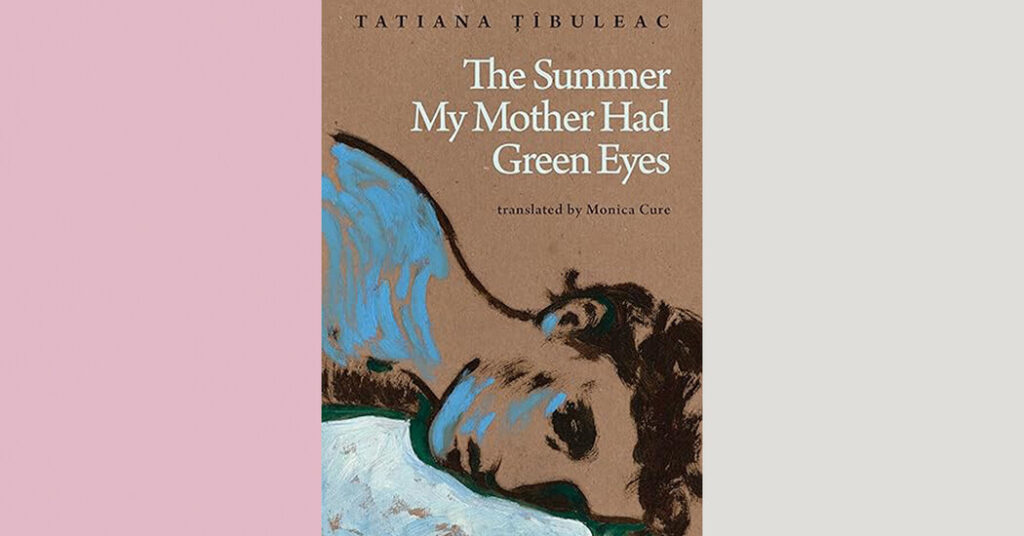
THE SUMMER MY MOTHER HAD GREEN EYES, by Tatiana Tibuleac; translated by Monica Cure
Death comes for us all, and we have conceived many philosophies to deal with it. Some insist that death is but a threshold leading to another life. Others wonder whether death is precisely what gives meaning to life, in the way that all things take on their significance from what they are not: light from darkness, love from hate, beginnings from endings.
The Moldovan writer Tatiana Tibuleac’s brief, profound novel “The Summer My Mother Had Green Eyes” belongs in the latter camp. Written in Romanian and translated, purposefully and to great effect, into British English by Monica Cure, the story concerns a renowned painter named Aleksy, who, as part of a therapy exercise, is reflecting on a summer he spent with his mother more than a decade earlier, when he was 18.
Aleksy and his family are Polish immigrants to north London. Their foreignness relegates them to their own universe, a kind of sheath in which Aleksy dwells in his own, often wretched solitude.
He and Mum, as she is called throughout, are spending the summer at a rented house in northern France. Aleksy would rather be anywhere else, for the simple reason that he hates Mum. “Dad called her ‘stupid cow.’ Dad’s new girlfriend called her ‘kielbasa.’ Only I was obliged to call her ‘Mum,’” he says. “I would’ve switched her, if I could, for any other mother in a split second.” The reader spends much of the book determining why.
We learn, early on, that Aleksy was sent to a school for troubled youth for seven years, and that he expressed his misanthropic thoughts through his behavior: Objects were smashed and people were harmed, largely in reaction to the untimely death of Aleksy’s little sister, Mika.
“Green Eyes” is a beautiful novel, owing as much to the acuity of the dialogue and the strangeness of its metaphors (like the “bloody sunflower field” whose stalks are “popping out all the flowers row by row like a bunch of fish eyes”) as to Tibuleac’s storytelling. Like a literary origamist, the author intricately folds in plot details so that each new revelation forces you to reconsider the shape of the whole narrative.
Aleksy tells us, for example, that passers-by often spit at his family home. We learn first, from his grandmother, that this happens because they’re “the richest family” in their London neighborhood. (“She thought everyone who could put salami on their table was rich.”) Then we suspect that they’re targeted for being immigrants. Aleksy’s narration later lays plain that they’re spat at because of something terrible he did to another child. By the end of the book, these piecemeal revelations leave us wondering if we’ve assumed anything correctly at all.
But the power of this novel comes chiefly from its reflections on grief. Mum is dying, it turns out, and the summer she coerces Aleksy to spend with her in France may be her last. “You only think about death when you’re dying … and that’s foolish,” she says. “Because death is the most likely thing that will happen to people rather than all their dreams.”
How Mum’s imminent death might make meaning of her difficult life, or rewrite the terms of her fraught relationship with Aleksy, are the stakes of Tibuleac’s moving tale. And understanding not only what death has taken from him, but also what it has given him, is Aleksy’s ultimate project. “It’s strange,” he says, perhaps as a warning, “how you can build a new life from the remains of the lives of others.”
THE SUMMER MY MOTHER HAD GREEN EYES | By Tatiana Tibuleac | Translated by Monica Cure | Deep Vellum | 182 pp. | $25.95
The post Why Does This Teenager Hate His Mother So Much? appeared first on New York Times.