President Trump seemed angry after the Senate voted last Thursday to pass a war powers resolution to the next stage, where lawmakers could approve the measure and seek to curb the president’s ability to wage war in Venezuela without congressional authorization.
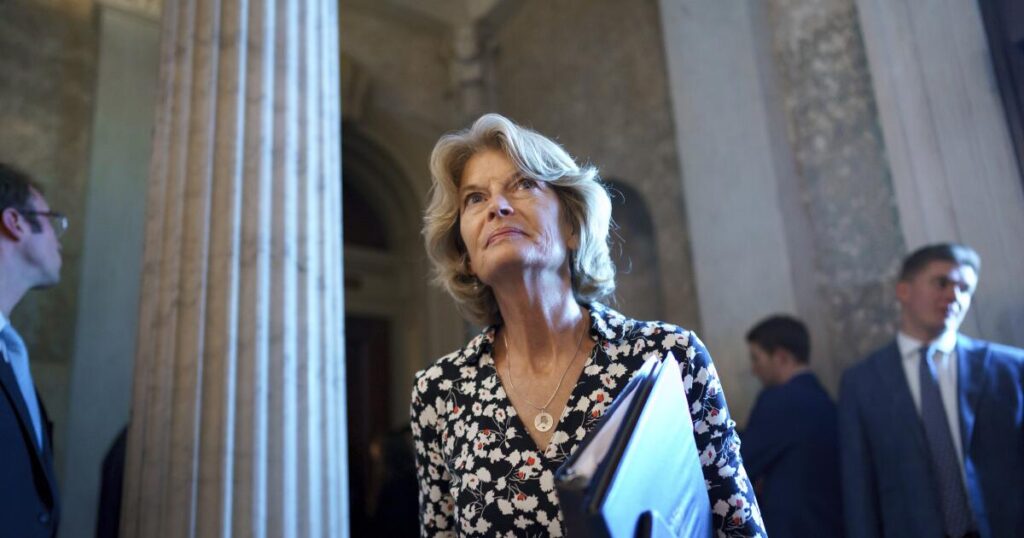
Trump said that day that five Republican senators who supported bringing the measure to a vote — Susan Collins (Maine), Lisa Murkowski (Alaska), Rand Paul (Ky.), Josh Hawley (Mo.) and Todd Young (Ind.) — “should never be elected to office again.”
Why should he get so riled up about this, to the point where he could put his own party’s control of the Senate at risk in November? Even if this resolution were to pass both houses of Congress, he could veto it and ultimately be unrestrained. He did this in 2019, when a war powers resolution mandating that the U.S. military cease its participation in the war in Yemen was passed in both the Senate and the House. Many people think that such legislation therefore can’t make a difference.
But the president’s ire is telling. These political moves on the Hill can get results even before the resolution has a final vote, or if it is vetoed by the president.
The Trump administration made significant concessions before the 2019 resolution was approved by Congress, in an attempt to prevent it from passing. For instance, months before it was approved, the U.S. military stopped refueling Saudi warplanes in midair. These concessions de-escalated the war and saved tens of thousands of lives.
A war powers resolution is an act of Congress that is based on a 1973 law of the same name. That law spells out and reinforces the power that our Constitution has allocated to Congress, to decide when the U.S. military can be involved in hostilities.
The U.S. military raid in Caracas that seized Venezuela’s President Nicolás Maduro and his wife, Cilia Flores, is illegal according to international law, the charters of the Organization of American States and the United Nations, as well as other treaties to which the United States is a signatory. According to our own Constitution, the government violates U.S. law when it violates treaties that our government has signed.
None of that restrained the Trump administration, which has not demonstrated much respect for the rule of law. But the White House does care about the political power of Congress. If there is an expanded war in Venezuela or anywhere else that Trump has threatened to use the military, the fact that Congress took steps to oppose it will increase the political cost to the president.
This is likely one of the main reasons that the Trump administration has at least promised to make concessions regarding military action in Latin America — and who knows, possibly he did make some compromises compared with what had been planned.
On Nov. 5, the day before the Senate was to vote on a war powers resolution to halt and prevent hostilities within or against Venezuela by U.S. armed forces, Secretary of State Marco Rubio, Secretary of Defense Pete Hegseth and White House counsel had a private briefing with senators.
They assured lawmakers that they were not going to have a land war or airstrikes in Venezuela. According to news reports, the White House counsel stated that they did not have a legal justification for such a war. It is clear that blocking the resolution was very important to these top officials. The day after that meeting, the war powers resolution was blocked by two votes. Two Republicans had joined the Democrats and independents in support of the resolution: Murkowski and Paul. That added up to 49 votes — not quite the needed majority.
But on Thursday, there were three additional Republicans who voted for the new resolution, so it will proceed to a final vote.
The war powers resolution is not just a political fight, but a matter of life and death. The blockade involved in the seizure of oil tankers is, according to experts, an unlawful use of military force. This means that the blockade would be included as a participation in hostilities that would require authorization from Congress.
Since 2015, the United States has imposed unilateral economic sanctions that destroyed Venezuela’s economy. From 2012 to 2020, Venezuela suffered the worst peacetime depression in world history. Real (inflation-adjusted) GDP, or income, fell by 74%. Think of the economic destruction of the U.S. Great Depression, multiplied by three times. Most of this was the result of the sanctions.
This unprecedented devastation is generally attributed to Maduro in public discussion. But U.S. sanctions deliberately cut Venezuela off from international finance, as well as blocking most of its oil sales, which accounted for more than 90% of foreign exchange (mostly dollar) earnings. This devastated the economy.
In the first year of Trump sanctions from 2017-18, Venezuela’s deaths increased by tens of thousands of people, at a time when oil prices were increasing. Sanctions were expanded even more the following year. About a quarter of the population, more than 7 million people, emigrated after 2015 — 750,000 of them to the United States.
We know that the deadly impact of sanctions that target the civilian population is real. Research published in July by the Lancet Global Health, by my colleagues Francisco Rodriguez, Silvio Rendon and myself, estimated the global death toll from unilateral economic sanctions, as these are, at 564,000 per year over the past decade. This is comparable to the worldwide deaths from armed conflict. A majority of the victims over the 1970-2021 period were children.
The Trump administration has, in the last few days, been moving in the direction of lifting some sanctions to allow for oil exports, according to the president’s stated plan to “run Venezuela.” This is ironic because Venezuela has for many years wanted more investment and trade, including in oil, with the United States, and it was U.S. sanctions that prohibited it.
Such lifting of sanctions would be a big step forward, in terms of saving lives of people who are deprived of food, medicine and other necessities in Venezuela, as a result of these sanctions and the economic destruction that they cause.
But to create the stability that Venezuela needs to recover, we will have to take the military and economic violence out of this campaign. There are members of Congress moving toward that goal, and they need all the help that they can get, before it’s too late.
Mark Weisbrot is co-director of the Center for Economic and Policy Research and author of “Failed: What the ‘Experts’ Got Wrong About the Global Economy.”
The post A Senate war powers resolution on Venezuela actually could curb Trump appeared first on Los Angeles Times.