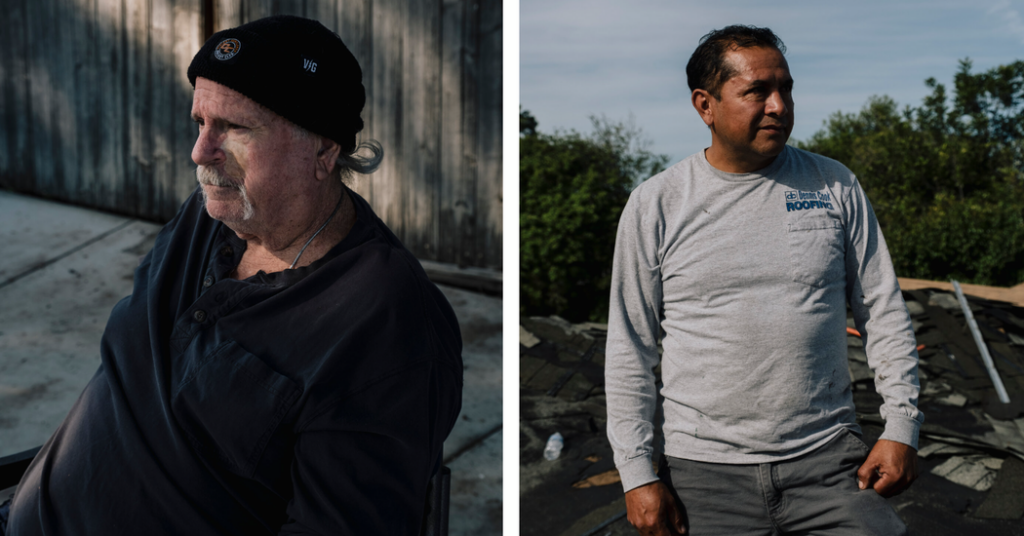
In 1976, Matthew Moore marched into the roofers’ union hall in Orange County, Calif., signed his card and, at 19, found his calling. Within hours, he put on a pair of hot boots, climbed a ladder and became one of the many union men laying the roofs of tract homes spreading out across Southern California.
Only two years later, Mr. Moore, a native of the state who never went to college, bought a three-bedroom house of his own in Whittier.
“That kind of work suited me right down to my soul,” said Mr. Moore, now 68 and retired. “I worked outside in the sun every day. Nothing better.”
It was also the kind of well-paying blue-collar job that once helped drive a strong middle-class economy, and has largely vanished. It’s work that many Americans want to see restored.
In the decades since Mr. Moore walked into that union hall, an enormous demographic shift has transformed his industry. In the 1970s and 1980s, the share of foreign-born workers in construction was the same as in other industries. But that quickly changed. Today that share is nearly twice as high as in other jobs.
An oft-repeated explanation for this sea change is that immigrants took jobs from Americans while, somewhat paradoxically, Americans no longer wanted to do the backbreaking work required to build a house. But a review of data and historical records, as well as interviews with many people who work in or study construction, tell a different story: First, construction jobs became less desirable, as eroding wages and working conditions diminished the quality and job security of the profession. Only then did immigrants, with the encouragement of the political and business class, fill a gap that was already opening.
Most of those foreign-born workers are not naturalized citizens, and many are undocumented. That leaves an industry of 6.8 million workers particularly vulnerable to President Trump’s mass deportation effort: Builders are reporting labor shortages as some workers are detained or deported and others stay home amid immigration raids.
And without workers, an already strained housing market will only grow more so, driving up historically high home prices and slowing the production of new homes.
‘A pickup truck and a ladder’
When Mr. Moore started his career, unionized construction was a good living, especially for workers without a college degree. In 1973, a quarter of workers were unionized, and in construction it was 40 percent. But those numbers were already starting to decline.
The leaders of some of the country’s largest corporations had recently formed a lobbying group, the Business Roundtable, to push back against the strength of unions and for weaker labor laws. The unions, which were also dealing with internal tensions, were unable to stem a tide that only swelled with the pro-business election of Ronald Reagan.
But Mr. Moore was young and happy to have a good-paying job out in the California sunshine. He spent his 20s laying roofs on houses and driving to the beach after work, a surfboard strapped to the top of his Volkswagen bus.
In Southern California, the national labor fight came to a head in 1983 when the carpenters union went on a four-month strike to block builders from using nonunion labor. The effort largely failed, opening the door to a nonunion work force and marking a tipping of a big domino for California’s construction unions.
“They lost all their power,” said Richard Denger, president of a residential framing company that closed in 2014. His father-in-law, Ray Cook, had negotiated on behalf of the builders in the strike.
After the strike, Mr. Moore started seeing two worker gates: one for the union crews and the other for the nonunion ones. So did Mr. Denger. Across the state, according to reports at the time, builders started bringing in nonunion crews, leaving only commercial work for the union workers.
Mr. Denger, whose company framed tract homes, said that after the strike builders offered him less money for jobs, and that translated to lower wages for his crews. “The builders will only pay you so much, so you go along with it or you’re out of business,” he said. “The prices of houses never went down even though all the wages went down. Somebody made the money.”
What was happening in California was happening across the country, both in states with a strong union presence, like Illinois, Massachusetts and New York, and those that prohibited mandatory union membership — “right to work” states like Arizona, Florida and Texas where the population, and housing production, was booming.
The share of construction workers in a union began to decline precipitously, and even an effort to recruit foreign-born members could not stave off the losses. As of 2024, nine of 10 workers in the construction industry are nonunion.
And with that decline in union strength came a decline in the economic standing for both union and nonunion workers. In 1973, the average union construction worker made $1.71 for every $1 the average American worker earned hourly. Today, unionized construction workers earn $1.15 for every $1 an American worker earns. And nonunion construction workers make just 86 cents for every dollar earned by the average American worker, often without health or retirement benefits.
“By us opening the door to the nonunion sector, basically we shot ourselves in the foot,” said James A. Hadel, international president of the United Union of Roofers, Waterproofers and Allied Workers. “All it takes is a pickup truck and a ladder and that’s what we’re competing against.”
‘No other way to survive’
After one week of tearing roofs off houses in San Diego in 1991, Mariano Martinez was so sore he didn’t think he could do the work. “I said, ‘I want to quit; I don’t think I’m going to make it,’” Mr. Martinez, now 54, recalled. Then 19 years old and originally from Oaxaca, Mexico, he spoke almost no English and knew nothing about construction.
After three months, he learned how to lay a roof, and his pay jumped to $100 a day in cash, without benefits. Mr. Martinez never looked for a union job. He’d heard that the pay was better but that you weren’t always sure when you would have work. He stayed so busy that by 1999, he bought a three-bedroom home in Oceanside, for $180,000. After his son joined the army, Mr. Martinez became a citizen in 2024.
Mr. Martinez had arrived in the United States on the cusp of a major immigration boom. Workers interviewed for this article who crossed illegally during that period described a southern border that was more porous, even as barriers were going up. With the help of smugglers, many managed to get across on foot or in vehicles. In a common practice that continues today, builders avoided knowingly hiring undocumented workers by keeping laborers off their payrolls and instead hiring subcontractors or labor brokers who employed the workers.
In the 1990s and early 2000s, residential construction was booming in places like Atlanta, Phoenix and Houston. Many immigrants, often from Mexico, slipped across the border and headed straight to those fast-growing cities as demand for workers soared. While the number of American-born construction workers rose, the number of immigrant workers increased much more — all against the backdrop of falling union membership.
In Orange County, Mr. Moore began to see his generation of American-born unionized roofers leave the industry. “They all just disappeared,” he said. One day in 2000, he looked out at his job site and realized he was the only worker on the roof who wasn’t an immigrant.
By then, the high demand for housing and fewer worker protections had led to tough working conditions. For Mario, 47, who first came to the United States in 1997 from Morelia, Mexico, as a teenager, roofing paid better than picking cucumbers and bell peppers, but it wasn’t easy. Mario was an adult by the time he started roofing, but many undocumented roofers are minors, doing one of the deadliest jobs in the country usually without health insurance.
Mario, who requested to use only his first name and not to disclose his employer because he is in the country under temporary protected status, worked from dawn to dusk, sometimes seven days a week. He was earning $800 a week, not much more than what Mr. Martinez had earned a decade earlier. But he had recently moved in with his girlfriend (now his wife) and wanted to start a family. “There was no other way to survive,” Mario said in Spanish.
Unlike Mr. Martinez, who owns a home and has U.S. citizenship, Mario still rents and has a precarious legal status. Mario and Mr. Martinez were lucky enough to keep working through the Great Recession. From 2008 to 2011, the industry lost 1.7 million jobs, or a quarter of its work force.
Mario, who by then had two children, saw his income fall by a third. Mr. Martinez watched friends lose their jobs and their homes, but as a foreman who had been with the same company for years, he had enough work to weather the downturn. Mr. Moore, who had sustained several serious injuries from falls, including a broken back and pelvis, retired, like thousands of other American-born workers of his generation. “My back finally blew out,” he said. But thanks to his decades spent working union jobs, “I had more than enough hours for a pension.”
Immigrants who held onto their jobs say they have seen no meaningful wage gains in decades, and are still making today what they made before the Great Recession.
A shortage of workers and houses
The share of immigrants in the construction sector was last as high as it is today in the 1920s, when there were strong anti-immigrant policies.
The Great Depression followed, accelerating the labor movement that would transform American work for half a century. Critics of permissive immigration policies argue that the supply of underpaid workers suppresses wages. But unlike in America after the Great Depression, it’s unclear who would fill the gap in the construction industry should those workers leave.
Today, the industry is short 300,000 workers, according to the National Association of Homebuilders. Estimates put the national housing shortage somewhere between 1.5 million and five million homes. Without enough workers, building and repairing homes could take longer and cost more, driving up prices for home buyers and owners. A mass deportation policy that isn’t paired with a way to expand the domestic work force, or to make the jobs appealing again to American-born workers, could leave the industry hollowed out.
Adam Cook, who owns the roofing company in San Diego where Mr. Martinez works, says American-born workers, including the grown children of his longtime immigrant employees, may spend a summer or a few days roofing for extra money, but generally do not stay on the job long, often leaving for college or other opportunities.
Decades ago, strong unions trained generations of workers through on-the-job apprentice programs that provided young workers with job security and benefits. With unions decimated, there are far fewer apprenticeships available, and builders have not filled the void with a robust alternative. Instead, young Americans have increasingly gone to college, moving into white-collar jobs. And among those without a degree, millions fewer are working in manufacturing and construction, and more are working in service and sales jobs.
Supporters of stricter immigration policies argue that deportations would open up new jobs for Americans, and drive up wages. But research has shown that aggressive deportation policies don’t increase jobs for citizens, but instead lead to fewer construction jobs across the industry, simply because work slows as fewer homes are built.
“The idea that there are American workers waiting in the wings means you don’t understand the demographics of the construction workers,” said Natasha Iskander, a professor of urban planning and public service at N.Y.U.
As immigration crackdowns expand, builders and workers are feeling the pressure. Immigrants interviewed for this article, including Mario, said some workers are skipping work, fearing a raid. Without a full crew, projects are taking longer to complete, he said. Mr. Cook, 54, said some of his workers, regardless of their immigration status, refuse to take jobs near the Mexican border, fearing being detained, and his safety training sessions focus on immigration raids. “They’re basically moving targets,” he said.
A survey conducted last summer by the Associated General Contractors of America, a trade group, found that labor shortages are the leading cause of construction delays and that the overwhelming majority of contractors were struggling to find qualified workers.
Mr. Cook’s customers, mainly San Diego homeowners, have been paying more for their roofs since the pandemic drove up the cost of materials. A labor shortage could continue that trend. A roof that costs $19,000 this year might cost $21,000 next year, he said. “It’s just going to keep going up and up.”
Additional graphics work by Ani Matevosian. Ana Facio-Krajcer and Miriam Jordan contributed reporting.
Methodology
To assess the characteristics of construction workers in the U.S. through history, The Times analyzed anonymized individual census records obtained from IPUMS.
The Times included only workers who were currently employed when surveyed, worked in the construction industry and practiced a construction-related occupation, like a roofer or cement mason. They were considered U.S.-born unless the census record indicated they were foreign-born naturalized citizens or noncitizens.
For statistics on union membership and wages, The Times incorporated census figures compiled by Barry Hirsch, David Macpherson and William Even, available at unionstats.com.
Those figures include all workers in the private sector of the construction industry regardless of occupation. The Times’s analysis compares, by year, average hourly wages for these construction workers (union and nonunion) with the overall average wage of all workers.
Ronda Kaysen, a real estate reporter for The Times, writes about the intersection of housing and society.
The post Where Did All the American-Born Roofers Go? appeared first on New York Times.