Nicolás Maduro may be out, but Venezuela’s Chavista regime still holds power. Meanwhile, the opposition leader and Nobel Prize winner María Corina Machado is fighting to remain relevant. She’s scheduled to meet with President Trump at the White House on Thursday.
Francisco Rodríguez, a senior research fellow at the Center for Economic and Policy Research, joins the Opinion editor Dan Wakin to assess the state of the opposition, Machado’s prospects and how Donald Trump factors into Venezuela’s uncertain future.
Below is a transcript of an episode of “The Opinions.” We recommend listening to it in its original form for the full effect. You can do so using the player above or on the NYTimes app, Apple, Spotify, Amazon Music, YouTube, iHeartRadio or wherever you get your podcasts.
The transcript has been lightly edited for length and clarity.
Dan Wakin: I’m Dan Wakin, an international editor for New York Times Opinion. Since America’s recent military attack on Venezuela and the capture of its leader, Nicolás Maduro, the long-term leadership of the country is unclear. President Trump has said the U.S. will run it, suggesting the arrangement could last for years.
Meanwhile, Maduro’s government is largely intact, and the opposition movement — now mostly in hiding or in exile — is sidelined from the action. Trump is scheduled to meet this week with the opposition leader María Corina Machado.
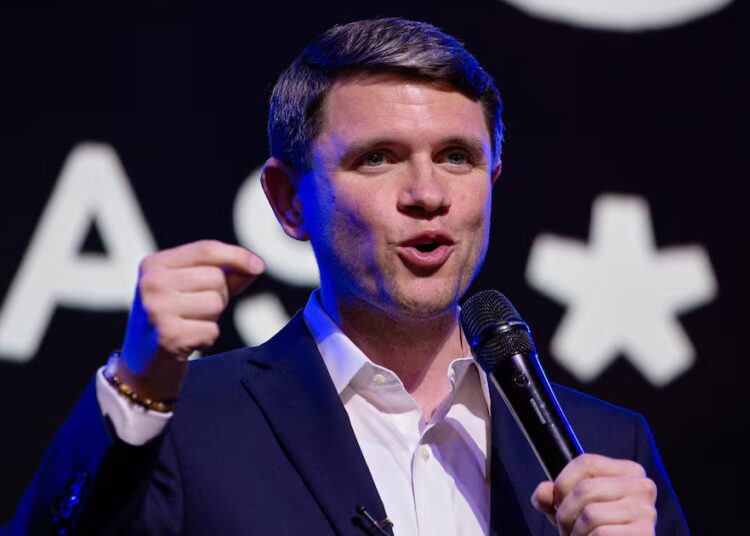
My guest today is Francisco Rodríguez, a Senior Research Fellow at the Center for Economic and Policy Research, who has worked in the Venezuelan National Assembly. He recently wrote a guest essay for Times Opinion arguing that Machado is not the right person to restore the country at this moment. I’m curious: If not her, then who? What comes next? I should say we’re recording on Monday morning and events are evolving.
Francisco, welcome.
Francisco Rodríguez: Thank you, Dan, for having me. It’s a pleasure being here.
Wakin: Francisco, what is the state of the opposition in Venezuela right now?
Rodríguez: The opposition right now is very demoralized, and it’s very demoralized because everything that has happened — everybody would’ve expected that the day that Maduro left, the opposition would come into power. And that’s exactly what didn’t happen. People are trying to make sense of this. I think that this has also led to a lot of soul searching in the opposition about whether the strategy was correct. I mean the strategy led by María Corina Machado, because she is an atypical type of leader.
She has a lot of popular support and made that felt in the 2024 elections. But she has been the most uncompromising leader in all of the opposition. If we can think about there being a left-right spectrum — which is, of course, an oversimplification — she’s been to the right of the opposition during these last 25 years. For example, she criticized Juan Guaidó, who was the leader of the National Assembly and recognized by many nations as the interim president of Venezuela for several years, for not calling for military intervention.
She embodies this paradox: somebody who’s received a Nobel Peace Prize but at the same time was openly calling for a military intervention.
And then there’s her closeness — or her attempt to get close — to Trump, which has led her not to criticize anything of what Trump has done up until now, including the stigmatization of Venezuelan immigrants; the deportation of Venezuelans, for example, to El Salvador, to a jail where there’s strong evidence that Venezuelans were subject to torture and inhumane treatments; also, the blowing up of boats in the Caribbean, which many — myself included — characterize as extrajudicial executions.
All of these examples are leading to questions in the opposition, where people are saying: Well, was this the right strategy? Did we want to get so close to the Republicans and to the Trump movement? Haven’t we alienated many other international actors and many national actors?
So people are now thinking: Well, was this strategy right? And what happens is something that happens a lot in politics. There’s a saying that nothing succeeds like success. Well, I think the corollary of that is: Nothing fails like failure. So the moment in which it becomes clear that your bid to take power did not work, if that’s the case, is the moment when everybody starts questioning whether what you did was right.
Wakin: Would it be questioned as a betrayal of the opposition for Machado to cozy up so much to Trump, to curry such favor with him when his whole strategy is not to overturn the regime, not to change the government, to keep the vice president in power?
Rodríguez: That is the moment at which this whole attempt becomes the focus of significant criticism. Because what we’ve also seen Machado do over the past week is maintain her attempt to appeal to President Trump. In fact, there’s a meeting that’s planned for later this week between them. So we’ll have to see what comes out of that meeting.
But she’s also insisted that one of the things that she wants to do is share her Nobel Peace Prize with Donald Trump, something that even led the Nobel Committee to issue a very unusual statement where they clarified that a Nobel Prize cannot be revoked, shared or transferred to another recipient. So if any of this works, then I think people will, of course, be happy if Trump changes his position and says: Yes, María Corina Machado has to lead the transition. Or what I think many people would be hoping now would be that Trump would say: Well, the next step is that you have to have elections, and you have to have elections soon, and they have to be free and fair elections. And then María Corina Machado can run like any other candidate.
If Venezuelans see that light at the end of the tunnel, then I think that this can still play well in her favor. But if what we see is a continuation of the current strategy by President Trump, including the idea that the election has to be delayed for an indefinite amount of time — President Trump actually said just a few days ago that Venezuelans wouldn’t know how to have an election. So that suggests that his view is one in which this process is going to occur very much in the long term. And we’re not sure who are going to be the relevant political actors at that moment and whether Machado’s star will have faded by that moment.
Wakin: Correct me if I’m wrong, but it sounds like you’re saying that Machado’s future in Venezuelan politics completely depends on what Donald Trump decides.
Rodríguez: That’s correct. And that I think is an implication of the way that she has framed the confrontation with Maduro and with Chavismo, particularly over the last few years. There was a moment in which Machado started uttering the phrase “We can’t do this alone.” So when people were saying: No, this is a problem that Venezuelans have to solve themselves, her response was: No, don’t tell us that we need to solve it. We’ve done everything possible. We need the international community to intervene. We need to ask for a military intervention.
That’s something that just about everybody in the Venezuelan opposition thought was utterly implausible — even in the first Trump administration. Even though he had kind of floated this idea of all options being on the table and that he had mentioned the possibility of an intervention, nobody really expected, even if Trump won a second term, that he would actually carry it out.
She’s put all her political eggs in this basket of calling for external military intervention. And what that means is that she has not put forward ideas about how to bring forward political change in Venezuela just through domestic mobilization. It makes her very dependent to the political dynamics of what happens in the U.S. And then on top of that, she’s made such efforts to court President Trump. She’s even gone as far as supporting this false narrative that Nicolás Maduro and Chavismo somehow had something to do with rigging the 2020 elections against President Trump.
So, yes, she regrettably has burned all of her bridges to other political actors. Once this strategy fails — I mean, if Trump does not support her, she doesn’t really have many others to appeal to.
Wakin: You pointed out that previously when there was an opposition leader named president, she had urged him to call for international intervention. Well, there was international intervention a few weeks ago, and unfortunately it’s not turned out the way she wanted, it seems.
Rodríguez: Exactly.
Wakin: So let’s turn to your personal experience. You have a very interesting background. You served as the chief economist of the Congressional Budget Office in Venezuela in the early years of the Chávez presidency, from 2000 to 2004. Can you tell me about that experience and how that affected or influenced your views on Chavismo and what it morphed into under Maduro?
Rodriguez: Sure. So in the year 2000, I was appointed head of the Venezuelan Congressional Budget Office by the Venezuelan National Assembly. And I was appointed with the support of both the government and the opposition.
I was there for four years. My relations with the government actually soured quite soon. And the reason is that the government believed that because they had the majority and because they had appointed me with that majority — even though they had also needed the votes of the opposition — that my office was going to be subordinate to the government majority.
So when I started essentially doing my job with independence, that ran me into trouble with several lawmakers. And one of them did not like the fact that I was questioning one of his projects, and in fact, asked the leadership of the government party to remove me.
Ultimately, they did it. And the legislator who I’m referring to who put a lot of effort into firing me was actually Nicolás Maduro. So it wasn’t a good start to our relationship. And in fact, from that moment on, I had never met him personally.
Wakin: Let’s talk about the transition to whatever comes next. You’ve written that the Constitution of Venezuela from 1999 is a big part of the problem with politics there and that the country has collapsed because of what you said is a “deeper failure of its political system to manage the conflicts inherent to a polarized society.” Can you explain that a bit, please?
Rodríguez: Sure. I came to study the Venezuelan economy as an economist, and as an economist, something that I was struck by was this huge collapse, the largest ever economic collapse seen outside wartime — 71 percent contraction of G.D.P. So how do we make sense of that?
A lot of people have talked about it — failed policies of socialism, state intervention, nationalizations, and all of those played a role. But frankly, Venezuela’s not the first country to ever try those. And sometimes when they’re tried, they can end in crises where you find declines of G.D.P. of 10, 15, 20, 25 percent but not of 71 percent.
So when I started looking and trying to study what was happening in Venezuela, what I found is that a lot of what had happened had to do with the collapse of the oil industry and the country’s oil revenues — and it’s because the oil industry had become the focus of a political struggle. On both sides of the political struggle, the government and the opposition tried to gain control or stop the other side from gaining control over the country’s revenues. Ultimately from the opposition side, that took the form of lobbying the U.S. government to impose economic sanctions. And these sanctions were incredibly damaging to the Venezuelan oil industry and to the Venezuelan economy. They don’t explain all of the collapse.
What I describe in my work is a pattern where both Maduro and the opposition started weaponizing the economy because they thought that it worked to their political advantage. They thought that if they controlled oil revenues, then, in the case of Maduro, that would allow him to stay in power. In the case of the opposition, that would allow them to drive first Chávez and then Maduro from power.
So ultimately what we saw in Venezuela was political conflict getting out of bounds.
Wakin: You had mentioned that there were two parties struggling for control of the oil industry in Venezuela or at least struggling to prevent the other side from having control. It seems like there’s now a third party in control of the Venezuelan oil industry, and that’s the president of the United States. I wonder if you could quickly sketch out what Trump’s plan is for the oil industry and what you see as the outcome.
Rodríguez: Well, what Trump has said is that the U.S. is going be running the Venezuelan economy, and I think that the best way to understand what he means is through a meeting that he had with oil industry executives a few days ago, in which he tried to convince them to invest in Venezuela, to invest in recovering Venezuela’s oil production. And he tried to convince them that there was a lot of money to be made in that.
There was not one representative of the Venezuelan government or of the opposition, for that matter, in that meeting. And Mr. Trump actually pointed that out. He said: You don’t have to deal with Venezuelans. You have to deal with me. So it’s the imposition, the complete imposition of external control. Trump didn’t just take out the head of state; he also has made clear that this is on his conditions.
Now, what are his conditions? His conditions are that Venezuela is going to send its oil to the U.S. It’s going to be under the management of U.S. authorities. U.S. authorities are going to sell that oil — some of it in the U.S., some of it outside the U.S. The money is going to go into a fund that is going to be administered, in President Trump’s words, by him for the benefit of the people of Venezuela and the U.S.
How do I see this? I see this in two ways. One of them is that this is the crudest expression of imperial power that the U.S. has attempted to exercise since the early 20th century, when it ran Cuba after the Spanish-American War or when it took control of the customs administration of Haiti and the Dominican Republic after it invaded those countries in the 1910s.
When all is said and done, there’s an economics to this, which is very relevant. Venezuela is able to sell its soil to the U.S., and it’s able to sell its oil to the Western world, which is something that it had not been able to do for the past seven years. Since sanctions were imposed, Venezuela was selling oil just to China — well, to China and Cuba. With Cuba, Venezuela wasn’t even selling it. It was almost giving it away. So reversing these sanctions is going to help the Venezuelan economy, and it’s going to generate revenues, which, if they do go at least in part to Venezuela, will be able to fuel a significant economic recovery.
It’s Trump reversing what he himself did. He was the one that said the U.S. is not going to buy Venezuelan oil and is going to get all of our allies not to buy Venezuelan oil. Now he is changing that, and that generates significant upside for the Venezuelan economy. And Trump is also doing something else, which is actually quite remarkable. As a Venezuelan, I don’t like having the U.S. president run the Venezuelan oil industry. But on the other hand, it’s not every day that you get the U.S. to do what countries like Venezuela would have a very hard time doing now: convincing investors to invest in Venezuela. All of this is economically positive, even though it’s being done through the exertion of control that violates the sovereignty of the country in very clear ways.
Where do I see the problems? I see the problems in the near term, in the short term, and I see the problems in the belief by the U.S. that they can actually run the Venezuelan economy. Because the reality is that President Trump and his cabinet have no idea how to run the Venezuelan economy. My fear is that in the time that it takes for the Trump administration to actually understand why they can’t do what they claim that they’re going to try to do, you could have a full-fledged economic crisis in Venezuela.
Venezuelan stocks of food and of basic items are running dangerously low. If the government doesn’t get some access to funding for imports, it’s going to have to impose very strict rationing probably within the next month. That’s also going to lead to hyperinflation. You’ve already seen a dangerous acceleration of the exchange rate.
I don’t see anybody dealing with these issues right now. The Trump administration seems to believe that this is just a question of getting some executives and convincing them to pump oil in Venezuela, and that’s part of the picture, but that’s only a small part of the important picture in the near term and in the medium term.
Wakin: I was going to ask you for a best-case/worst-case scenario, and I think you’ve just given the worst-case scenario. What about the best-case scenario? What could you predict as being a successful outcome?
Rodríguez: Well, that was a mixture, actually, of the best case and the worst case, because what I was trying to say is: Look, there’s tremendous economic upside to getting Venezuela access to oil markets again. This is an economy that has the capacity to produce a significant amount of oil.
That means that it has the capacity to go back to being a reliable supplier for the U.S. That also means that it has the capacity to go back to being a prosperous middle-income economy. Oil is not going to solve all the problems, and the country should carry out many other structural reforms, but at least it has that basis, and that basis is a basis that it’s not difficult to get running again.
But there’s also a deeper problem here, which is: Where does this lead politically, and does this lead the country to democracy or not? The fact that the Trump administration has spoken so little about democracy, so little about human rights, suggests that they would be content with having an autocratic government in Venezuela that just allows them to pump all the oil that they want out of there, that they would be happy to see a Saudi Arabia in the Caribbean.
Now, is that possible? Regrettably, I think that it is. I think it would be terrible for Venezuelans, but I don’t see anything necessarily impeding that. You have authoritarian governments in many other places, including many oil-dependent economies, and there’s a sense in which that oil wealth — which tends to make the state and the government very powerful — combined with these winners-take-all institutions, is a perfect recipe for autocracy. So I do think that you could get that scenario in which Delcy Rodríguez, Venezuela’s interim leader, just becomes the country’s new dictator.
The positive scenario is one in which the U.S. uses its leverage toward building a democratic transition in Venezuela. I don’t think that that democratic transition can be built overnight, or at least I think it’s very dangerous to do so. I think that the way to do it is to carry out institutional reforms — reforms, for example, in electoral institutions, independence of the judiciary. Start setting up the institutions of a democracy that also become the institutions that constrain the executive from persecuting its opponents so that when we get to an election, it’s an election in which the losers can decide: OK, we’re going to accept that we lost, and that doesn’t mean that we’re going to be persecuted and put in jail and that it’s the end of our political career and maybe of our lives.
Once you get there, you can have a free and fair election. That, for me, is the best-case scenario: one of a democratic and prosperous Venezuela. Is it possible? Yes. Is it assured? No.
Wakin: Well, with that, Francisco, I think we’ll leave it, and I just want to say thanks so much.
Rodríguez: Thank you very much. It was a pleasure.
Thoughts? Email us at [email protected].
This episode of “The Opinions” was produced by Derek Arthur. It was edited by Alison Bruzek and Kaari Pitkin. Mixing by Carole Sabouraud. Original music by Sonia Herrero, Pat McCusker and Carole Sabouraud. Fact-checking by Mary Marge Locker and Kate Sinclair. Audience strategy by Shannon Busta and Kristina Samulewski. The director of Opinion Audio is Annie-Rose Strasser.
The Times is committed to publishing a diversity of letters to the editor. We’d like to hear what you think about this or any of our articles. Here are some tips. And here’s our email: [email protected].
Follow the New York Times Opinion section on Facebook, Instagram, TikTok, Bluesky, WhatsApp and Threads.
The post What Comes Next for Venezuela — and Who Decides? appeared first on New York Times.