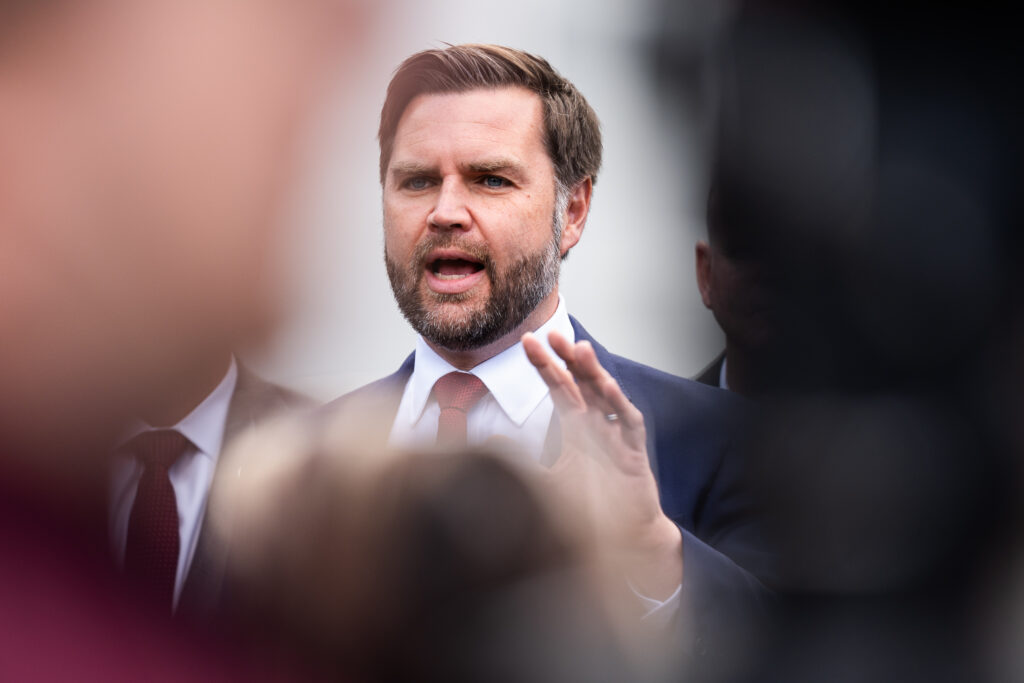
The heated debate over Greenland’s future heads Wednesday to the White House, where Vice President JD Vance will host a closed-door meeting with the Arctic island’s key stakeholders that some Europeans fear could further worsen a transatlantic divide that threatens to tear apart the NATO alliance.
Diplomats from Denmark and Greenland, a self-governing territory that remains part of the Danish realm, requested the meeting not with Vance but with Secretary of State Marco Rubio, Danish officials said. They did so last week after a series of provocative statements from President Donald Trump and at least one senior aide, who have suggested the United States could use military force to seize the country of approximately 57,000 people.
The talks were expected to take place at the State Department but the venue was changed after Vance expressed a desire to be included, said two U.S. officials, speaking on the condition of anonymity to describe the diplomatic engagement.
Danish Foreign Minister Lars Loekke Rasmussen is scheduled to attend the meeting alongside Greenland’s foreign minister, Vivian Motzfeldt, and Rubio will join Vance, officials said.
Spokespeople for the White House and State Department declined to discuss those concerns or offer further detail on what the administration hopes the meeting may accomplish. Asked why the meeting had been relocated from the State Department to the White House, one person with knowledge of the planning downplayed the move’s significance, saying principals of the National Security Council “coordinate joint meetings with each other all of the time at the White House.”
Trump has said the U.S. needs to “take Greenland,” citing its natural resources and strategic location in the Arctic Circle. “If we don’t do it, Russia or China will take over Greenland,” Trump said at the White House on Friday.
But with Danish officials pledging to address those concerns, the president also has offered another motivation: a desire for ownership of the giant landmass. “You have to own it,” he said Friday.
Some European officials, who had hoped Wednesday’s meeting would provide a forum to seek clarity from Rubio about the administration’s policy toward Greenland, expressed apprehension ahead of the talks, citing Vance’s planned involvement.
The vice president has been critical and dismissive of America’s traditional allies, including those in NATO. His scolding speech at a security conference in Germany early last year remains a sore subject on the continent — as does his Oval Office upbraiding of Ukraine’s president, Volodymyr Zelensky, who had come to Washington days later seeking a commitment from the administration as his country’s depleted military was losing ground to invading Russian forces.
Rasmussen and Motzfeldt could be walking into a “lion’s den,” Morten Messerschmidt, chairman of the hard-right Danish People’s Party, told Denmark’s public broadcaster, adding that it was hard for him to see how “anything good” could come of the talks.
Danish officials head into Wednesday’s meeting with a red line that may be exceedingly difficult — if not impossible — to align with Washington’s demands: Copenhagen has offered deeper military and economic cooperation with the U.S. but its leaders stridently oppose Trump’s insistence that they hand over control of Greenland, a territory that’s been part of the Danish kingdom for centuries.
They hope to steer their conversation with the U.S. administration back toward what they considered was a more cooperative track through much of last year, European diplomats said. But in holding firm, some worry they also risk inflaming tensions with Vance or Rubio.
Any U.S. move to punish Denmark could spark European countermeasures against Washington, and a quick transatlantic escalation. Or, in a situation that would also be damaging for Denmark and NATO, it could split Europe over how best to respond, unleashing a separate set of challenges about the future of the alliance.
Jeremy Shapiro, research director at the European Council on Foreign Relations and a former State Department official, said it was unlikely any compromise could be found at the meeting. “Frankly, the Danish have already offered everything that the Americans say they want and they have been refused,” Shapiro said.
Vance has offered a dim assessment of the Danish government’s handling of Greenland, telling Fox News last week, “I think the president’s willing to go as far as he has to” to secure U.S. interests in Greenland.
The vice president waded into Greenland policy last year, making a brief visit to the Arctic island in March. Vance did not meet with Danish or Greenlandic officials during his trip, but he tweaked officials in Copenhagen by stating that the U.S. would better manage the mineral-rich and strategically important territory.
“Denmark hasn’t done a good job at keeping Greenland safe,” the vice president asserted during his trip.
Tom Dans, whom Trump appointed to head of the U.S. Arctic Research Commission, defended Vance’s planned involvement in Wednesday’s meeting. The vice president, he said in an interview, is “the one who originally carried the torch” to Greenland at Trump’s direction and he “deserves a share of the honor in whatever happens.”
Vance’s attendance at Wednesday’s meeting, Dans added, “adds additional weight to the whole matter.”
Though Rubio serves both as secretary of state and White House national security adviser, two of the most important roles in U.S. foreign policy, to date he has not publicly played a leading role in Greenland policy.
Speaking to lawmakers during a classified briefing last week, Rubio said the president’s goal was to purchase the territory rather than seize it militarily, according to previous reporting from The Washington Post.
Later, Rubio told reporters that all presidents retain the right to take military action. He compared the situation with Greenland to that of Venezuela, where Rubio played a leading role in organizing a military-led operation to capture Venezuelan President Nicolás Maduro.
People familiar with the discussions, speaking on the condition of anonymity to describe private planning, said the Trump administration had not seriously discussed a military operation to seize Greenland. Officials in Greenland and Denmark have said, though, that the problem they have isn’t just the specter of a U.S. invasion but that the U.S. was moving to impose its will on Greenland’s residents — most of whom, opinion polls show, have no desire to be annexed by the United States.
“Greenland is not for sale,” Prime Minister Jens-Frederik Nielsen said Tuesday in Copenhagen, adding: “Greenland does not want to be owned by the United States. Greenland does not want to be governed by the United States. Greenland does not want to be part of the United States.”
“We choose the Greenland we know today, which is part of the kingdom of Denmark,” Nielson added.
Drew Horn, a former official in the first Trump administration who now leads GreenMet, a Washington-based company that works on critical minerals and supply chain issues, called the Greenlandic premier’s comments “irresponsible” given the scale of investment and support the U.S. could offer.
“This is not a question of forcing Greenland to ‘choose’ between the U.S. and Denmark, when the population of Greenland has made it overwhelmingly clear that they want to advance their own national interests,” Horn said.
Told Tuesday that Greenland’s prime minister had declared his desire that same day to remain with Denmark, Trump responded: “That’s their problem. I disagree with him. I don’t know who he is. Don’t know anything about him, but that’s going to be a big problem for him.”
Trump has spoken of his desire for the U.S. to own Greenland dating to his first term in office. The idea remains persistently unpopular with Americans, however. An Economist-YouGov poll published Tuesday found wide opposition to attempts to take Greenland under U.S. control through military action or through payments to Greenlanders, with more than two-thirds of Americans against both ideas.
The poll found little support even among people who identified as Trump voters, with just 30 percent saying they were in favor of paying Greenlanders and 17 percent in favor of military action.
Natalie Allison and Scott Clement contributed to this report.
The post Vance steps in to host White House talks on Greenland’s future appeared first on Washington Post.