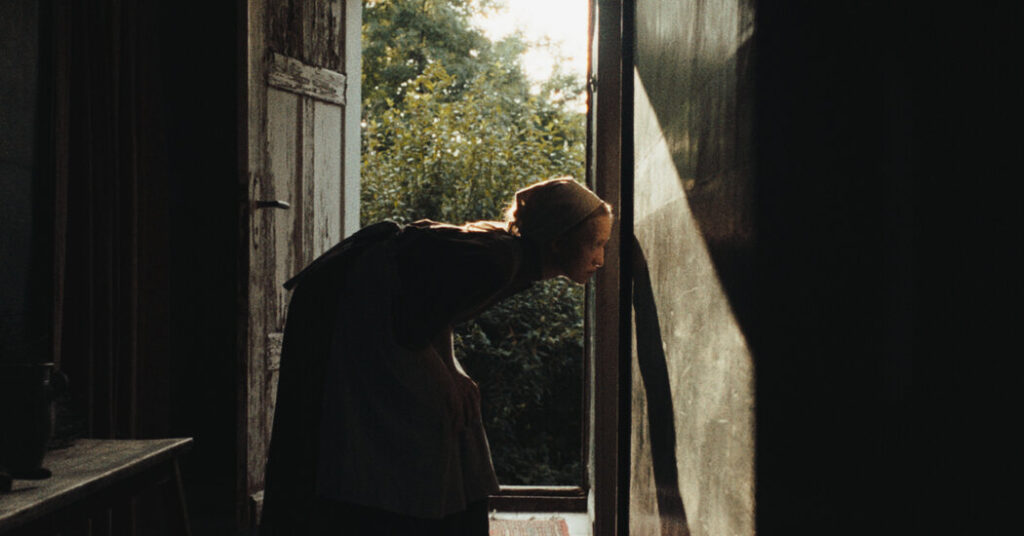
While the director Mascha Schilinski was researching “Sound of Falling,” her decades-spanning film set on a German farmstead, she came across a chilling sentence in a first-person account of life on such a property from the 1910s. Amid banal descriptions of laundry and parenting, a resident noted that “the women need to be made safe for the men.”
Schilinski, 41, was taken aback when she realized this was a reference to the forced sterilization of servants so that they wouldn’t become pregnant and miss work. “These are accounts we don’t know about,” she said in a recent interview, “because they are so filled with shame.”
Such untold stories inspired Schilinski to make “Sound of Silence,” one of the most unconventional and acclaimed German feature films in recent memory. After winning the Jury Prize at the Cannes Film Festival last year, it was released in Germany to ecstatic reviews in the summer. Now the movie, which is Germany’s submission for the international feature Oscar, is being released in U.S. theaters on Friday.
The film, which Schilinski co-wrote with Louise Peter, interweaves the stories of several girls living on a farm in the German state of Saxony-Anhalt in the 1910s, 1940s, 1980s and 2020s via ghostly, hallucinatory visuals and intricate sound design.
In the film’s 1914 story line, a girl navigates a series of deaths and gruesome injuries in her family; during World War II, a teenager develops an interest in an amputee living in the farmhouse; in 1980s, when the region is part of communist East Germany, a young woman navigates sexual advances from her uncle; and in the 2020s, two adolescent neighbors form an intense friendship.
“The word trauma is often associated with war or big stories, but sometimes it is just small, quiet things,” Schilinski explained in a Berlin cafe. “It is transmitted through generations, gets inscribed in our bodies and determines how we are. But we can’t understand how, because there are stores we don’t know about.”
In the film’s largely nonchronological structure, the shocks are mirrored and refracted through the characters’ experiences. Dramatic events include not only forced sterilization, but also parents’ attempted mutilation of their son, suicide and the forced marriage of a teenager.
German reviewers have praised the film’s unusual approach to little-known stories of women across the 20th century. A critic at the newspaper Frankfurter Allgemeine Zeitung praised Schilinski’s “countless brave aesthetic and formal decisions.” Der Spiegel newsmagazine called it “the most ambitious German film to have been made in ages.”
Kathleen Hildebrand, a film editor at the newspaper Sueddeutsche Zeitung, said that “Sound of Falling” reflected a rare level of ambition in German cinema. Movies from Germany are rarely invited to compete in the main selection in Cannes, she noted. The last German film to be a serious contender there, the bittersweet comedy “Toni Erdmann,” came out a decade ago.
“We are a big, wealthy nation, but other countries are better represented,” Hildebrand said. She added that it was not because of a lack of talent, but because the bureaucratic nature of Germany’s film public funding bodies, which play a large role in bankrolling its film industry, makes them reluctant to make unconventional choices. “It is not a country for big, bold films at the moment,” she said.
Schilinski said her modest budget — less than $2.5 million — made it challenging to produce a film that unfolds over more than a century. The project was shot in 33 days on a single empty farmstead in the Altmark region of northern Germany.
Although the area was home to prosperous farms in the 1800s, it has been one of the regions of the country most affected by demographic decline in recent years as disproportionate numbers of young and female residents moved to larger centers.
Because the director had spent time living on the farm during the research process, she was able to borrow equipment from local farmers, including a harvester from the Communist period, that the production otherwise would not have been able to afford. “It only worked because I know this village,” she said.
The film’s cinematographer, Fabian Gamper, who is also Schilinski’s real-life partner, said he wanted to movie to evoke “a memory from 300 years in the future of how things used to be,” but needed to adapt his approach because of budget limitations. To achieve some shots that look like period photographs, he created a pinhole camera, used in 19th-century photography, and, at one point, attached it to a drone.
The shoot was further complicated by German regulations for the film’s many child actors, who could shoot for only three hours per day. Schilinski auditioned hundreds of girls before selecting the 7-year-old actress Hanna Heckt to play Alma, the girl whose 1910s story line anchors the film.
“We wanted to find faces that looked like they had actually lived at exactly this time period,” Schilinski said.
She added that she likes to work with child actors, whom she said had a nearly “hallucinatory ability to uncover things,” acting like “little detectives.” Her first feature, “Dark Blue Girl,” featured a then-unknown child actress, Helena Zengel, who went on to be nominated for a Golden Globe for her role in “News of the World” with Tom Hanks.
Schilinski also emphasized that “Sound of Falling” reflected her lifelong interest in metaphysical connection. After dropping out of high school and working in a casting agency for children, she became a performer in a telepathy act in a traveling Italian circus. “My eyes were covered and I would say what people had in their bag,” she recalled.
Growing up in a prewar apartment in Berlin, she said, she had also been fixated on the experiences of people who might have lived there before her. “I was obsessed with what had happened there or what had caused an indentation in the wood floor,” she said.
“I have often had this feeling that you can go through life as a proxy, with issues that you can’t quite explain from your biography,” she said. “But that keep coming back.”
The post Telling the Stories of a House Full of Secrets appeared first on New York Times.