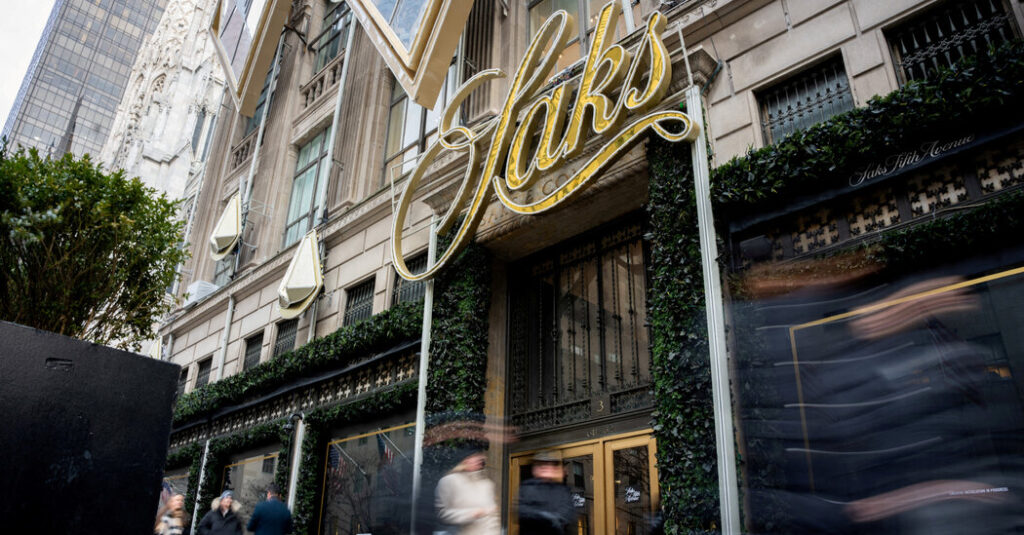
Saks Global, the company that owns Saks Fifth Avenue, Neiman Marcus and Bergdorf Goodman, filed for bankruptcy protection late Tuesday, crumbling under billions of dollars in debt, a fraying relationship with vendors and lagging sales.
The filing is the latest sign that America’s luxury department stores, once landmarks that served as immersive fantasy worlds for the wealthy and aspirational, are becoming an endangered species.
Geoffroy van Raemdonck, the former Neiman Marcus chief executive, will return as Saks Global’s C.E.O. He succeeds Richard Baker, the chief executive and executive chairman, who in 2024 orchestrated a $2.7 billion merger of Saks and the Neiman Marcus Group, which owned Bergdorf Goodman.
Saks and Neiman had spent the past several years trying to find creative ways to subsist despite mounting competition from e-commerce and the luxury brands themselves. Mr. Baker, a former real estate executive, in 2024 orchestrated a $2.7 billion merger of Saks and Neiman Marcus Group, which owned Bergdorf Goodman.
The deal was an attempt to revitalize three of the former beacons of high-end shopping in the United States, some of the only department stores that remained after the closures of Barneys New York, Lord & Taylor, Henri Bendel and Bonwit Teller. (Saks licensed the Barneys name in 2019 when that store was liquidated, creating a “Barneys at Saks” section).
By combining Saks and Neiman, Mr. Baker aimed to realize his grand vision of creating the ultimate luxury department store group, one that would be unrivaled in reach and power. “It was Richard Baker’s dream,” said Marigay McKee, a general partner at Fernbrook Capital and a former president of Saks under Mr. Baker. The idea was, “if I buy Neiman Marcus, and I have Saks, then we get leverage and buying power for exclusives, brands.”
Baker told the Times, “I am proud of what we did, though sorry we unintentionally created pain for our partners in the process.” He still believed, he added, that once Saks Global emerges from bankruptcy, “this will be a very successful company.”
The acquisition’s success hinged on the stores drastically improving their profitability. Yet the roughly $2 billion in debt Saks used to fund the deal quickly proved unsustainable.
The deal’s finances were “a recipe for disaster,” said Mickey Chadha, vice president of corporate finance at Moody’s Ratings. “It is the fastest failure of an acquisition of this magnitude that I’ve seen.”
Early on, Saks sought to renegotiate terms with its vendors, and executives were unable to entice shoppers, Mr. Chadha said. In October, the retailer said revenue for the quarter ending on Aug. 2 had fallen more than 13 percent, compared with the year prior. At the end of 2025, Saks missed a loan payment, and Marc Metrick stepped down as its chief executive. Mr. Baker took the job with bankruptcy imminent.
Adding to the problems: The department store landscape, along with its underlying foundations, had irrevocably changed over the prior decade. Once the gatekeepers of the relationship between U.S. consumers and brands, the large stores have been reduced to simply one option among many.
The growth of e-commerce, particularly during the Covid-19 pandemic, altered shopping patterns, as did the rise in social media storefronts. Secondhand buying gained popularity and more luxury brands began opening their own stores.
“Now many of Saks and Neiman’s biggest suppliers are also their biggest competitors,” said Andrew Rosen, an investor and adviser to brands such as Frame Denim, Alice & Olivia and Veronica Beard.
At the same time, luxury goods have come under pressure over the past year as American shoppers manage their households in an economy troubled by inflation, slowing job growth and international trade squabbles.
The Saks bankruptcy leaves three of America’s oldest and most luxurious department stores at risk, as management tries to figure out how to stay in business.
Saks Fifth Avenue was founded in 1924 as a jewel of American retail. The flagship store, designed in the neo-Renaissance style by Starrett & Van Vleck, stands across the street from Rockefeller Center. Saks made its name by sending a silk top hat to President Calvin Coolidge, brought the bob haircut to New York City and once housed an indoor ski hill for gentlemen shoppers.
When Saks was joined on Fifth Avenue by Bergdorf Goodman, which had been founded in 1899 as a tailor but moved to its landmark home in 1928, the two emporiums helped to frame New York City as the beating heart of gilded American consumption; to buy into their offerings was to buy into the life of the cocktail soirees they promised.
Neiman Marcus served the same purpose for Dallas and the well-heeled people of Texas, exporting that unabashed take on luxury and wealth to the rest of the country.
As the stores spread to shopping malls from coast to coast, they sold suburban America access to uptown Manhattan chic. Saks’s flagship became so prominent that its enormous shoe floor was granted a vanity ZIP code by the U.S. Postal Service: 10022-SHOE.
In 2020, not long after expanding with great fanfare to the Hudson Yards neighborhood of Manhattan, Neiman Marcus Group filed for bankruptcy during the pandemic lockdowns. Executives said the process would alleviate debt and allow the chain to restructure.
In 2021, Saks’s owner, Hudson’s Bay, and Mr. Baker, its chief executive, split the Saks e-commerce operation into a separate entity to try to lure more investment for its more attractive online business.
Saks undid that plan in 2024 when it acquired Neiman Marcus and reintegrated its businesses as Saks Global. As part of the deal, it spun out its Canadian retail and real state business which includes the famed department store Hudson’s Bay. That business later filed for bankruptcy and liquidated its assets.
Mr. Baker and Saks executives said that the merger would help reduce costs, add leverage over brands and provide shoppers a better experience through shared inventory and loyalty programs.
But instead of alleviating Saks’s problems, the deal doubled them.
In the 2024 fiscal year, the company reported a 10 percent drop in revenue, compared with the previous year, on a pro forma basis. To cut costs, Saks canceled its annual holiday light show at its Fifth Avenue store for the first time in two decades.
In early 2025, Saks’s chief executive, Mr. Metrick, warned vendors that payments would be delayed or made in installments as sales continued to slide, further antagonizing the designer brands whose wares drew people to stores. That sent a red flag to vendors. Then, in August, Saks restructured its debt to bolster its balance sheet. To raise cash, it sold several Neiman Marcus properties in California and Texas.
Critical employees had begun heading for the exits. Catherine Bloom, a superstar personal shopper for Neiman Marcus, and Yumi Shin, Bergdorf Goodman’s merchandising director, left for top jobs at Nordstrom. (Saks has sued to block Ms. Shin’s move, claiming she violated a noncompete agreement; Ms. Shin has asked the court to dismiss the lawsuit.)
Some major fashion brands, including Oscar de la Renta and Altuzarra, worried about payments and stopped shipping to Saks. In December, Hilldun, a firm that bought some of those unpaid invoices, told vendors to halt shipments to Saks. Chanel, one of Saks’s most valuable brands, pulled out of seven department stores.
Joseph Sarachek, managing partner of the Sarachek Law Firm, which has represented about 30 Saks vendors in their quest to be paid, said most had received compensation “dribbled in, in some way, but everybody is still owed money.”
“This is a very rough situation,” he added.
Kim Bhasin is a business reporter covering the retail industry for The Times.
The post Saks Files for Bankruptcy as Department Stores Fight for Survival appeared first on New York Times.