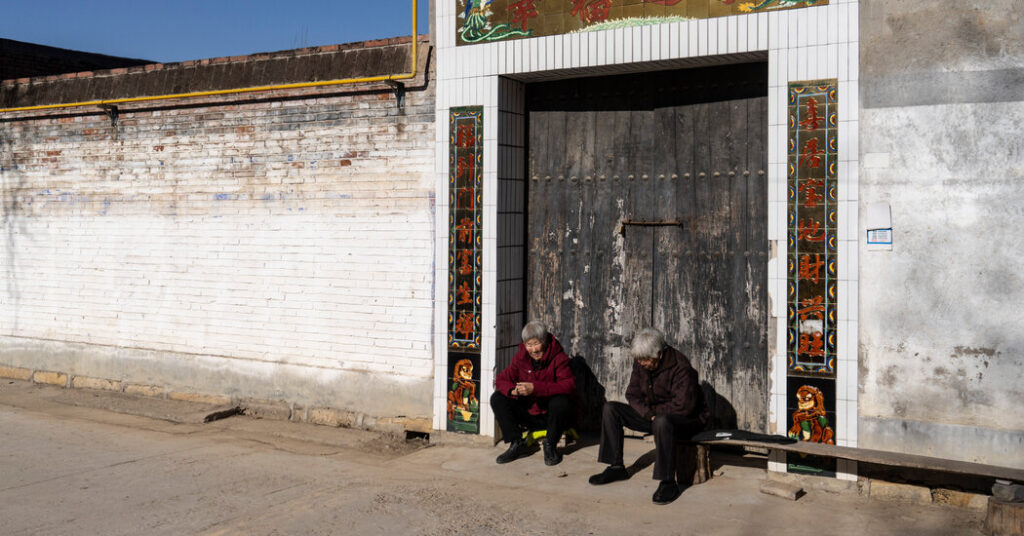
The temperature was 28 degrees, but Dong Tongzhou had turned off his heat at home and was standing in the village square wrapped in a tattered black coat, trying to soak up the midday sun. He wasn’t alone — other villagers sat on folding chairs and at a card table, as chickens strutted around and clucked.
Mr. Dong, 68, used to warm his one-room home by burning coal, he explained on a recent afternoon. Then the government banned that for environmental reasons, and offered natural gas as a replacement. But that could cost three times as much. To save money, Mr. Dong often sunbathed for warmth.
Even so, Mr. Dong said he spent about 1,000 yuan, or about $143, each winter to heat his home in Quyang county, in northern China’s Hebei Province. On a monthly basis, that works out to over a third of his pension of 800 yuan as a retired farmer and former soldier.
“If it gets even more expensive and I can’t afford it, then I’ll stop using it,” Mr. Dong said. On a nearby wall, a slogan painted in red urged villagers to be mindful of safety when using gas.
Across Hebei, which encircles China’s capital, Beijing, villagers like Mr. Dong are confronting the full cost of the country’s push for cleaner air. The central government has banned burning coal for residential heating in much of the province since 2017, in an effort to reduce the choking air pollution that enveloped the capital every winter. At first, local governments eased the transition by heavily subsidizing natural gas, which is cleaner but more expensive.
But this winter, officials sharply cut or eliminated the subsidies.
Reports of villagers huddling under multiple blankets or secretly burning firewood for warmth — firewood is banned, too — had circulated widely on Chinese social media. They spurred calls, including in major state-run news outlets, to relax the coal ban or restore subsidies. But China’s gains in air quality have been a political priority for the government, and many of the reports were quickly censored.
While villagers ration their heat, Beijing officials are celebrating a victory. Last week, the city announced it had recorded only one day of heavy pollution in 2025, a 98 percent drop compared with 2013. Officials held up the improvement as proof of the success of Beijing’s “blue sky defense war.”
“It was a top-down, authoritarian environmental policy of, we want to improve the air quality in Beijing. And often Hebei has to bear the cost,” said Cosimo Ries, an energy analyst at Trivium China, a consulting firm.
The expense of the government’s clean air campaign and its heavy-handed enforcement were a concern from the start, when officials descended upon villagers’ homes to confiscate their coal furnaces and fined or detained violators. Demand for gas overwhelmed supply, and some subsidies were slow to arrive. Hebei delayed its full transition from coal to 2020 as public anger grew.
Other vulnerabilities became clear in 2023, as global energy shocks collided with financial pressure at home.
The soaring price of natural gas, driven in part by Russia’s war in Ukraine, led energy companies in Hebei to cut off residential customers in favor of higher-paying industrial users. To ease the shortages, the government loosened price controls on residential gas, allowing utilities to pass on costs to households, but that meant gas became even more expensive. At the same time, some local governments were already struggling to pay out subsidies, because they were deeply in debt and the economy was slowing.
Beyond the rising costs, poorer villagers often seem to end up paying more than city residents to heat their homes. The price of gas per cubic meter in Hebei is generally 10 to 20 percent higher than in Beijing or Tianjin, according to Chinese media reports. And even when subsidies were dispersed, they could vary widely by each household’s employment status: In neighboring Shandong Province, for example, heating subsidies for retired government officials are as much as 13 times higher than for a low-income rural resident, according to Chinese media reports.
In the village in Quyang, Dong Chengjiang, 49, said he paid between $850 and $1,000 to heat three of the five rooms in his home with gas, more than double what he used to pay to burn coal. In 2021, the government subsidized almost half the cost. But this year, he said, he had received only 480 yuan, or less than $70.
“They didn’t give any explanation,” said Mr. Dong, who works odd jobs. “Now they give you 480, and if they don’t give you anything, what can you do?”
Between rising heating costs and falling wages, he has had to cut back on new clothes for his two school-age children, he said. He acknowledged that the air quality had improved, but said he didn’t think the trade-off was worthwhile.
At least Mr. Dong was still working and could scrape together money for the heating, however painfully. Another villager, who gave only her last name, Zhao, said she had a pension of a little more than $15 a month, as is common among many older rural residents. Ms. Zhao, 65, said she turned the heat on for only half an hour before bed each night.
Some villages have quietly eased the rules. A few streets down from Ms. Zhao, a couple in their 80s said they had been granted permission to burn coal because of their age. Officials were conducting door-to-door inspections less frequently than they had in earlier years, villagers said.
Over the long term, the answer is likely to lie less in natural gas and more in renewable energy. China is already the world’s leading producer of solar and wind power, and as electricity becomes cheaper, electric devices like heat pumps can replace gas boilers and coal furnaces, cutting emissions and, eventually, costs, said Deborah Seligsohn, a professor of Chinese environmental policy at Villanova University.
The Hebei villagers’ plight was not proof that China’s green transition had to come at the expense of ordinary people, she said. Rather, “this is an issue with inconsistent policy: They had subsidies and they got rid of them,” she said.
But installing a heat pump requires a large upfront payment, one that many village households cannot afford. That, along with the money already spent on installing gas systems, may make already-cash-strapped local governments and residents hesitant to make another switch, Ms. Seligsohn acknowledged.
On the main street outside the village in Quyang, multiple stores advertised heat pumps. But an employee at one store, who gave only his surname, Wang, said few people were interested.
Installation cost more than $2,800, he said, and the government did not offer any subsidies.
That was too expensive for many villagers, Mr. Wang said. After all, “many of them won’t even turn on their gas.”
Siyi Zhao contributed research.
Vivian Wang is a China correspondent based in Beijing, where she writes about how the country’s global rise and ambitions are shaping the daily lives of its people.
The post Beijing Won Its War for Blue Skies, but Villagers Are Paying the Price appeared first on New York Times.