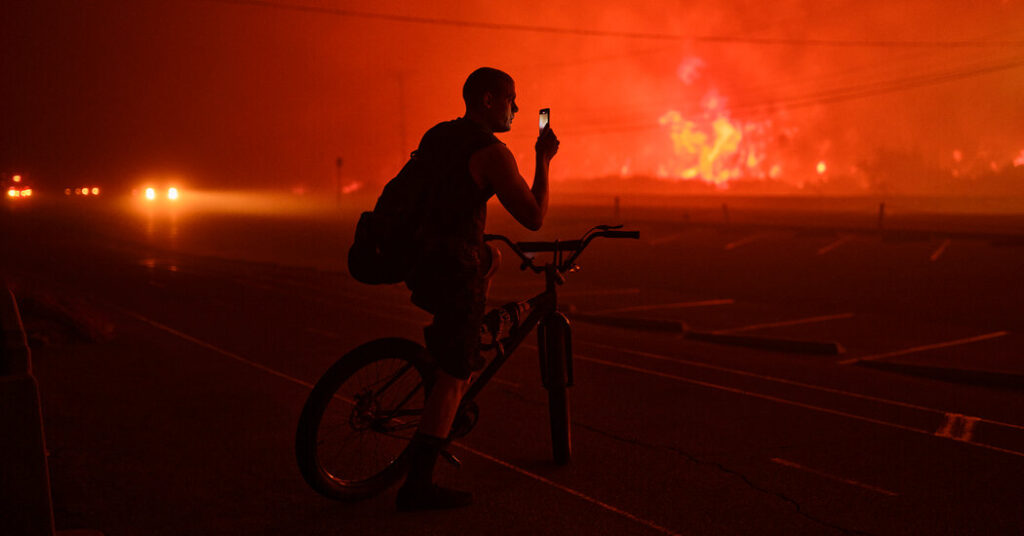
Last year — the third-warmest in modern history — opened with history-making fires in Los Angeles and closed with catastrophic floods in the United States and Southeast Asia. The intervening months were punctuated with disasters and extreme weather across the globe.
All the while, emissions of greenhouse gases climbed to new heights as the world burned coal, oil and gas for energy. Excess heat building up in the atmosphere and the oceans creates conditions that can exacerbate extreme weather. Here are some of the notable events that marked 2025.
Wildfires
Climate change is drying out landscapes and setting the stage for larger and more frequent wildfires around the world. A 2024 study found that the frequency and intensity of wildfires have doubled in the past two decades.
In January, flames overtook 60 square miles of Los Angeles neighborhoods, displaced more than 100,000 people and polluted the region with a cocktail of toxic chemicals as cars and buildings burned.
The start of the year also came with large fires in Patagonia in South America. Throughout the rest of the year, millions of acres in the Amazon basin burned as well.
The United States had large fires in Oregon, the Grand Canyon and Oklahoma, which burned hundreds of thousands of acres. Canadians experienced yet another record-breaking season with wildfire disasters that blanketed Arctic communities, as well as the East Coast of the U.S., in smoke.
In Europe, France suffered its largest wildfires in decades, while outbreaks across Mediterranean countries prompted thousands of people to evacuate. Tens of thousands more were displaced by Korea’s deadliest wildfire. In December, Australians began bracing for a difficult fire season as dry conditions and strong winds fed dozens of blazes across the country.
Heat
As the planet warms, extreme heat — often defined as prolonged temperatures over 90 degrees Fahrenheit — has become more common and deadly. Research has found heat waves are moving more slowly, lingering longer and occurring more often. In recent decades, annual deaths from heat have doubled.
For many people, particularly outside laborers, seniors and those with preexisting health conditions, exposure to elevated temperatures can be life threatening. Being exposed to extreme heat overnight, when cooler temperatures might otherwise give the body an opportunity to recover, can be especially dangerous.
Extreme heat can speed up aging and worsen the harmful effects of air pollution, too. Countries like Japan and Singapore have implemented new heat laws aimed at protecting workers.
Hotter temperatures are particularly pronounced in the Arctic, which is warming nearly four times faster than the rest of the globe. In 2025, the region saw record-breaking temperatures and rainfall.
Across the region, frozen soil is thawing and causing the ground to collapse (and in some cases, explode), while leaching out minerals that are turning rivers red. Sea ice, which once blocked ships from passing through Arctic oceans year round, is melting for longer stretches of time. This opens up new transportation routes and poses national security concerns for Arctic countries, including the United States.
In the ocean, several years of marine heat waves have caused a coral-bleaching event affecting more than 80 percent of the world’s reefs. In October, scientists announced that heat stress had driven two key species of coral in the Florida Keys to extinction.
Storms
Hurricanes and other tropical cyclones are fueled by hot ocean water and influenced by trade winds. Scientists have found that today’s storms are more likely to rapidly intensify and cause more damage than those of the past.
While no storms made landfall in the United States, several powerful ones swept through the Caribbean and Atlantic. In October, Hurricane Melissa intensified into a Category 5 storm, pummeling Jamaica before moving on to Haiti and causing widespread damage and killing dozens of people.
In other parts of the world, more than two dozen typhoons and cyclones inundated Asia and Pacific Island nations. The most intense of those was September’s Typhoon Ragasa, which heavily damaged parts of the Philippines and Taiwan before moving on to China, where millions of people evacuated.
A few months later, Cyclone Senyar, Cyclone Ditwah and Typhoon Koto combined with monsoon season to cause widespread flash flooding and landslides, killing more than a thousand people across Indonesia, Sri Lanka, Thailand and Malaysia.
The U.S. felt these Pacific forces in October when the remnants of Typhoon Halong, a storm that rapidly intensified near Japan, crossed over to western Alaska and flooded coastal villages, displacing hundreds of residents.
Extreme Precipitation
The year included the emergence of La Niña, one half of a cyclical weather pattern in the Pacific Ocean that increases the likelihood of heavy rainfall in some regions and drought in others. In the United States, severe thunderstorms alone caused at least $51 billion in damage.
Because warmer air is capable of carrying more moisture, climate change can make downpours heavier. The combination of drought and rain can be particularly deadly. Dry soils are less able to absorb water, so when a heavy storm strikes, the land can be more prone to flooding.
Last year was marked by several devastating floods. In July, intense rainfall caused flash flooding along the Guadalupe river in Texas. The disaster killed more than 100 people, including dozens of girls at a summer camp.
Throughout the summer and fall other large floods caused dozens of fatalities in Mexico and Nigeria, while more than a thousand people lost their lives in Pakistan. In August more than 1,400 villages and large swaths of farmland were submerged in Punjab, India. The year ended with heavy rainfall and floods in Washington and California as atmospheric river-driven storms swept across the West Coast.
Sachi Kitajima Mulkey covers climate and the environment for The Times.
The post 2025: A Year of Fire and Floods appeared first on New York Times.