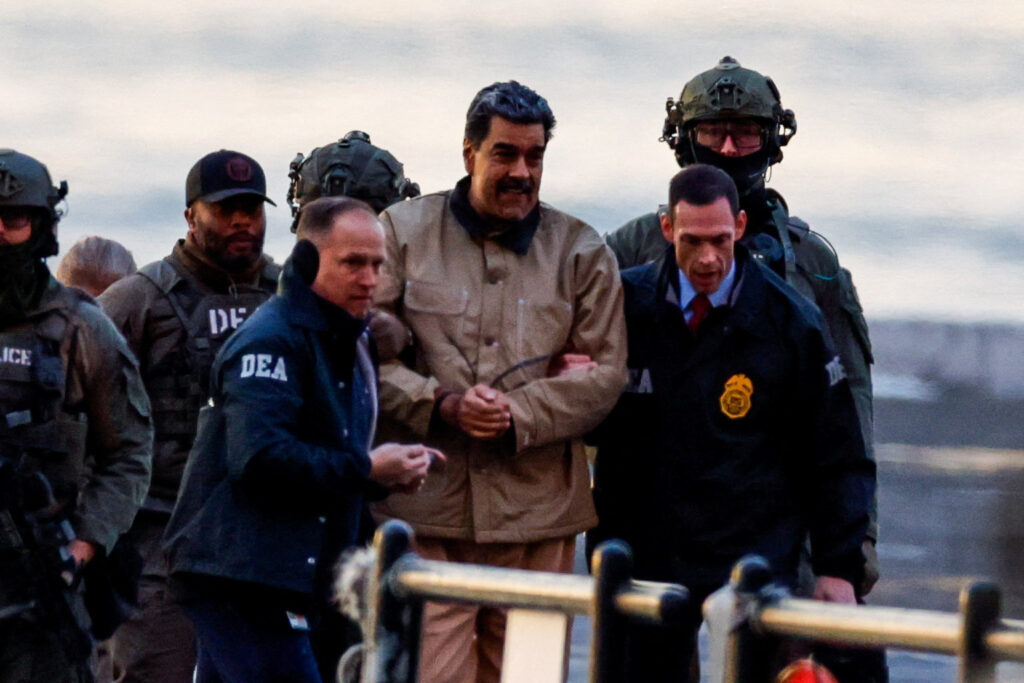
The Justice Department concluded in a legal opinion last month that neither U.S. nor international law constrained President Donald Trump’s authority to order the military-backed arrest of Venezuelan President Nicolás Maduro, according to a copy of the document made public Tuesday.
The memo, drafted last month by the department’s Office of Legal Counsel, reasoned that the president had “inherent constitutional authority” to deploy military forces to back an FBI arrest overseas, even if it violated international treaties. It also said Trump did not need to first seek congressional authorization to do so.
“The president may unilaterally order such an operation, as the amount of force involved serves important national interests and involves a use of force that he could reasonably conclude does not rise to the level of war in a constitutional sense,” wrote Assistant Attorney General T. Elliot Gaiser in the memo, dated Dec. 23.
Although the publicly released version of the memo is heavily redacted, it offers insights into the legal groundwork that formed the basis for Trump’s actions.
The Trump administration continues to face a wave of questions over the legality of the Jan. 3 operation that led to the capture of Maduro and his wife. Critics have said the operation, code-named “Absolute Resolve,” violated international treaties, including the United Nations charter, which bar nations from deploying military force inside another country without its permission except in instances of self-defense or when previously authorized by the U.N. Security Council.
The memo conceded that the operation “will constitute an armed conflict under international law” and raised questions about whether it would comply with treaties, but it said that regardless, the president had authority to proceed.
At least 80 people died during the operation, including members of the Venezuelan military, Maduro’s Cuban security staff and civilians. Several U.S. soldiers were injured, though no U.S. fatalities were reported.
The administration has broadly defended the incursion as a law enforcement operation backed by military personnel aimed at bringing Maduro to the U.S. to face trial on narco-terrorism charges. But in interviews, members of the president’s Cabinet have been reluctant to spell out in detail the legal rationale behind the operation.
“Let me ask the question again: What is the legal authority for the United States to be running Venezuela?” ABC’s “This Week” host George Stephanopoulos asked Secretary of State Marco Rubio on Jan. 4, the day after the raid.
Rubio did not respond directly but defended the presence of a U.S. armada around Venezuela to stop vessels that have been sanctioned by the Treasury Department.
Administration officials began briefing lawmakers on the Office of Legal Counsel’s December memo in closed-door sessions this week.
The memo builds off a controversial 1989 legal opinion by then-Assistant Attorney General William P. Barr that concluded that international treaties do not bar the U.S. from carrying out “forcible abductions” abroad to enforce domestic laws.
That memo was used that year to justify President George H.W. Bush’s deployment of U.S. forces to capture Panamanian strongman Gen. Manuel Antonio Noriega, who, like Maduro, had been indicted on drug trafficking charges in the United States. Courts upheld the government’s right to try Noriega, who was convicted on drug charges in 1992 and sentenced to 40 years in federal prison.
In drafting the legal opinion on the Maduro operation last month, Gaiser said he took Barr’s earlier memo as a given and focused his legal analysis primarily on the questions of whether the planned incursion violated U.S. law and whether congressional authorization was required. In both cases, Gaiser concluded, the answer was no.
Gaiser acknowledged the operation would raise a number of international law concerns, but he wrote that he reached no firm conclusion about whether the attack — as described to him in advance by administration officials — would constitute a violation of treaties.
As for whether the president could unilaterally deploy military force to carry out the mission, Gaiser pointed to years of Justice Department opinions that have concluded that a president has the authority to issue such orders if a deployment is in the national interest and if its “nature, scope and duration” fall short of what would be considered war in a constitutional sense.
The predawn operation involved more than 150 aircraft launched from 20 different locations, including fighter jets, planes that specialize in electronic jamming, B-1 supersonic bombers and others that are designed to detect early warnings of missile launches.
Gaiser noted that the proposed operation involved the type of force most likely to require congressional approval: putting “boots on the ground.” But because the administration assured him that there was no plan to occupy the country long term or engage in a “substantial and sustained” military effort in Venezuela after Maduro’s capture, seeking advance approval from Congress was not necessary, he said.
One U.S. lawmaker who read the classified version of the memo said that the White House clearly has a “high bar” for what it considers war. The lawmaker spoke on the condition of anonymity to discuss the classified memo. Previous presidents have also asserted high thresholds for what sorts of military actions would require congressional approval.
In defending his point, Gaiser argued that the number of possible U.S. casualties envisioned for the Maduro operation were expected to be far lower than what “would amount to a constitutional war.”
He noted that the United States suffered more than 40,000 casualties in the Vietnam War and more than 4,000 in the Iraq War. The unredacted version of the memo also noted that every year 300 U.S. service members die in accidents, the U.S. lawmaker who’d seen that document said.
“It says we don’t have a specific number threshold for the constitutional sense of war, but this is a number we should take into account,” the lawmaker said.
In interviews Tuesday, legal experts and some members of Congress assailed the memo’s legal reasoning. Brian Finucane, a legal expert at the International Crisis Group, panned what he described as the memo’s disregard for international law in service of legal theories that could justify a wide array of U.S. military conflicts.
“This view that international law and the U.N. Charter doesn’t bind the U.S. president is very significant and very dangerous,” he said. “It no doubt helps embolden the president,” he added, and “may be part of the reason that we’ve seen these references to action in Mexico, Colombia, Iran and even against Denmark.”
Rep. Sara Jacobs (D-California), a member of the Armed Services Committee, accused Justice Department lawyers of “trying to bend over backward” to justify Trump’s desires.
“But that’s not how U.S. or international law works,” she said. “I’m incredibly concerned that if this is their standard for logic and the rule of law, then they believe anywhere is fair game for U.S. military strikes or regime change, even without congressional authorization, and they will act on that belief.”
The post Previously secret memo gave legal basis for U.S. mission to nab Maduro appeared first on Washington Post.