Justice Brett M. Kavanaugh is an avid sports fan and has for years coached girls’ basketball teams. He finds cases concerning athletes engaging, and he often talks about the satisfaction he takes from coaching.
There is every reason, then, to think Justice Kavanaugh will find Tuesday’s arguments — about the future of high school and college women’s sports — riveting, and that he may play a key role in the questioning of the parties.
He talked about his years as a coach at his Supreme Court confirmation hearings in 2018.
“I love helping the girls grow into confident players,” he said. “I know that confidence on the basketball court translates into confidence in other aspects of life.”
He went on to praise Title IX, the civil rights law that bans sex discrimination in education and whose meaning is contested by the parties in Tuesday’s cases.
“Title IX helped make girls’ and women’s sports equal,” he said. “And I see that law’s legacy every night when I walk into my house as my daughters are getting back from lacrosse or basketball or hockey practice.”
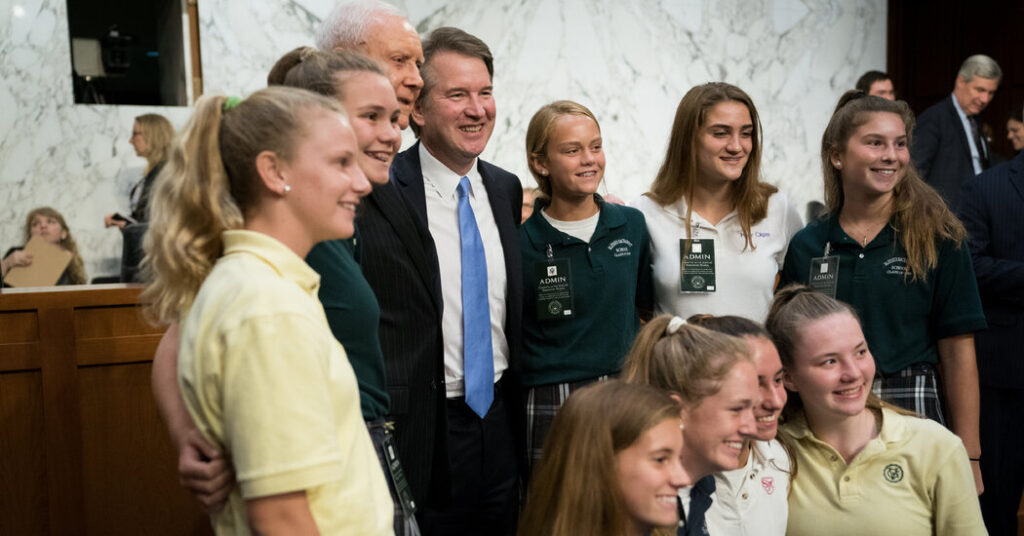
About a dozen current and former basketball players whom Justice Kavanaugh had coached turned up to support his nomination in 2018. They sat in the front rows in the Senate hearing room, in blue sweaters, ponytails and plaid skirts.
He has continued to coach, and to reflect on the experience.
“It keeps you in touch with the real world,” he said at a judicial conference in Kansas City, Mo., in July. “You really get isolated as a judge.”
The girls do not care about his day job, he said. They call him Coach K.
His perspective as a coach has come up during arguments in the past. They seemed to color a comment he made at a 2021 argument about a cheerleader who had been disciplined for a vulgar social media post.
“She’s competitive, she cares, she blew off steam like millions of other kids have when they’re disappointed about being cut from the high school team,” he said, adding: “I mean, a year’s suspension from the team just seems excessive to me.”
When the Supreme Court unanimously ruled that year that the National Collegiate Athletic Association could not ban some payments to student-athletes, Justice Kavanaugh added a concurring opinion calling for a broader overhaul.
“The N.C.A.A.’s business model would be flatly illegal in almost any other industry in America,” he wrote.
And when the court heard arguments in 2024 over a Tennessee law that banned some medical treatments for transgender youth, Justice Kavanaugh was already looking over the horizon.
“Would transgender athletes have a constitutional right, as you see it, to play in women’s and girls’ sports?” he asked the Biden administration’s lawyer, who said the issue was not before the court.
It is now.
Adam Liptak covers the Supreme Court and writes Sidebar, a column on legal developments. A graduate of Yale Law School, he practiced law for 14 years before joining The Times in 2002.
The post Justice Kavanaugh May Bring a Coach’s Perspective to the Case appeared first on New York Times.